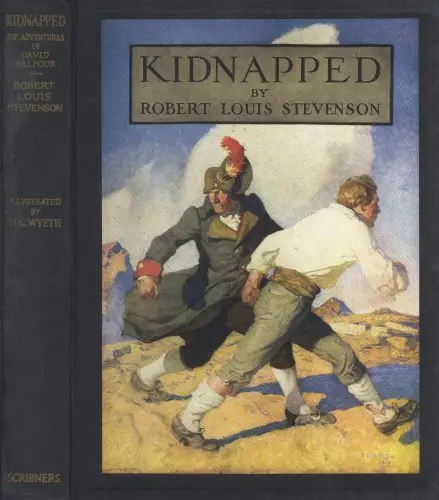
Vailima Letters Being Correspondence Addressed by Robert Louis Stevenson to Sidney Colvin, November 1890-October 1894
Robert Louis Stevenson
THE CLASSIC COLLECTION · 1887
"The Merry Men, and Other Tales and Fables" by Robert Louis Stevenson is a collection of short stories written in the late 19th century. The opening story, "The Merry Men," introduces readers to a richly atmospheric setting in the Scottish Hebrides, where themes of isolation, superstition, and the sea's treachery play a significant role. The protagonist, Charles Darnaway, discovers a family legacy tied to shipwrecks and hidden treasures, which intertwines with his feelings for his cousin Mary Ellen and their shared family history. The opening of "The Merry Men" sets the scene with Charles traveling to Aros, a remote island owned by his uncle, Gordon Darnaway. He reflects on family history, local legends, and the mysterious allure of the sea, particularly the treacherous Merry Men, a group of dangerous waves notorious for shipwrecks. As he arrives, he observes changes brought about by a recent shipwreck and the uneasy atmosphere surrounding his uncle and Mary Ellen. A sense of foreboding looms as he learns of surfacing dreams of treasure tied to an Armada ship that was lost long ago, prompting moral reflections on the implications of greed, loss, and the supernatural that seem to haunt Aros and its inhabitants.
Introduction adapted from the source catalogue; source summaries may be automatically generated.
Free to read · English · 80,681 words · No account needed
MAKE TIME FOR A GOOD BOOK
On by default. Untick to stop anonymous reading totals. Each page counts after 10 seconds in view. How this works.
Anonymous counting is on unless you have switched it off.
“Jean-Marie is a teller of the truth,” returned the Doctor, throwing
out his bust.
“He has never told a lie,” added madame. “He is the best of boys.”
“Never told a lie, has he not?” reflected Casimir. “Strange, very strange. Give me your attention, my young friend,” he continued. “You knew about this treasure?”
“He helped to bring it home,” interposed the Doctor.
“Desprez, I ask you nothing but to hold your tongue,” returned Casimir. “I mean to question this stable-boy of yours; and if you are so certain of his innocence, you can afford to let him answer for himself. Now, sir,” he resumed, pointing his eyeglass straight at Jean-Marie. “You knew it could be stolen with impunity? You knew you could not be prosecuted? Come! Did you, or did you not?”
“I did,” answered Jean-Marie, in a miserable whisper. He sat there changing colour like a revolving pharos, twisting his fingers hysterically, swallowing air, the picture of guilt.
“You knew where it was put?” resumed the inquisitor.
“Yes,” from Jean-Marie.
“You say you have been a thief before,” continued Casimir. “Now how am I to know that you are not one still? I suppose you could climb the green gate?”
“Yes,” still lower, from the culprit.
“Well, then, it was you who stole these things. You know it, and you dare not deny it. Look me in the face! Raise your sneak’s eyes, and answer!”
But in place of anything of that sort Jean-Marie broke into a dismal howl and fled from the arbour. Anastasie, as she pursued to capture and reassure the victim, found time to send one Parthian arrow—“Casimir, you are a brute!”
“My brother,” said Desprez, with the greatest dignity, “you take upon yourself a licence—”
“Desprez,” interrupted Casimir, “for Heaven’s sake be a man of the world. You telegraph me to leave my business and come down here on yours. I come, I ask the business, you say ‘Find me this thief!’ Well, I find him; I say ‘There he is!’ You need not like it, but you have no manner of right to take offence.”
“Well,” returned the Doctor, “I grant that; I will even thank you for your mistaken zeal. But your hypothesis was so extravagantly monstrous—”
“Look here,” interrupted Casimir; “was it you or Stasie?”
“Certainly not,” answered the Doctor.
“Very well; then it was the boy. Say no more about it,” said the brother-in-law, and he produced his cigar-case.
Your reading position is saved on this browser. Take it to another device with a library code. Reading pages adapt to text, rather than matching a printed edition.
Robert Louis Stevenson

Robert Louis Stevenson

Robert Louis Stevenson
BEHIND THE BOOK
This eBook is for the use of anyone anywhere in the United States and most other parts of the world at no cost and with almost no restrictions whatsoever. You may copy it, give it away or re-use it under the terms of the Project Gutenberg License included with this eBook or online at www.gutenberg.org. If you are not located in the United States, you will have to check the laws of the country where you are located before using this eBook. Read the source licence.
The original source file, including credits and licence, is retained by this library. Request an original-format copy at no charge. Please include the book title and Project Gutenberg identifier #344.
KEEP YOUR CURIOSITY GOING
Cécile Tormay

Moritz Busch
Coulson Kernahan
John L. Ransom

Maurice Baring
Frances Wright