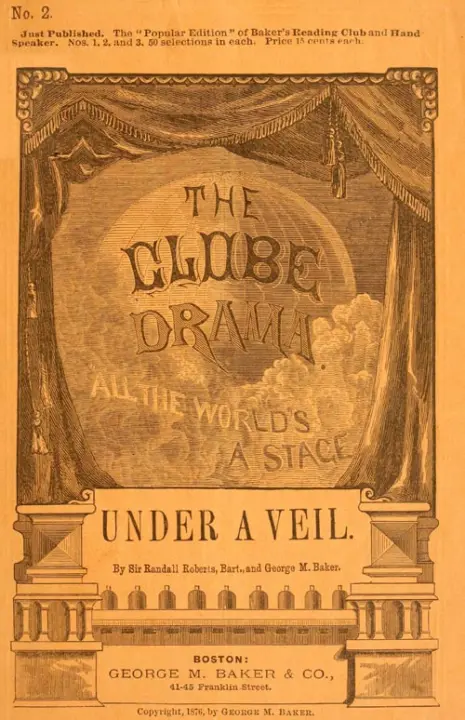
Under a Veil: A Comedietta in One Act
Randal H. (Randal Howland), Sir Roberts & George M. (George Melville) Baker
THE CLASSIC COLLECTION · 1902
"The Merry Christmas of the Old Woman who Lived in a Shoe" by George M. Baker is a holiday-themed play likely written in the late 19th century. This musical piece is intended for performance, featuring a whimsical story that revolves around the old woman and her numerous children, tackling themes of generosity and the spirit of Christmas. It draws upon familiar nursery rhyme elements, making it particularly appealing for family audiences and children. In this delightful play, the old woman struggles with poverty while caring for her many children, yearning to provide them with a memorable Christmas. Just as she despairs over her inability to afford gifts, Santa Claus, disguised as a beggar, appears at her doorstep. The children, unaware of his true identity, offer him their meager food in a show of kindness. Moved by their generosity, Santa reveals himself and rewards the children with a magical Christmas tree and presents, emphasizing the virtues of compassion and the joy of giving. This heartwarming tale captures the essence of the holiday season, highlighting that true wealth lies not in material possessions but in the warmth of love and kindness.
Introduction adapted from the source catalogue; source summaries may be automatically generated.
Free to read · English · 3,007 words · No account needed
MAKE TIME FOR A GOOD BOOK
On by default. Untick to stop anonymous reading totals. Each page counts after 10 seconds in view. How this works.
Anonymous counting is on unless you have switched it off.
Enter OLD WOMAN, with CHILDREN, L., from behind shoe. The largest hangs on to her skirts, the next in size to the largest, until they dwindle to the smallest; repeat song as they enter slowly, turn to R., march across stage; turn to L., march across again; turn to R., and form across stage.
O. W. Now go away, old man. 'Tis very queer
That you should seek to waste your sweetness here;
For we've no money, not a cent, to pay
For music; so you'd better up and move away.
Santa. Alas, alas! and can you be unkind
To one who's been by Fortune left behind;
Who has no friend, no money, and no clo'es;
The hunted victim of unnumbered woes?
Good dame, I ask not money: if you please,
A simple crust my hunger to appease.
O. W. Good gracious! Starving! Children, do you hear? The old man's hungry: quickly disappear!
(CHILDREN scamper behind shoe.)
Santa. She drives them in. To me 'tis very clear
Old Santa fails to find a welcome here.
O. W. We're very poor, have fasted many a day, Yet from our door ne'er drove the poor away.
Song; air, "Balm of Gilead," by the CHILDREN, who march in as before, carrying sticks, on which are stuck apples, potatoes, crusts of bread, turnip, carrot, "beat," &c. They move around the stage, singing as they pass SANTA; the last time, pitch their potatoes, &c., into his tin kitchen. He stands L. of stage; OLD WOMAN, R.
Oh, you sha'n't be hungry now,
Oh, you sha'n't be hungry now,
Oh, you sha'n't be hungry now,
Down at Copper Toe Shoe.
Cold potato--tato,
Cold potato--tato,
Cold pota--to,
Down at Copper Toe Shoe.
(No interlude.)
Oh, you sha'n't be hungry now,
Oh, you sha'n't be hungry now,
Oh, you sha'n't be hungry now,
Down at Copper Toe Shoe.
Crusts for breakfast--breakfast,
Crusts for breakfast--breakfast,
Crusts for break--fast,
Down at Copper Toe Shoe.
Oh, you sha'n't be hungry now,
Oh, you sha'n't be hungry now,
Oh, you sha'n't be hungry now,
Down at Copper Toe Shoe.
Broth for supper--supper,
Broth for supper--supper,
Broth for sup--per,
Down at Copper Toe Shoe.
Oh, you sha'n't, &c.
Santa. Well, well, I'm puzzled! Here's a grand surprise. Bless me, the tears are dropping from my eyes! Thank you, my children. This is quite bewitchin'; With eatables you've nearly filled my kitchen. Ah, little ones! you've learned the better part. They are the poor who lack the kindly heart; And they the rich, the noble, and the high, Who never willing pass the sufferer by. Now comes my triumph. Children, speak up bright:
What day is this?
All. Christmas.
Your reading position is saved on this browser. Take it to another device with a library code. Reading pages adapt to text, rather than matching a printed edition.
Randal H. (Randal Howland), Sir Roberts & George M. (George Melville) Baker
George M. (George Melville) Baker
George M. (George Melville) Baker
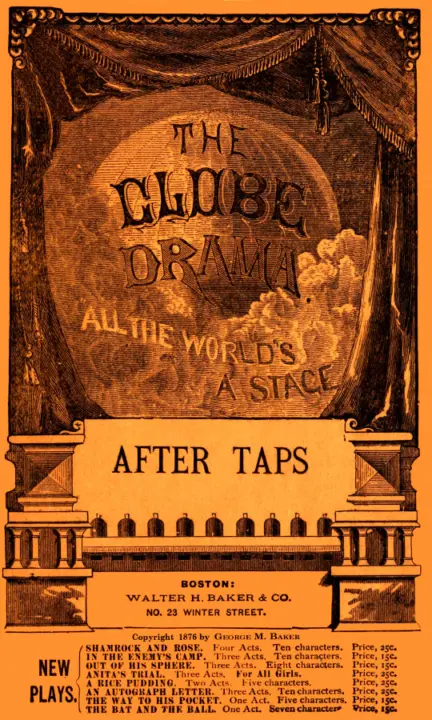
Rachel Baker Gale & George M. (George Melville) Baker
BEHIND THE BOOK
This eBook is for the use of anyone anywhere in the United States and most other parts of the world at no cost and with almost no restrictions whatsoever. You may copy it, give it away or re-use it under the terms of the Project Gutenberg License included with this eBook or online at www.gutenberg.org. If you are not located in the United States, you will have to check the laws of the country where you are located before using this eBook. Read the source licence.
The original source file, including credits and licence, is retained by this library. Request an original-format copy at no charge. Please include the book title and Project Gutenberg identifier #48832.
KEEP YOUR CURIOSITY GOING
Maurice Baring

Abby Morton Diaz
Helen Hunt Jackson
Mary Frances Blaisdell
Stuart Dodgson Collingwood

Kate Douglas Smith Wiggin