Under a Veil: A Comedietta in One Act
Randal H. (Randal Howland), Sir Roberts & George M. (George Melville) Baker
THE CLASSIC COLLECTION · 1902
"The Merry Christmas of the Old Woman who Lived in a Shoe" by George M. Baker is a holiday-themed play likely written in the late 19th century. This musical piece is intended for performance, featuring a whimsical story that revolves around the old woman and her numerous children, tackling themes of generosity and the spirit of Christmas. It draws upon familiar nursery rhyme elements, making it particularly appealing for family audiences and children. In this delightful play, the old woman struggles with poverty while caring for her many children, yearning to provide them with a memorable Christmas. Just as she despairs over her inability to afford gifts, Santa Claus, disguised as a beggar, appears at her doorstep. The children, unaware of his true identity, offer him their meager food in a show of kindness. Moved by their generosity, Santa reveals himself and rewards the children with a magical Christmas tree and presents, emphasizing the virtues of compassion and the joy of giving. This heartwarming tale captures the essence of the holiday season, highlighting that true wealth lies not in material possessions but in the warmth of love and kindness.
Introduction adapted from the source catalogue; source summaries may be automatically generated.
Free to read · English · 3,007 words · No account needed
MAKE TIME FOR A GOOD BOOK
On by default. Untick to stop anonymous reading totals. Each page counts after 10 seconds in view. How this works.
Anonymous counting is on unless you have switched it off.
To some she gave broth without any bread;
But never contented were they,
Till she whipped them all soundly, and put them to bed,
And then very happy were they,
And then very happy were they.
(Head appears at 2.)
"Now, mother, dear mother," the young ones would cry,
As they dropped off with a nod,
"To train up a child in the way to go,
O mother, dear, ne'er spare the rod.
(CHILD'S head appears at 3.)
For broth without bread is a watery waste;
And never contented are we,
Till with your good stick it is thickened to taste;
(Three heads appear at 4.)
And then, oh, how happy are we!
And then, oh, how happy are we!"
Enter OLD WOMAN, R. Her costume, bodice, quilted petticoat, sugar-loaf hat, high-heeled shoes, and cane.
O. W. Aha! (Heads disappear quick.)
Good gracious! can't I leave the house a minute, But what a head's at every window in it? Don't let me see the tip of a single nose; For, if you do, we'll surely come to blows. Poor dears! they want the air. Well, that is cheap And strengthening; for they live on air and sleep. Food is so high, and work is so unstiddy, Life's really wearing on this poor old widdy.
(Heads appear, one after the other, as before.)
Ah me! here's good old Christmas come again.
How can I join in the triumphant strain
Which moves all hearts? I am so old and poor,
With none to aid me from their generous store.
CHILD at 1. Mother, I want a drum.
CHILD at 2. I want a doll!
CHILD at 3. Gimme a sword!
Three CHILDREN at 4. Got presents for us all?
O. W. Aha! (Heads disappear quick.)
Poor dears! if with the will I had the power, The choicest Christmas gifts should on them shower.
Song: OLD WOMAN; air, "Comin' through the Rye."
If a widdy's with her biddies,
Living in a shoe,
If a widdy's work unstiddies,
What'll widdy do?
(Heads appear as before.)
Every mother loves her biddies;
Many a one have I;
But where get gifts to fill their fists,
When I've no gold to buy?
Aha! (Heads disappear quick.)
There is a sprite oft comes this night,
Whom children love full well;
But what's his name, and where's his hame,
He does not always tell.
(Heads appear as before.)
Lads and lassies know good Santa,
With presents not a few;
Would he were here, my chicks to cheer,
Living in a shoe!
Aha! (Heads disappear.)
Well, I'll get in, and make the children warm. Tucked in their beds, they're always safe from harm. And in their dreams, perhaps, such gifts will rise As wakeful, wretched poverty denies.
Your reading position is saved on this browser. Take it to another device with a library code. Reading pages adapt to text, rather than matching a printed edition.
Randal H. (Randal Howland), Sir Roberts & George M. (George Melville) Baker
George M. (George Melville) Baker
George M. (George Melville) Baker
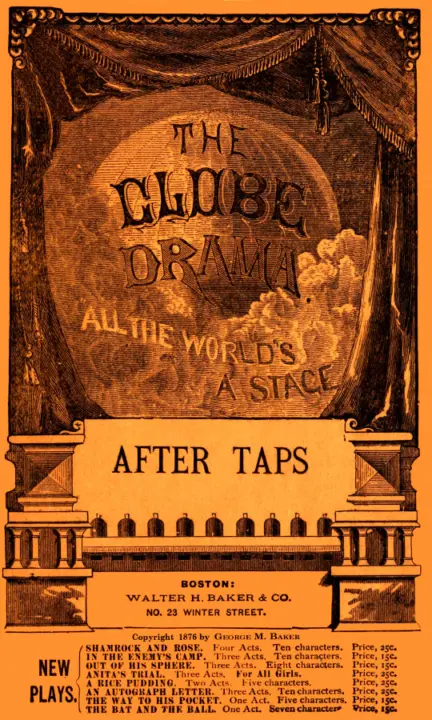
Rachel Baker Gale & George M. (George Melville) Baker
BEHIND THE BOOK
This eBook is for the use of anyone anywhere in the United States and most other parts of the world at no cost and with almost no restrictions whatsoever. You may copy it, give it away or re-use it under the terms of the Project Gutenberg License included with this eBook or online at www.gutenberg.org. If you are not located in the United States, you will have to check the laws of the country where you are located before using this eBook. Read the source licence.
The original source file, including credits and licence, is retained by this library. Request an original-format copy at no charge. Please include the book title and Project Gutenberg identifier #48832.
KEEP YOUR CURIOSITY GOING
Maurice Baring

Abby Morton Diaz
Helen Hunt Jackson
Mary Frances Blaisdell
Stuart Dodgson Collingwood

Kate Douglas Smith Wiggin