
Madame Roland: A Biographical Study
Ida M. (Ida Minerva) Tarbell
THE CLASSIC COLLECTION · 1916
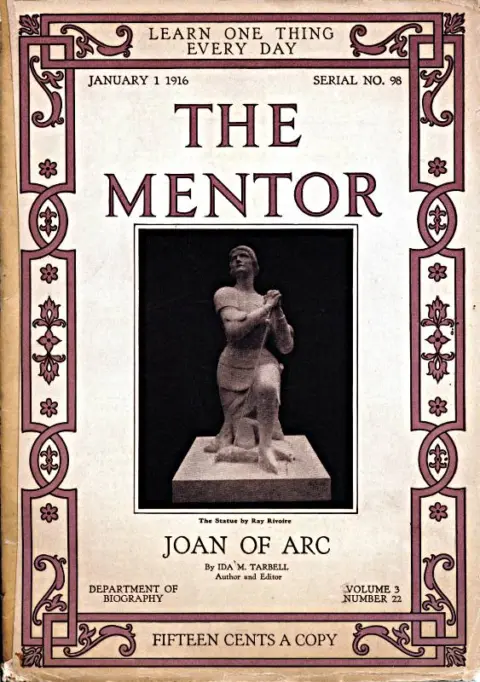
"The Mentor: Joan of Arc, v. 3, Num. 22, Serial No. 98, January 1, 1916" by Tarbell is a historical account written in the early 20th century. The book focuses on the life and legacy of Joan of Arc, a pivotal figure in French history who claimed to have received divine guidance to help save France during the Hundred Years' War. This account explores themes of faith, valor, and personal sacrifice, shedding light on her remarkable journey from a peasant girl to a national heroine, eventually leading to her martyrdom. In this book, the author, Ida M. Tarbell, presents a detailed narrative of Joan of Arc's life, beginning with her humble origins in Domrémy, France. The text recounts her divine visions that inspired her to support Charles VII and lift the English siege of Orléans, culminating in his coronation. It emphasizes the unwavering belief Joan held in her mission, despite the skepticism she faced from men in power. Ultimately, the book portrays her tragic capture, trial, and execution, skillfully capturing both her deep piety and the sociopolitical complexities of her time. Tarbell’s account illustrates how Joan’s unwavering faith and actions not only changed the course of a war but also led to her everlasting legacy as a symbol of courage and conviction.
Introduction adapted from the source catalogue; source summaries may be automatically generated.
Free to read · English · 9,251 words · No account needed
MAKE TIME FOR A GOOD BOOK
On by default. Untick to stop anonymous reading totals. Each page counts after 10 seconds in view. How this works.
Anonymous counting is on unless you have switched it off.
On May 30, 1431, she was burned to death in the marketplace of Rouen. Eight hundred soldiers surrounded the stake for fear that someone might attempt to save her. Only one kind priest who pitied her brought a cross and held it before her eyes while she was burning.
In 1436 a woman appeared who said she was Joan of Arc escaped from the flames. Many people believed her; but afterward she confessed to being an impostor.
On July 7, 1456, the pope revoked the sentence passed on the Maid. In February, 1903, a formal proposal was entered for her canonization, and on December 13, 1908, she was made a saint.
[* PREPARED BY THE EDITORIAL STAFF OF THE MENTOR ASSOCIATION ILLUSTRATION FOR THE MENTOR, VOL. 3, No. 22, SERIAL No. 98 COPYRIGHT, 1916, BY THE MENTOR ASSOCIATION, INC.]
By IDA M. TARBELL
JOAN OF ARC
By Foyatier
JOAN OF ARC
By J. Roulteau
JOAN OF ARC
By Princess Marie of
Orleans
JOAN OF ARC
By Henri Chapin
THE MAID OF
ORLEANS
By R. Wheelwright
JOAN OF ARC
By Jules Bastien-Lepage
Aside from the story of the Christ there is none in history which offers so complete a picture of the heights and depths of human character as that of Joan of Arc. So perfect is its symbolism that one coming for the first time to the records of the world might well believe it the invention of some consummate master of the intricacies of human nature, intent on showing to men the extremes of evil and of good of which they are capable.
[* Entered at the Postoffice at New York, N. Y., as second-class matter. Copyright, 1916, by The Mentor Association, Inc.]
Full of subtleties and mysteries as the story is, there is none in history more perfectly documented. We have not merely the proofs of what the Holy Maid claimed to be and what she did, but the details of her childhood, the inmost experiences of her spiritual and physical life. And these events and experiences stand on the evidences of not one, but of many, of those who were with her from her birth on January 6, 1412, in the little village of Domrémy, some 125 miles southeast of Paris, to the day nineteen years later, when, before the eyes of a great multitude of the people of Rouen (roo-ong), she was burned at the stake. She suffered her fate because a body of eminent lawyers and divines had found that she was, as their restrained and Christian language has it, "a liar, an inventor of revelations and apparitions, a deceiver, pernicious, presumptuous, light of faith, rash, superstitious, a soothsayer, a blasphemer against God and His saints, a contemner of God even in His sacraments, a prevaricator of divine law and of sacred doctrines and of ecclesiastical sanction, seditious, cruel, apostate, schismatic, having committed a thousand errors against religion, and by all these tokens rashly guilty towards God and Holy Church!"
Your reading position is saved on this browser. Take it to another device with a library code. Reading pages adapt to text, rather than matching a printed edition.
Ida M. (Ida Minerva) Tarbell

Ida M. (Ida Minerva) Tarbell

Ida M. (Ida Minerva) Tarbell
Ida M. (Ida Minerva) Tarbell
BEHIND THE BOOK
This eBook is for the use of anyone anywhere in the United States and most other parts of the world at no cost and with almost no restrictions whatsoever. You may copy it, give it away or re-use it under the terms of the Project Gutenberg License included with this eBook or online at www.gutenberg.org. If you are not located in the United States, you will have to check the laws of the country where you are located before using this eBook. Read the source licence.
The original source file, including credits and licence, is retained by this library. Request an original-format copy at no charge. Please include the book title and Project Gutenberg identifier #50859.
KEEP YOUR CURIOSITY GOING
Cécile Tormay

Moritz Busch
John L. Ransom
Frances Wright
Cécile Tormay

Mabel Potter Daggett