
The Writing of News A Handbook with Chapters on Newspaper Correspondence and Copy Reading
Charles G. (Charles Griffith) Ross
THE CLASSIC COLLECTION · 1905
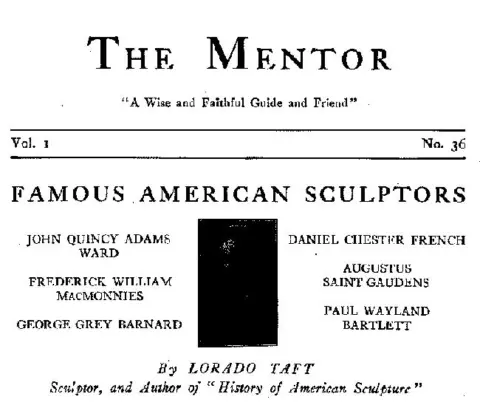
"The Mentor: Famous American Sculptors, Vol. 1, Num. 36, Serial No. 36" by Taft is a collection of biographical sketches focusing on notable American sculptors written during the early 20th century. The book provides insights into the lives and works of prominent figures in American sculpture, such as John Quincy Adams Ward, Augustus Saint Gaudens, and Daniel Chester French, among others. This publication is likely aimed at readers interested in art history and the development of sculpture as an artistic discipline in America. In this book, Taft details the contributions of each sculptor, highlighting their unique styles, notable works, and the influences that shaped their artistic journeys. For instance, John Quincy Adams Ward is celebrated for his mastery of portrait sculpture and monumental works like "The Indian Hunter," while Augustus Saint Gaudens is recognized for his versatility and iconic pieces such as the "Lincoln" statue in Chicago. The text contrasts the early imitative stages of American sculpture with the mature, distinct styles that emerged by the turn of the century, presenting a narrative of artistic evolution that reflects broader cultural shifts in the United States during this period. Through comprehensive profiles and discussions of key artworks, Taft illustrates the significance of these artists in solidifying America's presence in the global art scene.
Introduction adapted from the source catalogue; source summaries may be automatically generated.
Free to read · English · 6,687 words · No account needed
MAKE TIME FOR A GOOD BOOK
On by default. Untick to stop anonymous reading totals. Each page counts after 10 seconds in view. How this works.
Anonymous counting is on unless you have switched it off.
Bartlett collaborated with Ward upon the pedimental group of the New York Stock Exchange, and a logical result of the good work done there was the commission to design the long awaited pediment for the House of Representatives in Washington, a gigantic undertaking of great significance, which is now in progress.
To select these six names out of a hundred seems invidious. One wants to talk of Herbert Adams and his beautiful busts, of Karl Bitter and all the fine things he has done, of MacNeil and Grafly and Aitken and the Piccirillis and the Borglums and all the rest, of the Boston men, of the women sculptors, even of the little western group; but space fails. They are all working enthusiastically for the love of their art and for the fair fame of America.
SUPPLEMENTARY READING--“History of American Sculpture,” Lorado Taft; “American Masters of Sculpture,” Charles H. Caffin.
MAGAZINE ARTICLES--“George Grey Barnard, Sculptor,” G. B. Thaw World’s Work, December, 1902; “Daniel Chester French, Sculptor,” Lorado Taft Brush and Pencil, Vol. 5; “Bartlett” (“Some American Artists in Paris,”) Francis Keyser, Studio, Vol. 13; “Frederick MacMonnies, Sculptor,” H. H. Grier, Brush and Pencil, Vol. 10; “Augustus Saint Gaudens,” Kenyon Cox, Century, Vol. 13; “The Work of J. Q. A. Ward,” Russell Sturgis, Scribner’s, Vol. 32.
The Mentor Association, Inc.
381 Fourth Ave., New York, N. Y.
Vol. 1 No. 36
ANNUAL SUBSCRIPTION, FOUR DOLLARS. SINGLE COPIES TWENTY CENTS. FOREIGN POSTAGE, SEVENTY-FIVE CENTS EXTRA. CANADIAN POSTAGE, FIFTY CENTS EXTRA. ENTERED AT THE POST OFFICE AT NEW YORK, N. Y., AS SECOND-CLASS MATTER.
Editorial
“Seek knowledge wherever it can be found throughout the world.” So spoke Mutsuhito, late Emperor of Japan. It was a favorite maxim of his, and one frequently repeated by his subjects. It might well be a legend of The Mentor, for the wise thought beneath that injunction of the emperor’s is just what inspired The Mentor plan.
The method pursued in The Mentor finds, too, a striking parallel in Japanese life. In seeking knowledge and in the enjoyment of beautiful things, the Japanese set their minds on “one thing at a time.” Their habit of thought and their method of study are such as might be expressed in The Mentor principle, “Learn one thing every day.”
The thoroughness of the Japanese is well known. Their intelligence, enterprise, and up-to-dateness have been illustrated many times in the arts of peace and in the science of war. In this one particular principle of concentration in study, and single mindedness in the enjoyment of beautiful things, the Japanese may well be taken as a model for the rest of mankind.
Your reading position is saved on this browser. Take it to another device with a library code. Reading pages adapt to text, rather than matching a printed edition.
BEHIND THE BOOK
This eBook is for the use of anyone anywhere in the United States and most other parts of the world at no cost and with almost no restrictions whatsoever. You may copy it, give it away or re-use it under the terms of the Project Gutenberg License included with this eBook or online at www.gutenberg.org. If you are not located in the United States, you will have to check the laws of the country where you are located before using this eBook. Read the source licence.
The original source file, including credits and licence, is retained by this library. Request an original-format copy at no charge. Please include the book title and Project Gutenberg identifier #49804.
KEEP YOUR CURIOSITY GOING
Charles G. (Charles Griffith) Ross
Hannah Webster Foster

Emily Lawless
Edwin Hamlin Carr

Charles De Lano Hine
Andrew Ure