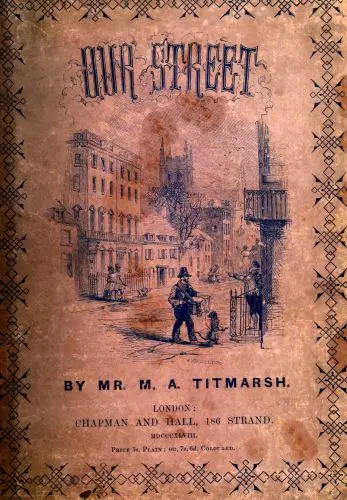
“Our Street”
William Makepeace Thackeray
THE CLASSIC COLLECTION · 1856
"The Memoirs of Mr. Charles J. Yellowplush" by William Makepeace Thackeray is a novel written in the early 19th century, characterized by satirical humor and social commentary. The narrative is presented through the voice of the protagonist, Mr. Charles James Harrington Fitzroy Yellowplush, a former footman who offers an irreverent view of society and its class distinctions, reflecting Thackeray's ingenuity in critiquing the social structures of his time. At the start of the story, readers are introduced to the life and origins of Charles Yellowplush, who recounts his childhood and early experiences with his eccentric mother and a series of jobs as a servant. He shares various anecdotes, revealing the chaotic and often absurd circumstances of his upbringing. As he describes his first position working for Mr. Bago and later for the flamboyant master, Mr. Frederic Altamont, the stage is set for a blend of humor and social observation as Yellowplush navigates the complexities of servant-master dynamics and the world of fashion and money. His reflections provide insight into the lives of both lower and upper classes, making for an engaging exploration into Victorian society.
Introduction adapted from the source catalogue; source summaries may be automatically generated.
Free to read · English · 58,223 words · No account needed
MAKE TIME FOR A GOOD BOOK
On by default. Untick to stop anonymous reading totals. Each page counts after 10 seconds in view. How this works.
Anonymous counting is on unless you have switched it off.
I was struck all of a heap--the truth flasht on my mind's hi. “Toinette,” says I, for that was the gal's name--“Toinette,” says I, giving her a kiss, “keep them for two minits, as you valyou my affeckshn;” and then I gave her another kiss, and ran up stares to our chambers. Master had now pretty well recovered of his wound, and was aloud to drive abowt: it was lucky for him that he had the strength to move. “Sir, sir,” says I, “the bailiffs are after you, and you must run for your life.”
“Bailiff?” says he: “nonsense! I don't, thank heaven, owe a shilling to
any man.”
“Stuff, sir,” says I, forgetting my respeck; “don't you owe money in England? I tell you the bailiffs are here, and will be on you in a moment.”
As I spoke, cling cling, ling ling, goes the bell of the antyshamber, and there they were sure enough!
What was to be done? Quick as litening, I throws off my livry coat, claps my goold lace hat on master's head, and makes him put on my livry. Then I wraps myself up in his dressing-gown, and lolling down on the sofa, bids him open the dor.
There they were--the bailiff--two jondarms with him--Toinette, and an old waiter. When Toinette sees master, she smiles, and says: “Dis donc, Charles! ou est donc ton maitre? Chez lui, n'est-ce pas? C'est le jeune a monsieur,” says she, curtsying to the bailiff.
The old waiter was just a-going to blurt out, “Mais ce n'est pas!” when Toinette stops him, and says, “Laissez donc passer ces messieurs, vieux bete;” and in they walk, the 2 jon d'arms taking their post in the hall.
Master throws open the salong doar very gravely, and touching MY hat says, “Have you any orders about the cab, sir?”
“Why, no, Chawls,” says I; “I shan't drive out to-day.”
The old bailiff grinned, for he understood English (having had plenty of English customers), and says in French, as master goes out, “I think, sir, you had better let your servant get a coach, for I am under the painful necessity of arresting you, au nom de la loi, for the sum of ninety-eight thousand seven hundred francs, owed by you to the Sieur Jacques Francois Lebrun, of Paris;” and he pulls out a number of bills, with master's acceptances on them sure enough.
“Take a chair, sir,” says I; and down he sits; and I began to chaff him, as well as I could, about the weather, my illness, my sad axdent, having lost one of my hands, which was stuck into my busum, and so on.
Your reading position is saved on this browser. Take it to another device with a library code. Reading pages adapt to text, rather than matching a printed edition.
William Makepeace Thackeray
William Makepeace Thackeray
Charles Dickens & William Makepeace Thackeray
William Makepeace Thackeray
BEHIND THE BOOK
This eBook is for the use of anyone anywhere in the United States and most other parts of the world at no cost and with almost no restrictions whatsoever. You may copy it, give it away or re-use it under the terms of the Project Gutenberg License included with this eBook or online at www.gutenberg.org. If you are not located in the United States, you will have to check the laws of the country where you are located before using this eBook. Read the source licence.
The original source file, including credits and licence, is retained by this library. Request an original-format copy at no charge. Please include the book title and Project Gutenberg identifier #2796.
KEEP YOUR CURIOSITY GOING
Coulson Kernahan

Maurice Baring
Frances Wright
Cécile Tormay

Frederic Jesup Stimson

W. H. P. (William Henry Pope) Jarvis