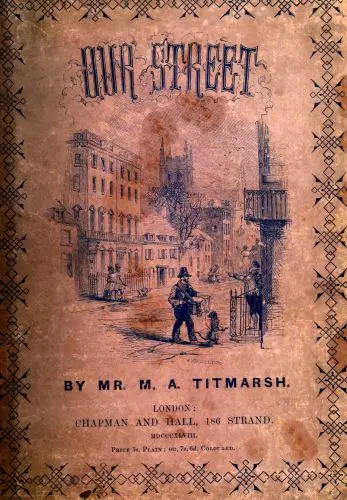
“Our Street”
William Makepeace Thackeray
THE CLASSIC COLLECTION · 1856
"The Memoirs of Mr. Charles J. Yellowplush" by William Makepeace Thackeray is a novel written in the early 19th century, characterized by satirical humor and social commentary. The narrative is presented through the voice of the protagonist, Mr. Charles James Harrington Fitzroy Yellowplush, a former footman who offers an irreverent view of society and its class distinctions, reflecting Thackeray's ingenuity in critiquing the social structures of his time. At the start of the story, readers are introduced to the life and origins of Charles Yellowplush, who recounts his childhood and early experiences with his eccentric mother and a series of jobs as a servant. He shares various anecdotes, revealing the chaotic and often absurd circumstances of his upbringing. As he describes his first position working for Mr. Bago and later for the flamboyant master, Mr. Frederic Altamont, the stage is set for a blend of humor and social observation as Yellowplush navigates the complexities of servant-master dynamics and the world of fashion and money. His reflections provide insight into the lives of both lower and upper classes, making for an engaging exploration into Victorian society.
Introduction adapted from the source catalogue; source summaries may be automatically generated.
Free to read · English · 58,223 words · No account needed
MAKE TIME FOR A GOOD BOOK
On by default. Untick to stop anonymous reading totals. Each page counts after 10 seconds in view. How this works.
Anonymous counting is on unless you have switched it off.
DIDN'T HE GO--that's all! My i, how his i's shone, as he skipt across the room, and seated himself by my lady!
“Look!” said she, “my agents write me over that they have received a remittance of 7,200 rupees, at 2s. 9d. a rupee. Do tell me what the sum is, in pounds and shillings;” which master did with great gravity.
“Nine hundred and ninety pounds. Good; I daresay you are right. I'm sure I can't go through the fatigue to see. And now comes another question. Whose money is this, mine or Matilda's? You see it is the interest of a sum in India, which we have not had occasion to touch; and, according to the terms of poor Sir George's will, I really don't know how to dispose of the money except to spend it. Matilda, what shall we do with it?”
“La, ma'am, I wish you would arrange the business yourself.”
“Well, then, Algernon, YOU tell me;” and she laid her hand on his and looked him most pathetickly in the face.
“Why,” says he, “I don't know how Sir George left his money; you must let me see his will, first.”
“Oh, willingly.”
Master's chair seemed suddenly to have got springs in the cushns; he was obliged to HOLD HIMSELF DOWN.
“Look here, I have only a copy, taken by my hand from Sir George's own manuscript. Soldiers, you know, do not employ lawyers much, and this was written on the night before going into action.” And she read, “'I, George Griffin,' &c. &c.--you know how these things begin--'being now of sane mind'--um, um, um,--'leave to my friends, Thomas Abraham Hicks, a colonel in the H. E. I. Company's Service, and to John Monro Mackirkincroft (of the house of Huffle, Mackirkincroft, and Dobbs, at Calcutta), the whole of my property, to be realized as speedily as they may (consistently with the interests of the property), in trust for my wife, Leonora Emilia Griffin (born L. E. Kicksey), and my only legitimate child, Matilda Griffin. The interest resulting from such property to be paid to them, share and share alike; the principal to remain untouched, in the names of the said T. A. Hicks and J. M. Mackirkincroft, until the death of my wife, Leonora Emilia Griffin, when it shall be paid to my daughter, Matilda Griffin, her heirs, executors, or assigns.'”
“There,” said my lady, “we won't read any more; all the rest is stuff. But now you know the whole business, tell us what is to be done with the money?”
“Why, the money, unquestionably, should be divided between you.”
“Tant mieux, say I; I really thought it had been all Matilda's.”
Your reading position is saved on this browser. Take it to another device with a library code. Reading pages adapt to text, rather than matching a printed edition.
William Makepeace Thackeray
William Makepeace Thackeray
Charles Dickens & William Makepeace Thackeray
William Makepeace Thackeray
BEHIND THE BOOK
This eBook is for the use of anyone anywhere in the United States and most other parts of the world at no cost and with almost no restrictions whatsoever. You may copy it, give it away or re-use it under the terms of the Project Gutenberg License included with this eBook or online at www.gutenberg.org. If you are not located in the United States, you will have to check the laws of the country where you are located before using this eBook. Read the source licence.
The original source file, including credits and licence, is retained by this library. Request an original-format copy at no charge. Please include the book title and Project Gutenberg identifier #2796.
KEEP YOUR CURIOSITY GOING
Coulson Kernahan

Maurice Baring
Frances Wright
Cécile Tormay

Frederic Jesup Stimson

W. H. P. (William Henry Pope) Jarvis