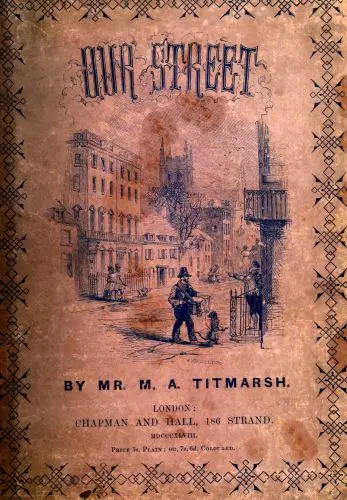
“Our Street”
William Makepeace Thackeray
THE CLASSIC COLLECTION · 1856
"The Memoirs of Mr. Charles J. Yellowplush" by William Makepeace Thackeray is a novel written in the early 19th century, characterized by satirical humor and social commentary. The narrative is presented through the voice of the protagonist, Mr. Charles James Harrington Fitzroy Yellowplush, a former footman who offers an irreverent view of society and its class distinctions, reflecting Thackeray's ingenuity in critiquing the social structures of his time. At the start of the story, readers are introduced to the life and origins of Charles Yellowplush, who recounts his childhood and early experiences with his eccentric mother and a series of jobs as a servant. He shares various anecdotes, revealing the chaotic and often absurd circumstances of his upbringing. As he describes his first position working for Mr. Bago and later for the flamboyant master, Mr. Frederic Altamont, the stage is set for a blend of humor and social observation as Yellowplush navigates the complexities of servant-master dynamics and the world of fashion and money. His reflections provide insight into the lives of both lower and upper classes, making for an engaging exploration into Victorian society.
Introduction adapted from the source catalogue; source summaries may be automatically generated.
Free to read · English · 58,223 words · No account needed
MAKE TIME FOR A GOOD BOOK
On by default. Untick to stop anonymous reading totals. Each page counts after 10 seconds in view. How this works.
Anonymous counting is on unless you have switched it off.
Knowing the Cafe de Paris to be shut at that hour, I didn't say a word, but quietly establisht myself in the ante-room; where, as it happened by a singler coinstdints, I could hear every word of the conversation between this exlent pair of relatifs.
“Help yourself, and get another bottle,” says my lord, after a sollum paws. My poar master, the king of all other compnies in which he moved, seamed here but to play secknd fiddill, and went to the cubbard, from which his father had already igstracted two bottils of his prime Sillary.
He put it down before his father, coft, spit, opened the windows, stirred the fire, yawned, clapt his hand to his forehead, and suttnly seamed as uneezy as a genlmn could be. But it was of no use; the old one would not budg. “Help yourself,” says he again, “and pass me the bottil.”
“You are very good, father,” says master; “but really, I neither drink
nor smoke.”
“Right, my boy: quite right. Talk about a good conscience in this life--a good STOMACK is everythink. No bad nights, no headachs--eh? Quite cool and collected for your law studies in the morning?--eh?” And the old nobleman here grinned, in a manner which would have done creddit to Mr. Grimoldi.
Master sate pale and wincing, as I've seen a pore soldier under the cat. He didn't anser a word. His exlent pa went on, warming as he continued to speak, and drinking a fresh glas at evry full stop.
“How you must improve, with such talents and such principles! Why, Algernon, all London talks of your industry and perseverance: you're not merely a philosopher, man; hang it! you've got the philosopher's stone. Fine rooms, fine horses, champagne, and all for 200 a year!”
“I presume, sir,” says my master, “that you mean the two hundred a year which YOU pay me?”
“The very sum, my boy; the very sum!” cries my lord, laffin as if he would die. “Why, that's the wonder! I never pay the two hundred a year, and you keep all this state up upon nothing. Give me your secret, O you young Trismegistus! Tell your old father how such wonders can be worked, and I will--yes, then, upon my word, I will--pay you your two hundred a year!”
“Enfin, my lord,” says Mr. Deuceace, starting up, and losing all patience, “will you have the goodness to tell me what this visit means? You leave me to starve, for all you care; and you grow mighty facetious because I earn my bread. You find me in prosperity, and--”
Your reading position is saved on this browser. Take it to another device with a library code. Reading pages adapt to text, rather than matching a printed edition.
William Makepeace Thackeray
William Makepeace Thackeray
Charles Dickens & William Makepeace Thackeray
William Makepeace Thackeray
BEHIND THE BOOK
This eBook is for the use of anyone anywhere in the United States and most other parts of the world at no cost and with almost no restrictions whatsoever. You may copy it, give it away or re-use it under the terms of the Project Gutenberg License included with this eBook or online at www.gutenberg.org. If you are not located in the United States, you will have to check the laws of the country where you are located before using this eBook. Read the source licence.
The original source file, including credits and licence, is retained by this library. Request an original-format copy at no charge. Please include the book title and Project Gutenberg identifier #2796.
KEEP YOUR CURIOSITY GOING
Coulson Kernahan

Maurice Baring
Frances Wright
Cécile Tormay

Frederic Jesup Stimson

W. H. P. (William Henry Pope) Jarvis