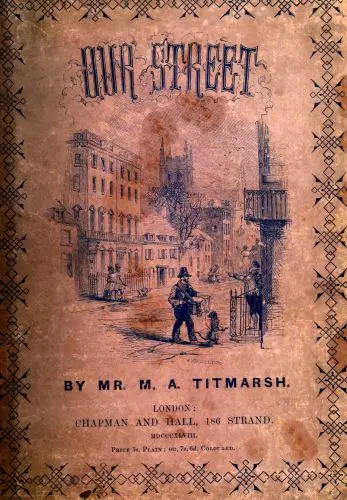
“Our Street”
William Makepeace Thackeray
THE CLASSIC COLLECTION · 1856
"The Memoirs of Mr. Charles J. Yellowplush" by William Makepeace Thackeray is a novel written in the early 19th century, characterized by satirical humor and social commentary. The narrative is presented through the voice of the protagonist, Mr. Charles James Harrington Fitzroy Yellowplush, a former footman who offers an irreverent view of society and its class distinctions, reflecting Thackeray's ingenuity in critiquing the social structures of his time. At the start of the story, readers are introduced to the life and origins of Charles Yellowplush, who recounts his childhood and early experiences with his eccentric mother and a series of jobs as a servant. He shares various anecdotes, revealing the chaotic and often absurd circumstances of his upbringing. As he describes his first position working for Mr. Bago and later for the flamboyant master, Mr. Frederic Altamont, the stage is set for a blend of humor and social observation as Yellowplush navigates the complexities of servant-master dynamics and the world of fashion and money. His reflections provide insight into the lives of both lower and upper classes, making for an engaging exploration into Victorian society.
Introduction adapted from the source catalogue; source summaries may be automatically generated.
Free to read · English · 58,223 words · No account needed
MAKE TIME FOR A GOOD BOOK
On by default. Untick to stop anonymous reading totals. Each page counts after 10 seconds in view. How this works.
Anonymous counting is on unless you have switched it off.
Old Mrs. Shum screamed, and ran at her like a Bengal tiger. Her great arms vent veeling about like a vinmill, as she cuffed and thumped poor Mary for taking her pa's part. Mary Shum, who was always a-crying before, didn't shed a tear now. “I will do it again,” she said, “if Betsy insults my father.” New thumps, new shreex; and the old horridan went on beatin the poor girl till she was quite exosted, and fell down on the sophy, puffin like a poppus.
“For shame, Mary,” began old Shum; “for shame, you naughty gal, you! for hurting the feelings of your dear mamma, and beating your kind sister.”
“Why, it was because she called you a--”
“If she did, you pert miss,” said Shum, looking mighty dignitified, “I could correct her, and not you.”
“You correct me, indeed!” said Miss Betsy, turning up her nose, if possible, higher than before; “I should like to see you erect me! Imperence!” and they all began laffin again.
By this time Mrs. S. had recovered from the effex of her exsize, and she began to pour in HER wolly. Fust she called Mary names, then Shum.
“Oh, why,” screeched she, “why did I ever leave a genteel famly, where I ad every ellygance and lucksry, to marry a creatur like this? He is unfit to be called a man, he is unworthy to marry a gentlewoman; and as for that hussy, I disown her. Thank heaven she an't a Slamcoe; she is only fit to be a Shum!”
“That's true, mamma,” said all the gals; for their mother had taught them this pretty piece of manners, and they despised their father heartily: indeed, I have always remarked that, in famlies where the wife is internally talking about the merits of her branch, the husband is invariably a spooney.
Well, when she was exosted again, down she fell on the sofy, at her old trix--more screeching--more convulshuns: and she wouldn't stop, this time, till Shum had got her half a pint of her old remedy, from the “Blue Lion” over the way. She grew more easy as she finished the gin; but Mary was sent out of the room, and told not to come back agin all day.
“Miss Mary,” says I,--for my heart yurned to the poor gal, as she came sobbing and miserable down stairs: “Miss Mary,” says I, “if I might make so bold, here's master's room empty, and I know where the cold bif and pickles is.” “Oh, Charles!” said she, nodding her head sadly, “I'm too retched to have any happytite.” And she flung herself on a chair, and began to cry fit to bust.
Your reading position is saved on this browser. Take it to another device with a library code. Reading pages adapt to text, rather than matching a printed edition.
William Makepeace Thackeray
William Makepeace Thackeray
Charles Dickens & William Makepeace Thackeray
William Makepeace Thackeray
BEHIND THE BOOK
This eBook is for the use of anyone anywhere in the United States and most other parts of the world at no cost and with almost no restrictions whatsoever. You may copy it, give it away or re-use it under the terms of the Project Gutenberg License included with this eBook or online at www.gutenberg.org. If you are not located in the United States, you will have to check the laws of the country where you are located before using this eBook. Read the source licence.
The original source file, including credits and licence, is retained by this library. Request an original-format copy at no charge. Please include the book title and Project Gutenberg identifier #2796.
KEEP YOUR CURIOSITY GOING
Coulson Kernahan

Maurice Baring
Frances Wright
Cécile Tormay

Frederic Jesup Stimson

W. H. P. (William Henry Pope) Jarvis