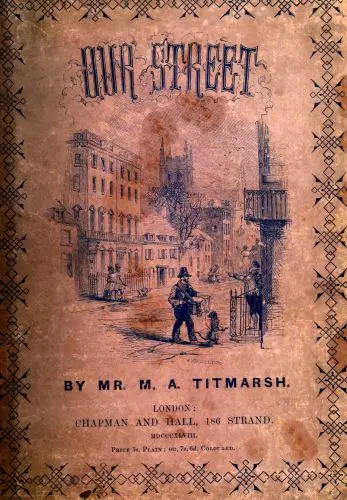
“Our Street”
William Makepeace Thackeray
THE CLASSIC COLLECTION · 1856
"The Memoirs of Mr. Charles J. Yellowplush" by William Makepeace Thackeray is a novel written in the early 19th century, characterized by satirical humor and social commentary. The narrative is presented through the voice of the protagonist, Mr. Charles James Harrington Fitzroy Yellowplush, a former footman who offers an irreverent view of society and its class distinctions, reflecting Thackeray's ingenuity in critiquing the social structures of his time. At the start of the story, readers are introduced to the life and origins of Charles Yellowplush, who recounts his childhood and early experiences with his eccentric mother and a series of jobs as a servant. He shares various anecdotes, revealing the chaotic and often absurd circumstances of his upbringing. As he describes his first position working for Mr. Bago and later for the flamboyant master, Mr. Frederic Altamont, the stage is set for a blend of humor and social observation as Yellowplush navigates the complexities of servant-master dynamics and the world of fashion and money. His reflections provide insight into the lives of both lower and upper classes, making for an engaging exploration into Victorian society.
Introduction adapted from the source catalogue; source summaries may be automatically generated.
Free to read · English · 58,223 words · No account needed
MAKE TIME FOR A GOOD BOOK
On by default. Untick to stop anonymous reading totals. Each page counts after 10 seconds in view. How this works.
Anonymous counting is on unless you have switched it off.
MAYFAIR, Nov. 30, 1839. Midnite.
HONRABBLE BARNET!--Retired from the littery world a year or moar, I didn't think anythink would injuice me to come forrards again: for I was content with my share of reputation, and propoas'd to add nothink to those immortial wux which have rendered this Magaseen so sallybrated.
Shall I tell you the reazn of my re-appearants?--a desire for the benefick of my fellow-creatures? Fiddlestick! A mighty truth with which my busm labored, and which I must bring forth or die? Nonsince--stuff: money's the secret, my dear Barnet,--money--l'argong, gelt, spicunia. Here's quarter-day coming, and I'm blest if I can pay my landlud, unless I can ad hartificially to my inkum.
This is, however, betwigst you and me. There's no need to blacard the streets with it, or to tell the British public that Fitzroy Y-ll-wpl-sh is short of money, or that the sallybrated hauthor of the Y--- Papers is in peskewniary difficklties, or is fiteagued by his superhuman littery labors, or by his famly suckmstansies, or by any other pusnal matter: my maxim, dear B, is on these pints to be as quiet as posbile. What the juice does the public care for you or me? Why must we always, in prefizzes and what not, be a-talking about ourselves and our igstrodnary merrats, woas, and injaries? It is on this subjick that I porpies, my dear Barnet, to speak to you in a frendly way; and praps you'll find my advise tolrabbly holesum.
Well, then,--if you care about the apinions, fur good or evil, of us poor suvvants, I tell you, in the most candied way, I like you, Barnet. I've had my fling at you in my day (for, entry nou, that last stoary I roat about you and Larnder was as big a bownsir as ever was)--I've had my fling at you; but I like you. One may objeck to an immense deal of your writings, which, betwigst you and me, contain more sham scentiment, sham morallaty, sham poatry, than you'd like to own; but, in spite of this, there's the STUFF in you: you've a kind and loyal heart in you, Barnet--a trifle deboshed, perhaps; a kean i, igspecially for what's comic (as for your tradgady, it's mighty flatchulent), and a ready plesnt pen. The man who says you are an As is an As himself. Don't believe him, Barnet! not that I suppose you wil,--for, if I've formed a correck apinion of you from your wucks, you think your small-beear as good as most men's: every man does,--and why not? We brew, and we love our own tap--amen; but the pint betwigst us, is this stewpid, absudd way of crying out, because the public don't like it too. Why shood they, my dear Barnet? You may vow that they are fools; or that the critix are your enemies; or that the wuld should judge your poams by your critticle rules, and not their own: you may beat your breast, and vow you are a marter, and you won't mend the matter. Take heart, man! you're not so misrabble after all: your spirits need not be so VERY cast down; you are not so VERY badly paid. I'd lay a wager that you make, with one thing or another--plays, novvles, pamphlicks, and little odd jobbs here and there--your three thowsnd a year. There's many a man, dear Bullwig that works for less, and lives content. Why shouldn't you? Three thowsnd a year is no such bad thing,--let alone the barnetcy: it must be a great comfort to have that bloody hand in your skitching.
Your reading position is saved on this browser. Take it to another device with a library code. Reading pages adapt to text, rather than matching a printed edition.
William Makepeace Thackeray
William Makepeace Thackeray
Charles Dickens & William Makepeace Thackeray
William Makepeace Thackeray
BEHIND THE BOOK
This eBook is for the use of anyone anywhere in the United States and most other parts of the world at no cost and with almost no restrictions whatsoever. You may copy it, give it away or re-use it under the terms of the Project Gutenberg License included with this eBook or online at www.gutenberg.org. If you are not located in the United States, you will have to check the laws of the country where you are located before using this eBook. Read the source licence.
The original source file, including credits and licence, is retained by this library. Request an original-format copy at no charge. Please include the book title and Project Gutenberg identifier #2796.
KEEP YOUR CURIOSITY GOING
Coulson Kernahan

Maurice Baring
Frances Wright
Cécile Tormay

Frederic Jesup Stimson

W. H. P. (William Henry Pope) Jarvis