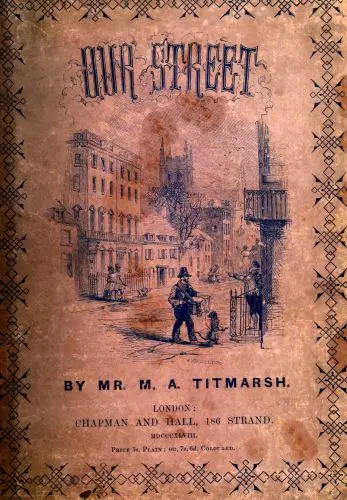
“Our Street”
William Makepeace Thackeray
THE CLASSIC COLLECTION · 1856
"The Memoirs of Mr. Charles J. Yellowplush" by William Makepeace Thackeray is a novel written in the early 19th century, characterized by satirical humor and social commentary. The narrative is presented through the voice of the protagonist, Mr. Charles James Harrington Fitzroy Yellowplush, a former footman who offers an irreverent view of society and its class distinctions, reflecting Thackeray's ingenuity in critiquing the social structures of his time. At the start of the story, readers are introduced to the life and origins of Charles Yellowplush, who recounts his childhood and early experiences with his eccentric mother and a series of jobs as a servant. He shares various anecdotes, revealing the chaotic and often absurd circumstances of his upbringing. As he describes his first position working for Mr. Bago and later for the flamboyant master, Mr. Frederic Altamont, the stage is set for a blend of humor and social observation as Yellowplush navigates the complexities of servant-master dynamics and the world of fashion and money. His reflections provide insight into the lives of both lower and upper classes, making for an engaging exploration into Victorian society.
Introduction adapted from the source catalogue; source summaries may be automatically generated.
Free to read · English · 58,223 words · No account needed
MAKE TIME FOR A GOOD BOOK
On by default. Untick to stop anonymous reading totals. Each page counts after 10 seconds in view. How this works.
Anonymous counting is on unless you have switched it off.
“It's the littherary wontherr of the wurrld,” says he; “and sure your lordship must have seen it; the latther numbers ispicially--cheap as durrt, bound in gleezed calico, six shillings a vollum. The illusthrious neems of Walther Scott, Thomas Moore, Docther Southey, Sir James Mackintosh, Docther Donovan, and meself, are to be found in the list of conthributors. It's the Phaynix of Cyclopajies--a litherary Bacon.”
“A what?” says the genlmn nex to him.
“A Bacon, shining in the darkness of our age; fild wid the pure end lambent flame of science, burning with the gorrgeous scintillations of divine litherature--a monumintum, in fact, are perinnius, bound in pink calico, six shillings a vollum.”
“This wigmawole,” said Mr. Bulwig (who seemed rather disgusted that his friend should take up so much of the convassation), “this wigmawole is all vewy well; but it's cuwious that you don't wemember, in chawactewising the litewawy mewits of the vawious magazines, cwonicles, weviews, and encyclopaedias, the existence of a cwitical weview and litewary chwonicle, which, though the aewa of its appeawance is dated only at a vewy few months pwevious to the pwesent pewiod, is, nevertheless, so wemarkable for its intwinsic mewits as to be wead, not in the metwopolis alone, but in the countwy--not in Fwance merely, but in the west of Euwope--whewever our pure Wenglish is spoken, it stwetches its peaceful sceptre--pewused in Amewica, fwom New York to Ningawa--wepwinted in Canada, from Montweal to Towonto--and, as I am gwatified to hear fwom my fwend the governor of Cape Coast Castle, wegularly weceived in Afwica, and twanslated into the Mandingo language by the missionawies and the bushwangers. I need not say, gentlemen--sir--that is, Mr. Speaker--I mean, Sir John--that I allude to the Litewary Chwonicle, of which I have the honor to be pwincipal contwibutor.”
“Very true; my dear Mr. Bullwig,” says my master: “you and I being Whigs, must of course stand by our own friends; and I will agree, without a moment's hesitation, that the Literary what-d'ye-call'em is the prince of periodicals.”
“The pwince of pewiodicals?” says Bullwig; “my dear Sir John, it's the empewow of the pwess.”
“Soit,--let it be the emperor of the press, as you poetically call it: but, between ourselves, confess it,--Do not the Tory writers beat your Whigs hollow? You talk about magazines. Look at--”
“Look at hwat?” shouts out Larder. “There's none, Sir Jan, compared to
ourrs.”
“Pardon me, I think that--”
“It is 'Bentley's Mislany' you mane?” says Ignatius, as sharp as a
niddle.
“Why, no; but--”
“O thin, it's Co'burn, sure! and that divvle Thayodor--a pretty paper, sir, but light--thrashy, milk-and-wathery--not sthrong, like the Litherary Chran--good luck to it.”
Your reading position is saved on this browser. Take it to another device with a library code. Reading pages adapt to text, rather than matching a printed edition.
William Makepeace Thackeray
William Makepeace Thackeray
Charles Dickens & William Makepeace Thackeray
William Makepeace Thackeray
BEHIND THE BOOK
This eBook is for the use of anyone anywhere in the United States and most other parts of the world at no cost and with almost no restrictions whatsoever. You may copy it, give it away or re-use it under the terms of the Project Gutenberg License included with this eBook or online at www.gutenberg.org. If you are not located in the United States, you will have to check the laws of the country where you are located before using this eBook. Read the source licence.
The original source file, including credits and licence, is retained by this library. Request an original-format copy at no charge. Please include the book title and Project Gutenberg identifier #2796.
KEEP YOUR CURIOSITY GOING
Coulson Kernahan

Maurice Baring
Frances Wright
Cécile Tormay

Frederic Jesup Stimson

W. H. P. (William Henry Pope) Jarvis