THE CLASSIC COLLECTION✦An outlaw’s diary: the CommuneCLASSIC FREE BOOKS
An outlaw’s diary: the Commune
Cécile Tormay
THE CLASSIC COLLECTION · 1906
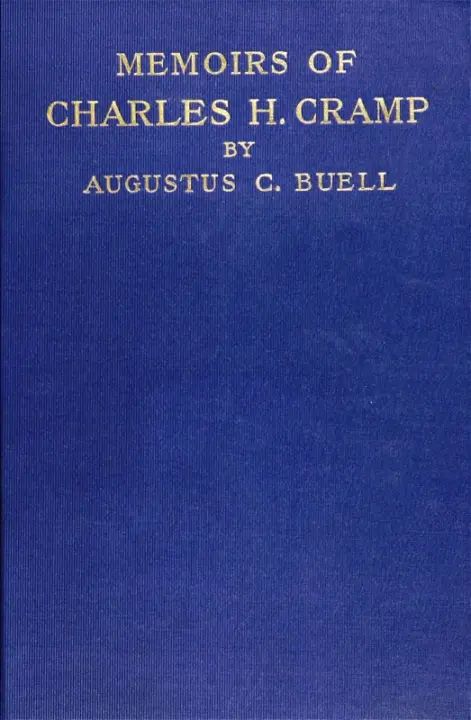
"The Memoirs of Charles H. Cramp" by Augustus C. Buell is a historical account written in the early 20th century. The book chronicles the life and contributions of Charles Henry Cramp, a prominent figure in naval architecture and shipbuilding during a transformative period in America's maritime history. It captures his personal journey alongside the evolution of naval engineering, linking his professional milestones to key historical events and technological advancements. The opening of the memoir establishes the impressive scope of Cramp's life, highlighting his significance in the shipbuilding industry from colonial times to the late 19th century. It discusses the early development of shipbuilding in Philadelphia and the role of innovative figures like Paul Jones, setting a foundation for Cramp's eventual rise in the field. The text delves into the historical context of naval architecture, illustrating Philadelphia's importance as a shipbuilding hub, and introduces Cramp's family lineage, which was steeped in this trade. As readers embark on this memoir, they gain an appreciation for both Cramp's achievements and the rich narrative of American naval history that unfolds throughout the book.
Introduction adapted from the source catalogue; source summaries may be automatically generated.
Free to read · English · 62,639 words · No account needed
MAKE TIME FOR A GOOD BOOK
On by default. Untick to stop anonymous reading totals. Each page counts after 10 seconds in view. How this works.
Anonymous counting is on unless you have switched it off.
“The foreign ship-owner who carries our over-sea commerce makes us pay the freight both ways.
“For our exports we get the foreign market price less the freight.
“For our imports we pay the foreign market price plus the freight.
“No fine-spun theory of any cloistered or collegiate doctrinaire can
wipe out these facts.
“The fact that so long as the freight is paid to a foreign ship-owner, so long will it be a foreign profit on a foreign product, is fundamental and unanswerable.
“The English steamship is a foreign product, and its earnings, which we pay, are a foreign profit.
“No sane man will argue that a foreign profit on a foreign product can be of domestic benefit.
“Add to this the fact, equally important, that the carrier of commerce controls its exchanges, and the condition of commercial, financial, and industrial subjugation is complete. Such is our condition to-day.
“Great Britain has many outlying colonies and dependencies.
“The greatest two are India and the United States.
“She holds India by force of arms, whereby her control of that country costs her something. She has to pay something for her financial and commercial drainage of India.
“She holds the United States by the folly of its own people, whereby her control of this country costs her nothing. She has to pay nothing for her financial and commercial drainage of the United States.
“But the amount of her annual drainage of gold from the United States far exceeds that from India.
“Therefore the United States is by far the most valuable of all the dependencies of Great Britain.
“In the relation of India to England there is something pitiable, because India is helpless.
“In the relation of the United States to England there is nothing that is not contemptible, because it is the willing servitude of a nation that could help herself if she would.
“England is wide awake to those conditions, and keenly appreciates their priceless value to her.
“The United States blinks at them, half dazed, half asleep, insensible of their tremendous damage to her.
“England, clearly seeing that in this age more than ever before ocean empire is world empire, strains every nerve to perpetuate her sea power and exhausts her resources to double-rivet the fetters which it fastens upon mankind.
“Though in 1885 England already had a navy superior to those of any two and equal to those of any three other powers, if not to all others, she has since that date built a new navy which, with what remains most available of the old one, overshadows the world, and makes the sea as much British territory as the County of Middlesex.”
Your reading position is saved on this browser. Take it to another device with a library code. Reading pages adapt to text, rather than matching a printed edition.
BEHIND THE BOOK
This eBook is for the use of anyone anywhere in the United States and most other parts of the world at no cost and with almost no restrictions whatsoever. You may copy it, give it away or re-use it under the terms of the Project Gutenberg License included with this eBook or online at www.gutenberg.org. If you are not located in the United States, you will have to check the laws of the country where you are located before using this eBook. Read the source licence.
The original source file, including credits and licence, is retained by this library. Request an original-format copy at no charge. Please include the book title and Project Gutenberg identifier #57081.
KEEP YOUR CURIOSITY GOING
Cécile Tormay

Moritz Busch
John L. Ransom
Frances Wright
Cécile Tormay

Mabel Potter Daggett