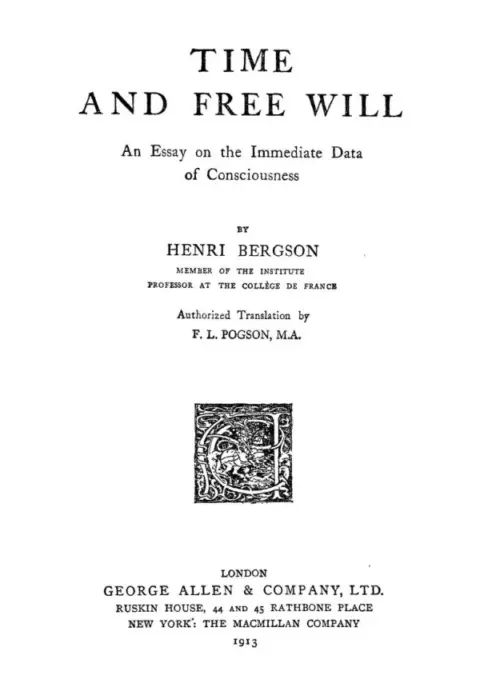
Time and Free Will: An Essay on the Immediate Data of Consciousness
Henri Bergson
THE CLASSIC COLLECTION · 1915
"The Meaning of the War: Life & Matter in Conflict" by Henri Bergson is a philosophical examination of the nature of war, written during the early 20th century amid the tumult of World War I. This text, a discourse delivered at the Académie des Sciences Morales et Politiques, delves into the conflict between life and mechanized forces, exploring how these opposing principles manifest in the face of war. Bergson articulates his views on the broader implications of warfare, challenging the materialistic perspectives prevalent at the time. In this work, Bergson argues that World War I represents the struggle between the vibrant forces of life and the rigid mechanisms of a militarized society, particularly criticizing Germany's embrace of a materialistic and militaristic ideology. He contrasts the organic growth of nations with the artificial unification stemming from Prussian militarism, stressing how this mechanized mindset ultimately leads to violence and destruction. As he reflects on the moral implications of war, Bergson emphasizes that true moral and spiritual strength arises from ideals of justice and freedom, which stand in stark opposition to Germany's brute force. Thus, he posits that the outcome of the war is not just a matter of material superiority but a decisive confrontation between moral forces that can rejuvenate humanity and the destructive paths of mechanization.
Introduction adapted from the source catalogue; source summaries may be automatically generated.
Free to read · English · 5,067 words · No account needed
MAKE TIME FOR A GOOD BOOK
On by default. Untick to stop anonymous reading totals. Each page counts after 10 seconds in view. How this works.
Anonymous counting is on unless you have switched it off.
For, even though the spirit of conquest knows no limit in itself, it must limit its ambitions as long as the question is simply that of seizing a neighbour's territory. To constitute their kingdom, kings of Prussia had been obliged to undertake a long series of wars. Whether the name of the spoiler be Frederick or William, not more than one or two provinces can be annexed at a time: to take more is to weaken oneself. But suppose that the same insatiable thirst for conquest enters into the new form of wealth--what follows? Boundless ambition, which till then had spread out the coming of its gains over indefinite time, since each one of them would be worth only a definite portion of space, will now leap all at once to an object boundless as itself. Rights will be set up on every point of the globe where raw material for industry, refitting stations for ships, concessions for capitalists, or outlets for production are seen to exist. In fact, the policy which had served Prussia so well passed at a bound from the most calculating prudence to the wildest temerity. Bismarck, whose common-sense put some restraint on the logic of his principles, was still averse to colonial enterprises; he said that all the affairs of the East were not worth the bones of one Pomeranian grenadier. But Germany, retaining Bismarck's former impulse, went straight on and rushed forward along the lines of least resistance to east and west: on the one side lay the route to the Orient, on the other the empire of the sea. But in so doing she virtually declared war on the nations which Bismarck had managed to keep allied or friendly. Her ambition looked forward to the domination of the world.
Moreover, there was no moral restraint which could keep this ambition under control. Intoxicated by victory, by the prestige which victory had given her, and of which her commerce, her industry, her science even, had reaped the benefit, Germany plunged into a material prosperity such as she had never known, such as she would never have dared to dream of. She told herself that if force had wrought this miracle, if force had given her riches and honour, it was because force had within it a hidden virtue, mysterious--nay, divine. Yes, brute force with its train of trickery and lies, when it comes with powers of attack sufficient for the conquest of the world, must needs be in direct line from heaven and a revelation of the will of God on earth. The people to whom this power of attack had come were the elect, a chosen race by whose side the others are races of bondmen. To such a race nothing is forbidden that may help in establishing its dominion. Let none speak to it of inviolable right! Right is what is written in a treaty; a treaty is what registers the will of a conqueror--that is, the direction of his force for the time being: force, then, and right are the same thing; and if force is pleased to take a new direction, the old right becomes ancient history and the treaty, which backed it with a solemn undertaking, no more than a scrap of paper. Thus Germany, struck with wonder in presence of her victories, of the brute force which had been their means, of the material prosperity which was the outcome, translated her amazement into an idea. And see how, at the call of this idea, a thousand thoughts, as if awaked from slumber, and shaking off the dust of libraries, came rushing in from every side--thoughts which Germany had suffered to sleep among her poets and philosophers, every one which could lend a seductive or striking form to a conviction already made! Henceforth German imperialism had a theory of its own. Taught in schools and universities, it easily moulded to itself a nation already broken-in to passive obedience and having no loftier ideal wherewith to oppose the official doctrine. Many persons have explained the aberrations of German policy as due to that theory. For my part, I see in it nothing more than a philosophy doomed to translate into ideas what was, in its essence, insatiable ambition and will perverted by pride. The doctrine is an effect rather than a cause; and should the day come when Germany, conscious of her moral humiliation, shall say, to excuse herself, that she had trusted herself too much to certain theories, that an error of judgment is not a crime, it will then be necessary to remind her that her philosophy was simply a translation into intellectual terms of her brutality, her appetites, and her vices. So, too, in most cases, doctrines are the means by which nations and individuals seek to explain what they are and what they do. Germany, having finally become a predatory nation, invokes Hegel as witness; just as a Germany enamoured of moral beauty would have declared herself faithful to Kant, just as a sentimental Germany would have found her tutelary genius in Jacobi or Schopenhauer. Had she leaned in any other direction and been unable to find at home the philosophy she needed, she would have procured it from abroad. Thus when she wished to convince herself that predestined races exist, she took from France, that she might hoist him into celebrity, a writer whom we have not read--Gobineau.
Your reading position is saved on this browser. Take it to another device with a library code. Reading pages adapt to text, rather than matching a printed edition.
BEHIND THE BOOK
This eBook is for the use of anyone anywhere in the United States and most other parts of the world at no cost and with almost no restrictions whatsoever. You may copy it, give it away or re-use it under the terms of the Project Gutenberg License included with this eBook or online at www.gutenberg.org. If you are not located in the United States, you will have to check the laws of the country where you are located before using this eBook. Read the source licence.
The original source file, including credits and licence, is retained by this library. Request an original-format copy at no charge. Please include the book title and Project Gutenberg identifier #17111.
KEEP YOUR CURIOSITY GOING

David Patterson (Spirit) Hatch
Cécile Tormay

Moritz Busch
Coulson Kernahan
John L. Ransom

Ralph Waldo Emerson