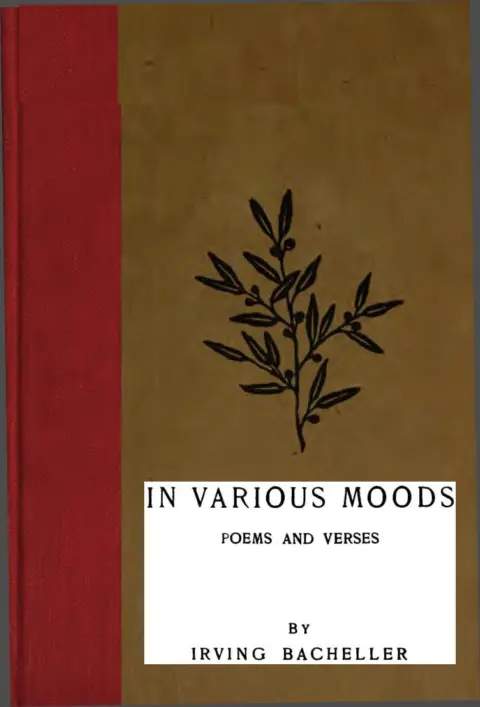
In Various Moods: Poems and Verses
Irving Bacheller
THE CLASSIC COLLECTION · 1892
"The Master of Silence: A Romance" by Irving Bacheller is a fictional novel written in the late 19th century. The story revolves around the young protagonist, Kendric Lane, who embarks on a mysterious journey from England to America, driven by an urgent letter from his estranged uncle, Revis Lane. As Kendric navigates through themes of family, isolation, and self-discovery, he encounters strange characters and unexpected challenges that shape his future. The beginning of the book introduces us to Kendric's life as he leaves his unhappy home in London, following his father's death and the dubious guidance of his stepmother and guardian. He arrives in Liverpool as an apprentice only to be thrust into a series of peculiar encounters, including a visit from a deaf-mute messenger seeking assistance and delivering an enigmatic letter from his uncle that leads Kendric on a quest to find him. As the narrative unfolds, we learn about Kendric’s loneliness and his budding friendship with a kind boy named Phil and his family, all while a sense of mystery and impending adventure lurks in the air. This setup primes the reader for a journey full of intrigue and emotional depth as Kendric seeks to uncover the truth surrounding his uncle and his own destiny.
Introduction adapted from the source catalogue; source summaries may be automatically generated.
Free to read · English · 29,881 words · No account needed
MAKE TIME FOR A GOOD BOOK
On by default. Untick to stop anonymous reading totals. Each page counts after 10 seconds in view. How this works.
Anonymous counting is on unless you have switched it off.
“My daughter, Mr. Lane, whom I shall ask you to escort to dinner,” said he, addressing Rayel. After I had been introduced to the young lady she took Rayel's arm, and the company proceeded to the dining-hall. My seat at the table was almost directly opposite Rayel. His grave and dignified demeanor was made doubly conspicuous by the coquettish airs and ready tongue of the young lady who sat beside him. Under a steady fire of compliments and questions and artful glances I saw that he began to grow uneasy.
“That was a beautiful portrait you painted!” exclaimed Miss Paddington,
looking sentimental.
“Thank you,” said he; “my cousin also admires it, but I must own that it does not quite suit me.”
“Perhaps you are an admirer of the lady it represents,” said she, peering shyly into his eyes. “The Count de Montalle has fallen in love with her and has borrowed the portrait from my father.”
“Ze picture--ah! monsieur, it is beautiful,” said the Count, who sat near them. “But ze lady--she sat for me long ago and I had ze honor myself to paint her portrait.”
He was a thin, wiry Frenchman, with small, black eyes, a forehead sloping to a bald crown, an aquiline nose and a pointed chin, adorned with an imperial. The face was almost mephistophelian in effect. He had painted her portrait! Was the man an impostor? I asked myself.
“The Count is an artist himself, you know,” said Miss Paddington.
“Yes--an artist?” asked Rayel in a half-incredulous tone. Then he looked inquiringly at the gentleman referred to, as if doubtful of his own understanding of the words he had repeated.
“Yes,” said the Count with emphasis. “For twenty years I have devote
myself to ze art.”
“To what art, sir?” asked Rayel, in a tone suggesting doubt.
I was now thoroughly frightened at the serious turn of the dialogue. Was this “Count” a pretender and one of the many bogus noblemen of whom I had read? Rayel was sounding him, that was quite evident. I saw now the mistake I had made in bringing my cousin to such a place.
“Quel impudence!” exclaimed the insulted nobleman, under his breath.
“Forgive me, sir,” quickly answered Rayel, “I did not know it was wrong
to ask you.”
“I wish you would paint my portrait, Mr. Lane,” said the young lady, who did not seem to appreciate the gravity of the situation.
“That would be easy enough,” he answered.
“Would it? Ah, but I fear you would find me too plain a subject. I am not beautiful, you know, but if I wore my best clothes you might think I would do.”
Your reading position is saved on this browser. Take it to another device with a library code. Reading pages adapt to text, rather than matching a printed edition.
Irving Bacheller
Irving Bacheller
Irving Bacheller
Irving Bacheller
BEHIND THE BOOK
This eBook is for the use of anyone anywhere in the United States and most other parts of the world at no cost and with almost no restrictions whatsoever. You may copy it, give it away or re-use it under the terms of the Project Gutenberg License included with this eBook or online at www.gutenberg.org. If you are not located in the United States, you will have to check the laws of the country where you are located before using this eBook. Read the source licence.
The original source file, including credits and licence, is retained by this library. Request an original-format copy at no charge. Please include the book title and Project Gutenberg identifier #7486.
KEEP YOUR CURIOSITY GOING
Coulson Kernahan

Maurice Baring
Frances Wright
Cécile Tormay

Frederic Jesup Stimson

W. H. P. (William Henry Pope) Jarvis