Anthony John
Jerome K. (Jerome Klapka) Jerome
THE CLASSIC COLLECTION · 1911
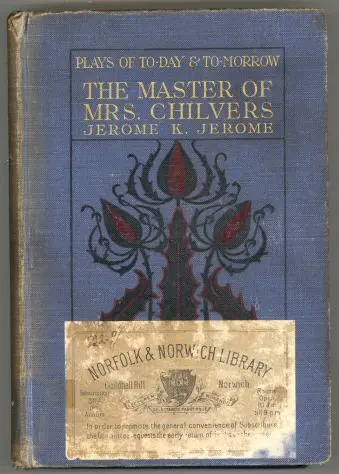
"The Master of Mrs. Chilvers: An Improbable Comedy" by Jerome K. Jerome is a stage play written during the early 20th century. The narrative centers on the themes of women's rights, political ambition, and the complexities of marriage, highlighted through the characters of Annys Chilvers, a woman advocating for women's suffrage, and her husband, Geoffrey Chilvers, a Member of Parliament who finds himself embroiled in a political contest against his own wife. With comedy woven into the serious societal discussions of the era, the play explores the dynamics between genders in a rapidly evolving socio-political landscape. The beginning of "The Master of Mrs. Chilvers" introduces us to a gathering in a drawing-room that serves as the setting for a meeting of the Women’s Parliamentary Franchise League. Key characters, including Annys Chilvers and her mother, Lady Mogton, engage in a passionate discussion about women's suffrage and the upcoming election. As they strategize on presenting a female candidate, the tension builds around the implications of Annys running against her husband Geoffrey in an election now made possible by a recent legal decision about women candidates. The opening establishes a comedic yet serious exploration of gender roles, with strong dialogues reflecting the struggles and aspirations of the women's movement of the time.
Introduction adapted from the source catalogue; source summaries may be automatically generated.
Free to read · English · 21,852 words · No account needed
MAKE TIME FOR A GOOD BOOK
On by default. Untick to stop anonymous reading totals. Each page counts after 10 seconds in view. How this works.
Anonymous counting is on unless you have switched it off.
MRS. CHINN. (Quite indifferent to the moral aspect of the case.) If you would be so kind, sir.
GEOFFREY. Umph! I suppose you know what you’re doing; appealing through your womanhood to man’s weakness—employing “backstairs influence” to gain your private ends, indifferent to the higher issues of the public weal? All the things that are going to cease when woman has the vote.
MRS. CHINN. You see, sir, he’s the youngest.
(Gradually the decent but dingy figure of MRS. CHINN has taken to itself new shape. To GEOFFREY, it almost seems as though there were growing out of the shadows over against him the figure of great Artemis herself—Artemis of the Thousand Breasts. He had returned home angry, bitter against all women. As she unfolds her simple tale understanding comes to him. So long as there are “Mrs. Chinns” in the world, Woman claims homage.)
GEOFFREY. How many were there?
MRS. CHINN. Ten altogether, six living.
GEOFFREY. Been a bit of a struggle for you, hasn’t it?
MRS. CHINN. It has been a bit difficult, at times; especially after
their poor father died.
GEOFFREY. How many were you left with?
MRS. CHINN. Eight, sir.
GEOFFREY. How on earth did you manage to keep them?
MRS. CHINN. Well, you see, sir, the two eldest, they were earning a little. I don’t think I could have done it without that.
GEOFFREY. Wasn’t there any source from which you could have obtained help? What was your husband?
MRS. CHINN. He worked in the shipyards, sir. There was some talk about it. But, of course, that always means taking the children away from you.
GEOFFREY. Would not that have been better for them?
MRS. CHINN. Not always, sir. Of course, if I hadn’t been able to do my duty by them I should have had to. But, thank God, I’ve always been strong.
GEOFFREY. (He rises.) I will see what can be done.
MRS. CHINN. Thank you, sir.
GEOFFREY. (Half-way, he turns.) When does the next boat sail—for
Canada?
MRS. CHINN. To-morrow night, sir, from Glasgow. I have booked his
passage.
GEOFFREY. (With a smile.) You seem to have taken everything for
granted.
MRS. CHINN. You see, sir, it’s the disgrace. All the others are doing so well. It would upset them so.
(He goes out.)
(There is a moment.)
(ANNYS enters. She is wearing her outdoor things.)
ANNYS. Mrs. Chinn!
MRS. CHINN. (She has risen; she curtseys.) Good evening, ma’am.
ANNYS. (She is taking off her hat.) Nothing wrong, is there?
MRS. CHINN. My boy, ma’am, my youngest, has been getting into trouble.
Your reading position is saved on this browser. Take it to another device with a library code. Reading pages adapt to text, rather than matching a printed edition.
Jerome K. (Jerome Klapka) Jerome
Jerome K. (Jerome Klapka) Jerome
Jerome K. (Jerome Klapka) Jerome
Jerome K. (Jerome Klapka) Jerome
BEHIND THE BOOK
This eBook is for the use of anyone anywhere in the United States and most other parts of the world at no cost and with almost no restrictions whatsoever. You may copy it, give it away or re-use it under the terms of the Project Gutenberg License included with this eBook or online at www.gutenberg.org. If you are not located in the United States, you will have to check the laws of the country where you are located before using this eBook. Read the source licence.
The original source file, including credits and licence, is retained by this library. Request an original-format copy at no charge. Please include the book title and Project Gutenberg identifier #2195.
KEEP YOUR CURIOSITY GOING
Maurice Baring
W. B. (William Butler) Yeats
Edward Martyn

John Brougham & Charlotte Brontë
Marguerite Merington
Leonid Andreyev