Anthony John
Jerome K. (Jerome Klapka) Jerome
THE CLASSIC COLLECTION · 1911
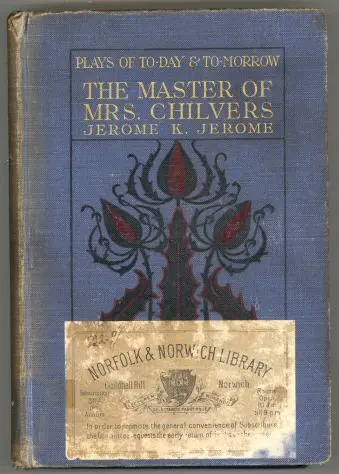
"The Master of Mrs. Chilvers: An Improbable Comedy" by Jerome K. Jerome is a stage play written during the early 20th century. The narrative centers on the themes of women's rights, political ambition, and the complexities of marriage, highlighted through the characters of Annys Chilvers, a woman advocating for women's suffrage, and her husband, Geoffrey Chilvers, a Member of Parliament who finds himself embroiled in a political contest against his own wife. With comedy woven into the serious societal discussions of the era, the play explores the dynamics between genders in a rapidly evolving socio-political landscape. The beginning of "The Master of Mrs. Chilvers" introduces us to a gathering in a drawing-room that serves as the setting for a meeting of the Women’s Parliamentary Franchise League. Key characters, including Annys Chilvers and her mother, Lady Mogton, engage in a passionate discussion about women's suffrage and the upcoming election. As they strategize on presenting a female candidate, the tension builds around the implications of Annys running against her husband Geoffrey in an election now made possible by a recent legal decision about women candidates. The opening establishes a comedic yet serious exploration of gender roles, with strong dialogues reflecting the struggles and aspirations of the women's movement of the time.
Introduction adapted from the source catalogue; source summaries may be automatically generated.
Free to read · English · 21,852 words · No account needed
MAKE TIME FOR A GOOD BOOK
On by default. Untick to stop anonymous reading totals. Each page counts after 10 seconds in view. How this works.
Anonymous counting is on unless you have switched it off.
ELIZABETH. (She lays her hand upon her.) It isn’t a few more mothers that the world has need of. It is the women whom God has appointed—to whom He has given freedom, that they may champion the cause of the mothers, helpless by reason of their motherhood.
(A moment. GEOFFREY enters.)
GEOFFREY. Good evening.
ANNYS. (Rises; a smile struggles for possession. But he only shakes hands, and it dies away.)
ELIZABETH. Good evening.
(They shake hands.)
GEOFFREY. You are not interested in the counting?
ANNYS. The room is rather crowded. Mamma thought I would be better out here. How have you been?
GEOFFREY. Oh, all right. It’s going to be a very near thing, they tell
me.
ANNYS. Yes, I shall be glad when it’s over.
GEOFFREY. It’s always a trying time. What are you going to do, if you
win?
(LADY MOGTON looks in.)
LADY MOGTON. (Seeing GEOFFREY.) Oh, good evening.
GEOFFREY. Good evening.
LADY MOGTON. Chilvers, 2,960—Annys Chilvers, 2,874.
(She disappears—closes door.)
ANNYS. Perhaps I’m not going to win. (She goes to him, smiling.) I hope you’ll win. I would so much rather you won.
GEOFFREY. Very kind of you. I’m afraid that won’t make it a certainty.
ANNYS. (His answer has hardened her again.) How can I? It would not be fair. Without your consent I should never have entered upon it. It was understood that the seat, in any case, would be yours.
GEOFFREY. I would rather you considered yourself quite free. In warfare it doesn’t pay to be “fair” to one’s enemy.
ANNYS. (Still hardening.) Besides, there is no need. There will be other opportunities. I can contest some other constituency. If I win, claim the seat for that.
(A moment.)
GEOFFREY. So this is only the beginning? You have decided to devote yourself to a political career?
ANNYS. Why not?
GEOFFREY. If I were to ask you to abandon it, to come back to your place at my side—helping me, strengthening me?
ANNYS. You mean you would have me abandon my own task—merge myself in
you?
GEOFFREY. Be my wife.
ANNYS. It would not be right. I, too, have my work.
GEOFFREY. If it takes you away from me?
ANNYS. Why need it take me away from you? Why cannot we work together for common ends, each in our own way?
GEOFFREY. We talked like that before we tried it. Marriage is not a partnership; it is a leadership.
ANNYS. (She looks at him.) You mean—an ownership.
GEOFFREY. Perhaps you’re right. I didn’t make it. I’m only—beginning to understand it.
Your reading position is saved on this browser. Take it to another device with a library code. Reading pages adapt to text, rather than matching a printed edition.
Jerome K. (Jerome Klapka) Jerome
Jerome K. (Jerome Klapka) Jerome
Jerome K. (Jerome Klapka) Jerome
Jerome K. (Jerome Klapka) Jerome
BEHIND THE BOOK
This eBook is for the use of anyone anywhere in the United States and most other parts of the world at no cost and with almost no restrictions whatsoever. You may copy it, give it away or re-use it under the terms of the Project Gutenberg License included with this eBook or online at www.gutenberg.org. If you are not located in the United States, you will have to check the laws of the country where you are located before using this eBook. Read the source licence.
The original source file, including credits and licence, is retained by this library. Request an original-format copy at no charge. Please include the book title and Project Gutenberg identifier #2195.
KEEP YOUR CURIOSITY GOING
Maurice Baring
W. B. (William Butler) Yeats
Edward Martyn

John Brougham & Charlotte Brontë
Marguerite Merington
Leonid Andreyev