Anthony John
Jerome K. (Jerome Klapka) Jerome
THE CLASSIC COLLECTION · 1911
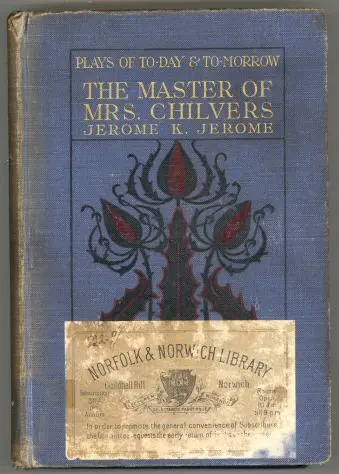
"The Master of Mrs. Chilvers: An Improbable Comedy" by Jerome K. Jerome is a stage play written during the early 20th century. The narrative centers on the themes of women's rights, political ambition, and the complexities of marriage, highlighted through the characters of Annys Chilvers, a woman advocating for women's suffrage, and her husband, Geoffrey Chilvers, a Member of Parliament who finds himself embroiled in a political contest against his own wife. With comedy woven into the serious societal discussions of the era, the play explores the dynamics between genders in a rapidly evolving socio-political landscape. The beginning of "The Master of Mrs. Chilvers" introduces us to a gathering in a drawing-room that serves as the setting for a meeting of the Women’s Parliamentary Franchise League. Key characters, including Annys Chilvers and her mother, Lady Mogton, engage in a passionate discussion about women's suffrage and the upcoming election. As they strategize on presenting a female candidate, the tension builds around the implications of Annys running against her husband Geoffrey in an election now made possible by a recent legal decision about women candidates. The opening establishes a comedic yet serious exploration of gender roles, with strong dialogues reflecting the struggles and aspirations of the women's movement of the time.
Introduction adapted from the source catalogue; source summaries may be automatically generated.
Free to read · English · 21,852 words · No account needed
MAKE TIME FOR A GOOD BOOK
On by default. Untick to stop anonymous reading totals. Each page counts after 10 seconds in view. How this works.
Anonymous counting is on unless you have switched it off.
(It was the moment that was bound to come. The man’s instincts, training, have involuntarily asserted themselves. Shall the woman yield? If so, then down goes the whole movement—her claim to freedom of judgment, of action, in all things. All watch the struggle with breathless interest.)
ANNYS. (She speaks very slowly, very quietly, but with a new note in her voice.) I am sorry, but I have given much thought to this matter, and—I do not agree with you.
MRS. PEEKIN. You will help us?
ANNYS. I will do what I can.
PEEKIN. (He takes from his pocket a folded paper.) It is always so much more satisfactory when these things are in writing. Candidates, with the best intentions in the world, are apt to forget. (He has spread the paper on a corner of the table. He has in his hand his fountain-pen.)
ANNYS. (With a smile.) I am not likely to forget, but if you wish it—(She approaches the table.)
GEOFFREY. (He interposes. His voice is very low, almost a whisper.) My wife will not sign.
ANNYS. (She also speaks low, but there is no yielding in her voice.) I am not only your wife. I have a duty also to others.
GEOFFREY. It is for you to choose. (He leaves the way open to her.)
(The silence can almost be felt. She moves to the table, takes up the paper. It contains but a few lines of writing. Having read it, she holds out her hand for the pen. PEEKIN puts it in her hand. With a firm hand she signs, folds the paper, and returns it to him. She remains standing by the table. With the removal of the tension there comes a rustle, a breaking of the silence.)
MISS RICKETTS. (She seizes ANNYS’S hand, hanging listlessly by her side, and, stooping, kisses it.)
MISS BORLASSE. That is all, isn’t it?
PEEKIN. We thank you, Mrs. Chilvers. Good afternoon.
ANNYS. (The natural reaction is asserting itself. She pulls herself together sufficiently to murmur her answer.) Good afternoon.
MRS. PEEKIN. (The DEPUTATION is moving away; she takes from her waist a small bunch of flowers, and, turning, places them in ANNYS’S hand.)
ANNYS. (She smiles, remains standing silent, the flowers in her
hand.)
(“Good afternoons” are exchanged with some of the others.
Finally:)
PEEKIN. Good afternoon, Mr. Chilvers.
GEOFFREY. (Who has moved away.) Good afternoon.
(The DEPUTATION joins SIGSBY by the door. He leads them out.)
ELIZABETH. (To PHOEBE.) Are you going my way?
PHOEBE. (She glances round at ANNYS.) Yes, I’ll come with you.
Your reading position is saved on this browser. Take it to another device with a library code. Reading pages adapt to text, rather than matching a printed edition.
Jerome K. (Jerome Klapka) Jerome
Jerome K. (Jerome Klapka) Jerome
Jerome K. (Jerome Klapka) Jerome
Jerome K. (Jerome Klapka) Jerome
BEHIND THE BOOK
This eBook is for the use of anyone anywhere in the United States and most other parts of the world at no cost and with almost no restrictions whatsoever. You may copy it, give it away or re-use it under the terms of the Project Gutenberg License included with this eBook or online at www.gutenberg.org. If you are not located in the United States, you will have to check the laws of the country where you are located before using this eBook. Read the source licence.
The original source file, including credits and licence, is retained by this library. Request an original-format copy at no charge. Please include the book title and Project Gutenberg identifier #2195.
KEEP YOUR CURIOSITY GOING
Maurice Baring
W. B. (William Butler) Yeats
Edward Martyn

John Brougham & Charlotte Brontë
Marguerite Merington
Leonid Andreyev