Anthony John
Jerome K. (Jerome Klapka) Jerome
THE CLASSIC COLLECTION · 1911
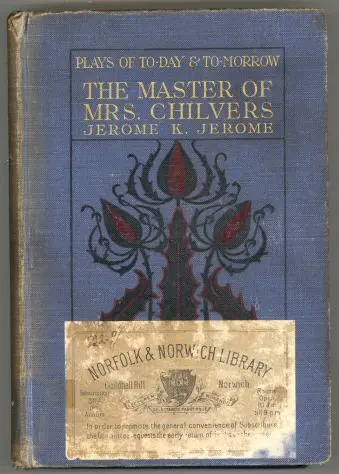
"The Master of Mrs. Chilvers: An Improbable Comedy" by Jerome K. Jerome is a stage play written during the early 20th century. The narrative centers on the themes of women's rights, political ambition, and the complexities of marriage, highlighted through the characters of Annys Chilvers, a woman advocating for women's suffrage, and her husband, Geoffrey Chilvers, a Member of Parliament who finds himself embroiled in a political contest against his own wife. With comedy woven into the serious societal discussions of the era, the play explores the dynamics between genders in a rapidly evolving socio-political landscape. The beginning of "The Master of Mrs. Chilvers" introduces us to a gathering in a drawing-room that serves as the setting for a meeting of the Women’s Parliamentary Franchise League. Key characters, including Annys Chilvers and her mother, Lady Mogton, engage in a passionate discussion about women's suffrage and the upcoming election. As they strategize on presenting a female candidate, the tension builds around the implications of Annys running against her husband Geoffrey in an election now made possible by a recent legal decision about women candidates. The opening establishes a comedic yet serious exploration of gender roles, with strong dialogues reflecting the struggles and aspirations of the women's movement of the time.
Introduction adapted from the source catalogue; source summaries may be automatically generated.
Free to read · English · 21,852 words · No account needed
MAKE TIME FOR A GOOD BOOK
On by default. Untick to stop anonymous reading totals. Each page counts after 10 seconds in view. How this works.
Anonymous counting is on unless you have switched it off.
ANNYS. (The atmosphere has grown suddenly oppressive.) Oh, I—I think we might find some other reason than that. (She hands him back the letter.)
GEOFFREY. It’s the only one of any importance. It embraces all the others. Shall woman be mother—or politician? (He puts the letter in his pocket.)
ANNYS. Why cannot she be both?
GEOFFREY. (He is looking at her searchingly.) Because if she is the one, she doesn’t want to be the other.
(A silence.)
ANNYS. You are wrong. It is the mother instinct that makes us politicians. We want to take care of the world.
GEOFFREY. Exactly. You think man’s job more interesting than your own.
ANNYS. (After a moment.) Who told you that it was a man’s job?
GEOFFREY. Well. (He shrugs his shoulders.) We can’t do yours.
ANNYS. Can’t we help each other?
GEOFFREY. As, for instance, in this election! (He gives a short
laugh.)
ANNYS. Of course, this is an exceptional case.
GEOFFREY. It’s an epitome of the whole question. You are trying to take my job away from me. To the neglect of your own.
ANNYS. (After another moment’s silence.) Haven’t I always tried to do
my duty?
GEOFFREY. I have thought so.
ANNYS. Oh, my dear, we mustn’t quarrel. You will win this election. I want you to win it. Next time we must fight side by side again.
GEOFFREY. Don’t you see? Fighting you means fighting the whole movement. (He indicates the posters pinned to the walls.) That sort of thing.
ANNYS. (After a brief inspection.) Not that way. (Shaking her head.) It would break my heart for you to turn against us. Win because you are the better man. (Smiling.) I want you to be the better man.
GEOFFREY. I would rather be your husband.
ANNYS. (Smiling.) Isn’t that the same thing?
GEOFFREY. No. I want a wife.
ANNYS. What precisely do you mean by “wife”?
GEOFFREY. It’s an old-established word.
(MRS. CHINN has entered to complete the tea arrangements. She is
arranging the table.)
MRS. CHINN. There’s a deputation downstairs, sir, just come for you.
GEOFFREY. What are they?
MRS. CHINN. It’s one of those societies for the reform of something. They said you were expecting them.
SIGSBY. (Breaking away from the group by the window.) Quite right. (Looks at his watch.) Five o’clock, I’ll bring them up.
GEOFFREY. Happen to know what it is they want to reform?
SIGSBY. (By door.) Laws relating to the physical relationship between
the sexes, I think.
GEOFFREY. Oh, only that!
SIGSBY. Something of the sort.
Your reading position is saved on this browser. Take it to another device with a library code. Reading pages adapt to text, rather than matching a printed edition.
Jerome K. (Jerome Klapka) Jerome
Jerome K. (Jerome Klapka) Jerome
Jerome K. (Jerome Klapka) Jerome
Jerome K. (Jerome Klapka) Jerome
BEHIND THE BOOK
This eBook is for the use of anyone anywhere in the United States and most other parts of the world at no cost and with almost no restrictions whatsoever. You may copy it, give it away or re-use it under the terms of the Project Gutenberg License included with this eBook or online at www.gutenberg.org. If you are not located in the United States, you will have to check the laws of the country where you are located before using this eBook. Read the source licence.
The original source file, including credits and licence, is retained by this library. Request an original-format copy at no charge. Please include the book title and Project Gutenberg identifier #2195.
KEEP YOUR CURIOSITY GOING
Maurice Baring
W. B. (William Butler) Yeats
Edward Martyn

John Brougham & Charlotte Brontë
Marguerite Merington
Leonid Andreyev