Anthony John
Jerome K. (Jerome Klapka) Jerome
THE CLASSIC COLLECTION · 1911
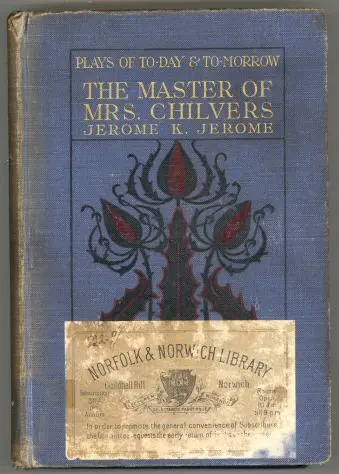
"The Master of Mrs. Chilvers: An Improbable Comedy" by Jerome K. Jerome is a stage play written during the early 20th century. The narrative centers on the themes of women's rights, political ambition, and the complexities of marriage, highlighted through the characters of Annys Chilvers, a woman advocating for women's suffrage, and her husband, Geoffrey Chilvers, a Member of Parliament who finds himself embroiled in a political contest against his own wife. With comedy woven into the serious societal discussions of the era, the play explores the dynamics between genders in a rapidly evolving socio-political landscape. The beginning of "The Master of Mrs. Chilvers" introduces us to a gathering in a drawing-room that serves as the setting for a meeting of the Women’s Parliamentary Franchise League. Key characters, including Annys Chilvers and her mother, Lady Mogton, engage in a passionate discussion about women's suffrage and the upcoming election. As they strategize on presenting a female candidate, the tension builds around the implications of Annys running against her husband Geoffrey in an election now made possible by a recent legal decision about women candidates. The opening establishes a comedic yet serious exploration of gender roles, with strong dialogues reflecting the struggles and aspirations of the women's movement of the time.
Introduction adapted from the source catalogue; source summaries may be automatically generated.
Free to read · English · 21,852 words · No account needed
MAKE TIME FOR A GOOD BOOK
On by default. Untick to stop anonymous reading totals. Each page counts after 10 seconds in view. How this works.
Anonymous counting is on unless you have switched it off.
ST. HERBERT. Would you care to look through McCaw v. Potts? (He has
the papers in his hand.)
GEOFFREY. I’ll ask you for it when I want it.
PHOEBE. (At door.) You’ll be alone this evening?
ANNYS. Yes. Come in to dinner.
PHOEBE. All right. Goodbye.
ST. HERBERT. Goodbye.
(GEOFFREY and ANNYS answer them. They go out, closing the door. GEOFFREY is by the fire. ANNYS comes to him.)
ANNYS. (She puts her arms round him.) You don’t mind?
GEOFFREY. (He holds her at arms’ length—looking into her eyes and smiling.) I believe you are looking forward to it.
ANNYS. Do you know how long we have been married? Eight years. And do you know, sir, that all that time we have never had a difference? Don’t you think it will be good for you?
GEOFFREY. Do you know why we have never had a difference? Because you have always had your own way.
ANNYS. Oh!
GEOFFREY. You have got so used to it, you don’t notice it.
ANNYS. Then it will be good for me. I must learn to suffer opposition.
(She laughs.)
GEOFFREY. You won’t like it.
ANNYS. Do you know, I’m not at all sure that I shan’t. (Unconsciously they let loose of one another.) You see, I shall have the right of hitting back. (Again she laughs.)
GEOFFREY. (Also laughingly.) Is woman going to develop the fighting
instinct?
ANNYS. I wonder.
(A moment’s silence.)
GEOFFREY. The difficulty in our case is there seems nothing to fight
about.
ANNYS. We must think of something. (Laughs.)
GEOFFREY. What line are you going to take—what is your argument: why they should vote for you in preference to me?
ANNYS. Simply that I am a woman.
GEOFFREY. My dear child, that won’t be enough. Why should they vote for you merely because you’re a woman?
ANNYS. (Slightly astonished.) Because—because women are wanted in
public life.
GEOFFREY. Who wants them?
ANNYS. (More astonished.) Who? Why—(it doesn’t seem too clear.) Why, all of us—you, yourself!
GEOFFREY. I’m not East Poplar.
ANNYS. (Is puzzled a moment, then valiantly.) I shall ask them to send me to Parliament to represent the interests of their women—and therefore of themselves—the interests of their children.
GEOFFREY. Children! What do you know about children?
(Another silence.)
ANNYS. Personally—no. We have had no children of our own, of course. But (hopefully) it is a woman’s instinct.
GEOFFREY. Oh, Lord! That’s what the lady said who had buried seven.
Your reading position is saved on this browser. Take it to another device with a library code. Reading pages adapt to text, rather than matching a printed edition.
Jerome K. (Jerome Klapka) Jerome
Jerome K. (Jerome Klapka) Jerome
Jerome K. (Jerome Klapka) Jerome
Jerome K. (Jerome Klapka) Jerome
BEHIND THE BOOK
This eBook is for the use of anyone anywhere in the United States and most other parts of the world at no cost and with almost no restrictions whatsoever. You may copy it, give it away or re-use it under the terms of the Project Gutenberg License included with this eBook or online at www.gutenberg.org. If you are not located in the United States, you will have to check the laws of the country where you are located before using this eBook. Read the source licence.
The original source file, including credits and licence, is retained by this library. Request an original-format copy at no charge. Please include the book title and Project Gutenberg identifier #2195.
KEEP YOUR CURIOSITY GOING
Maurice Baring
W. B. (William Butler) Yeats
Edward Martyn

John Brougham & Charlotte Brontë
Marguerite Merington
Leonid Andreyev