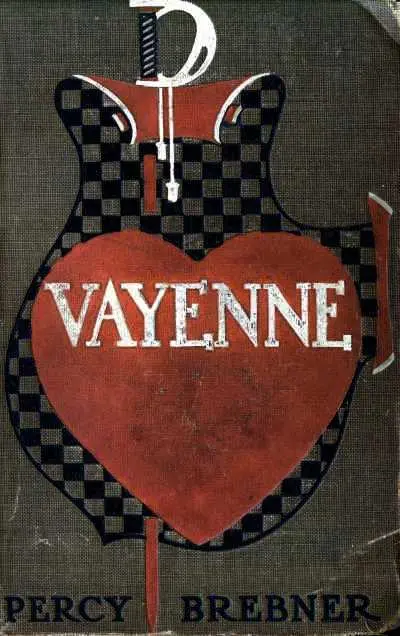
Vayenne
Percy James Brebner
THE CLASSIC COLLECTION · 1916
"The Master Detective: Being Some Further Investigations of Christopher Quarles" by Percy James Brebner is a detective novel written in the early 20th century. The story revolves around the astute and eccentric detective Christopher Quarles as he solves various intricate cases, starting with the mysterious disappearance of Sir Grenville Rusholm's body immediately after his supposed death. Quarles is accompanied by his friend and investigator Murray Wigan, who calls upon Quarles's expertise to unravel the enigma central to this startling crime. At the start of the book, we are introduced to a shocking scene where mourners gather for Sir Grenville Rusholm's funeral, only to discover that his coffin is inexplicably empty, save for two pieces of lead. This revelation prompts Wigan to seek out Quarles, who has vowed to retire from crime-solving. However, Quarles is ultimately drawn back into the fray, intrigued by the mystery. The opening chapters lay a complex groundwork for investigations involving themes of deception, social status, and familial ties. As they delve deeper, Quarles and Wigan consider various suspects, motives, and the implications behind the corpse's disappearance, setting the stage for a gripping whodunit that weaves through the murky waters of societal intrigue.
Introduction adapted from the source catalogue; source summaries may be automatically generated.
Free to read · English · 90,869 words · No account needed
MAKE TIME FOR A GOOD BOOK
On by default. Untick to stop anonymous reading totals. Each page counts after 10 seconds in view. How this works.
Anonymous counting is on unless you have switched it off.
"Very little," Watson replied. "He told us he had no relations, and he received very few letters, which seemed to be from agents and business people. I did not question him very closely when he applied to me. I judged that he was down on his luck, but he fitted my requirements, and my wife was favorably impressed with him."
"And you have no reason to regret taking him into your company?"
"On the contrary, he proved a great acquisition, a far better man than the one whose place he took."
"That is not quite what I meant," said Quarles. "Companies of entertainers vary, not only in ability, but in individual tastes, in personnel. By engaging Mr. Henley you were obliged to admit him into your private circle, and I imagine--"
"That is what I meant by saying my wife approved of him," said Watson. "I wouldn't engage the finest tenor in the world unless he were a decent fellow. It wouldn't be fair to the rest of us."
Quarles nodded his appreciation of such an attitude.
"Of course, as long as he behaves decently I am satisfied," Watson went on. "I don't make my enquiries too particular. For instance, I shouldn't bar a man because he had got into trouble."
"Have you any reason to suppose that Henley had done so?" Quarles asked. "That might account for his mysterious death."
"I have no such suspicion," Watson answered; "indeed, he was not that kind of man. It is my way--my clumsy way of explaining what I mean by decent. Many a decent man has seen the inside of a prison. By being there he pays his debt, and afterwards, in common justice, he should be free, really free, free from his fellow-man's contempt."
"You have started my husband on his pet hobby," laughed Mrs. Watson. "He always declares that our prisons hold some of the best men in the world."
"Some of the strongest and most potential," corrected her husband.
"I am inclined to agree with him," said Quarles.
"But I am taking up your time and not asking the one or two questions I came especially to ask. You dress for the performance in the tent, I suppose?"
"The men do. The ladies dress here and go down with cloaks over their
costumes."
Quarles undid a small brown paper parcel--I had wondered what he had brought with him--and produced the pierrot's hat.
"That is Henley's, I suppose?"
Watson looked at it.
"Undoubtedly. There is an 'H' in it, you see. We all put our initial in like that so that we should know our own."
"Now, can you suggest why Henley was wearing his dress?" asked Quarles.
Your reading position is saved on this browser. Take it to another device with a library code. Reading pages adapt to text, rather than matching a printed edition.
Percy James Brebner
Percy James Brebner
Percy James Brebner
Percy James Brebner
BEHIND THE BOOK
This eBook is for the use of anyone anywhere in the United States and most other parts of the world at no cost and with almost no restrictions whatsoever. You may copy it, give it away or re-use it under the terms of the Project Gutenberg License included with this eBook or online at www.gutenberg.org. If you are not located in the United States, you will have to check the laws of the country where you are located before using this eBook. Read the source licence.
The original source file, including credits and licence, is retained by this library. Request an original-format copy at no charge. Please include the book title and Project Gutenberg identifier #9796.
KEEP YOUR CURIOSITY GOING
Coulson Kernahan

Maurice Baring
Frances Wright
Cécile Tormay

Frederic Jesup Stimson

W. H. P. (William Henry Pope) Jarvis