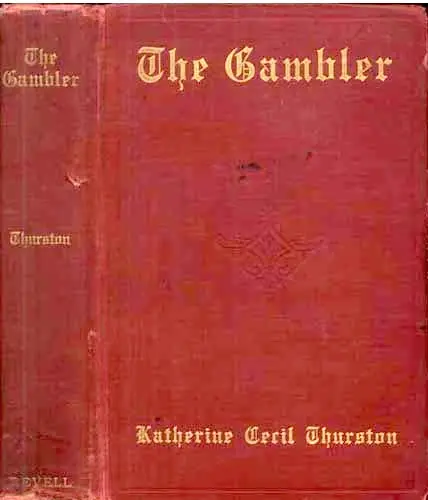
The Gambler: A Novel
Katherine Cecil Thurston
THE CLASSIC COLLECTION · 1904
"The Masquerader" by Katherine Cecil Thurston is a novel written during the early 20th century. The story centers around John Chilcote, a member of Parliament who grapples with the pressures of his political life and personal demons, particularly his addiction to morphia. The narrative begins in a fog-laden London, where Chilcote encounters a doppelganger named John Loder, setting off a chain of events that explores themes of identity, desperation, and the façade of social appearances. At the start of the novel, a significant fog disrupts London life, and it is on this night that Chilcote's struggle with his identity and addiction becomes pronounced. He navigates the dense fog both literally and metaphorically, illustrating his self-absorbed and tumultuous state. After an unsettling encounter with a mysterious stranger who shares his striking resemblance, Chilcote experiences a blend of fascination and distress. The conversation hints at greater themes of ambition and downfall, particularly surrounding a public figure named Lexington. As this initial scene unfolds, it becomes clear that the duality of the characters and their individual struggles will play a crucial role in the unfolding narrative. Chilcote's increasing unrest foreshadows his later desperate proposal to Loder, which will shape the course of the story.
Introduction adapted from the source catalogue; source summaries may be automatically generated.
Free to read · English · 83,467 words · No account needed
MAKE TIME FOR A GOOD BOOK
On by default. Untick to stop anonymous reading totals. Each page counts after 10 seconds in view. How this works.
Anonymous counting is on unless you have switched it off.
As he entered the house, the hall was empty. He swore irritably under his breath and pressed the nearest bell. Since his momentary exaltation in Fraide's presence, his spirits had steadily fallen, until now they hung at the lowest ebb.
As he waited in unconcealed impatience for an answer to his summons, he caught sight of his man Allsopp at the head of the stairs.
“Come here!” he called, pleased to find some one upon whom to vent his irritation. “Has that wire come for me?”
“No, sir. I inquired five minutes back.”
“Inquire again.”
“Yes, sir.” Allsopp disappeared.
A second after his disappearance the bell of the hall door whizzed
loudly.
Chileote started. All sudden sounds, like all strong lights, affected him. He half moved to the door, then stopped himself with a short exclamation. At the same instant Allsopp reappeared.
Chilcote turned on him excitedly.
“What the devil's the meaning of this?” he said. “A battery of servants in the house and nobody to open the hall door!”
Allsopp looked embarrassed. “Crapham is coming directly, sir. He only left the hall to ask Jeffries--”
Chilcote turned. “Confound Crapham!” he exclaimed. “Go and open the door
yourself.”
Allsopp hesitated, his dignity struggling with his obedience. As he waited, the bell sounded again.
“Did you hear me?” Chilcote said.
“Yes, sir.” Allsopp crossed the hall.
As the door was opened Chilcote passed his handkerchief from one hand to the other in the tension of hope and fear; then, as the sound of his own name in the shrill tones of a telegraph-boy reached his ears, he let the handkerchief drop to the ground.
Allsopp took the yellow envelope and carried it to his master.
“A telegram, sir,” he said. “And the boy wishes to know if there is an answer.” Picking up Chilcote's handkerchief, he turned aside with elaborate dignity.
Chilcote's hands were so unsteady that he could scarcely insert his finger under the flap of the envelope. Tearing off a corner, he wrenched the covering apart and smoothed out the flimsy pink paper.
The message was very simple, consisting of but seven words:
“Shall expect you at eleven to-night.-LODER.”
He read it two or three times, then he looked up. “No answer,” he said, mechanically; and to his own ears the relief in his voice sounded harsh and unnatural.
Exactly as the clocks chimed eleven Chilcote mounted the stairs to Loder's rooms. But this time there was more of haste than of uncertainty in his steps, and, reaching the landing, he crossed it in a couple of strides and knocked feverishly on the door.
It opened at once, and Loder stood before him.
Your reading position is saved on this browser. Take it to another device with a library code. Reading pages adapt to text, rather than matching a printed edition.
Katherine Cecil Thurston
Katherine Cecil Thurston
BEHIND THE BOOK
This eBook is for the use of anyone anywhere in the United States and most other parts of the world at no cost and with almost no restrictions whatsoever. You may copy it, give it away or re-use it under the terms of the Project Gutenberg License included with this eBook or online at www.gutenberg.org. If you are not located in the United States, you will have to check the laws of the country where you are located before using this eBook. Read the source licence.
The original source file, including credits and licence, is retained by this library. Request an original-format copy at no charge. Please include the book title and Project Gutenberg identifier #5422.
KEEP YOUR CURIOSITY GOING
Coulson Kernahan

Maurice Baring
Frances Wright
Cécile Tormay

Frederic Jesup Stimson

W. H. P. (William Henry Pope) Jarvis