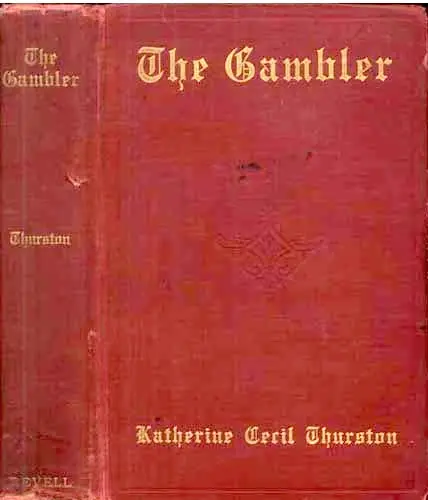
The Gambler: A Novel
Katherine Cecil Thurston
THE CLASSIC COLLECTION · 1904
"The Masquerader" by Katherine Cecil Thurston is a novel written during the early 20th century. The story centers around John Chilcote, a member of Parliament who grapples with the pressures of his political life and personal demons, particularly his addiction to morphia. The narrative begins in a fog-laden London, where Chilcote encounters a doppelganger named John Loder, setting off a chain of events that explores themes of identity, desperation, and the façade of social appearances. At the start of the novel, a significant fog disrupts London life, and it is on this night that Chilcote's struggle with his identity and addiction becomes pronounced. He navigates the dense fog both literally and metaphorically, illustrating his self-absorbed and tumultuous state. After an unsettling encounter with a mysterious stranger who shares his striking resemblance, Chilcote experiences a blend of fascination and distress. The conversation hints at greater themes of ambition and downfall, particularly surrounding a public figure named Lexington. As this initial scene unfolds, it becomes clear that the duality of the characters and their individual struggles will play a crucial role in the unfolding narrative. Chilcote's increasing unrest foreshadows his later desperate proposal to Loder, which will shape the course of the story.
Introduction adapted from the source catalogue; source summaries may be automatically generated.
Free to read · English · 83,467 words · No account needed
MAKE TIME FOR A GOOD BOOK
On by default. Untick to stop anonymous reading totals. Each page counts after 10 seconds in view. How this works.
Anonymous counting is on unless you have switched it off.
If Lillian felt any disappointment, she showed none. “Poor old thing!” she said, softly. “Try to sit here by me and we won't bother about anything.” She made a place for him beside her, and as he dropped into it she took his hand and patted it sympathetically.
The touch was soothing, and he bore it patiently enough. After a moment she lifted the hand with a little exclamation of reproof.
“You degenerate person! You have ceased to manicure. What has become of my excellent training?”
Chilcote laughed. “Run to seed,” he said, lightly. Then his expression and tone changed. “When a man gets to my age,” he added, “little social luxuries don't seem worth while; the social necessities are irksome enough. Personally, I envy the beggar in the street--exempt from shaving, exempt from washing--”
Lillian raised her delicate eyebrows. The sentiment was beyond her
perception.
“But manicuring,” she said, reproachfully, “when you have such nice hands. It was your hands and your eyes, you know, that first appealed to me.” She sighed gently, with a touch of sentimental remembrance. “And I thought it so strong of you not to wear rings--it must be such a temptation.” She looked down at her own fingers, glittering with jewels.
But the momentary pleasure of her touch was gone. Chilcote drew away his hand and picked up the book that lay between them.
“Other Men's Shoes!” he read. “A novel, of course?”
She smiled. “Of course. Such a fantastic story. Two men changing
identities.”
Chilcote rose and walked back to the mantel-piece.
“Changing identities?” he said, with a touch of interest.
“Yes. One man is an artist, the other a millionaire; one wants to know what fame is like, the other wants to know how it feels to be really sinfully rich. So they exchange experiences for a month.” She laughed.
Chilcote laughed as well. “But how?” he asked.
“Oh, I told you the idea was absurd. Fancy two people so much alike that neither their friends nor their servants see any difference! Such a thing couldn't be, could it?”
Chilcote looked down at the fire. “No,” he said, doubtfully. “No. I
suppose not.”
“Of course not. There are likenesses, but not freak likenesses like
that.”
Chilcote's head was bent as she spoke, but at the last words he lifted
it.
“By Jove! I don't know about that!” he said. “Not so very long ago I saw two men so much alike that I--I--” He stopped.
Lillian smiled.
He colored quickly. “You doubt me?” he asked.
“My dear Jack!” Her voice was delicately reproachful.
“Then you think that my--my imagination has been playing me tricks?”
Your reading position is saved on this browser. Take it to another device with a library code. Reading pages adapt to text, rather than matching a printed edition.
Katherine Cecil Thurston
Katherine Cecil Thurston
BEHIND THE BOOK
This eBook is for the use of anyone anywhere in the United States and most other parts of the world at no cost and with almost no restrictions whatsoever. You may copy it, give it away or re-use it under the terms of the Project Gutenberg License included with this eBook or online at www.gutenberg.org. If you are not located in the United States, you will have to check the laws of the country where you are located before using this eBook. Read the source licence.
The original source file, including credits and licence, is retained by this library. Request an original-format copy at no charge. Please include the book title and Project Gutenberg identifier #5422.
KEEP YOUR CURIOSITY GOING
Coulson Kernahan

Maurice Baring
Frances Wright
Cécile Tormay

Frederic Jesup Stimson

W. H. P. (William Henry Pope) Jarvis