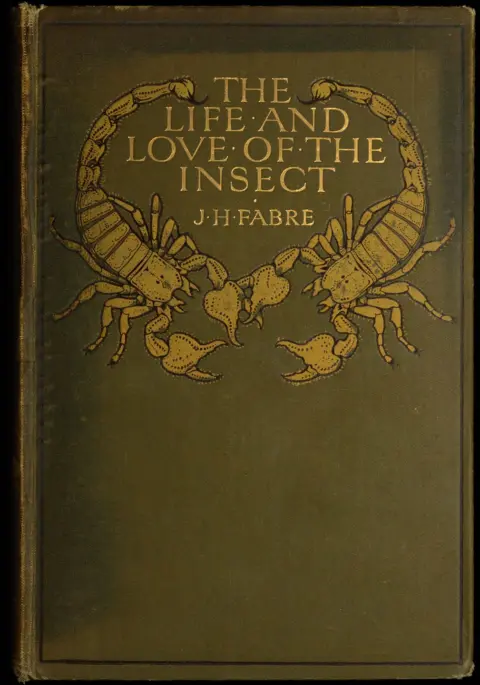
The Life and Love of the Insect
Jean-Henri Fabre
THE CLASSIC COLLECTION · 1914
"The Mason-Bees" by Jean-Henri Fabre is a scientific publication written during the late 19th century. The book explores the lives and behaviors of Mason-bees, focusing on their nesting habits and instinctive behaviors while also delving into experiments conducted by the author to better understand these insects and their psychology. At the start of the work, Fabre introduces his personal experience with the Mason-bee while teaching in a small primary school, describing the classroom's dismal conditions and the boys’ mischievous antics. He recounts how his fascination with the Mason-bees grew as he observed their impressive architectural skills utilizing pebbles and clay, leading him to conduct in-depth studies and experiments on their habits and instincts. In this opening section, he sets the stage for a greater exploration into the lives of these bees, emphasizing his desire to learn about their building techniques and behavior after they caught his attention during a survey class in the fields.
Introduction adapted from the source catalogue; source summaries may be automatically generated.
Free to read · English · 63,533 words · No account needed
MAKE TIME FOR A GOOD BOOK
On by default. Untick to stop anonymous reading totals. Each page counts after 10 seconds in view. How this works.
Anonymous counting is on unless you have switched it off.
The Leucopsis' egg is not even laid upon the Mason-bee's larva; it is hung by its bent pedicle to the fibrous wall of the cocoon. When I go to work very delicately, so as not to disturb the arrangement in knocking the nest off its support, and then extract and open the cocoon, I see the egg swinging from the silken vault. But it takes very little to make it fall. And so, most often, even though it be merely the effect of the shock sustained when the nest is removed from its pebble, I find the egg detached from its suspension-point and lying beside the larva, to which it never adheres in any circumstances. The Leucopsis' probe does not penetrate beyond the cocoon traversed; and the egg remains fastened to the ceiling, in the crook of some silky thread, by means of its hooked pedicle.
Amazon Ant (see Red Ant).
Ammophila.
Ammophila hirsuta (see Hairy Ammophila).
Ant (see also Black Ant, Red Ant).
Anthidium (see also Cotton-bee, Diadem Anthidium).
Anthophora (see also Hairy-footed Anthophora).
Anthrax (see also Anthrax sinuata).
Anthrax sinuata.
Anthrenus.
Ape.
Aphis.
Baboon.
Bastien.
Bee.
Bembex (see also Bembex rostrata).
Bembex rostrata.
Black Ant.
Blanchard, Emile.
Blue Osmia.
Bombylius.
Bumble-bee.
Butterfly.
Cabbage-caterpillar.
Cagliostro.
Carrier-pigeon.
Castelnau de la Porte, Francis Comte de.
Cat.
Caterpillar (see also Cabbage-caterpillar, Grey Worm, Processionary Caterpillar, Spurge-caterpillar).
Cerceris (see also Great Cerceris).
Cerceris tuberculata (see Great Cerceris).
Cetonia.
Chalcis.
Chalicodoma (see Mason-bee).
Chalicodoma muraria (see Mason-bee of the Walls).
Chalicodoma pyrenaica, C. pyrrhopeza, C. rufitarsis, C. sicula (see
Mason-bee of the Sheds).
Chalicodoma rufescens (see Mason-bee of the Shrubs).
Chat.
Chrysis (see also Parnopes carnea, Stilbum calens).
Clerus.
Coelyoxis.
Common Lizard.
Common Wasp.
Cornelius Nepos.
Cotton-bee.
Cricket.
Crioceris.
Crocisa.
Darwin, Charles Robert.
Darwin, Erasmus.
Diadem Anthidium.
Dioxys.
Dioxys cincta (see Dioxys).
Dog.
Dufour, Jean Marie Leon.
Duhamel du Monceau, Henri Louis.
Duruy, Jean Victor.
Euclid.
Eumenes Amadei.
Eyed Lizard.
Fabre, Mlle. Aglae, the author's daughter.
Fabre, Mlle. Antonia, the author's daughter.
Fabre, Mlle. Claire, the author's daughter.
Fabre, Mlle. Lucie, the author's granddaughter.
Favier, the author's factotum.
Fly.
Franklin, Benjamin.
Gad-fly.
Gnat.
Golden Wasp (see Chrysis).
Gold-fish.
Grasshopper (see Green Grasshopper).
Great Cerceris.
Green Grasshopper.
Grey Lizard.
Grey Worm.
Hairy Ammophila.
Hairy-footed Anthophora.
Halictus.
Hive-bee.
Huber, Francois.
Ichneumon-fly.
Lacordaire, Jean Theodore.
Lamb.
Lark.
Latreille's Osmia.
Leaf-cutter (see Megachile).
Leucopsis.
Leucopsis dorsigera.
Leucopsis gigas (see Leucopsis).
Le Vaillant, Francois.
Lion.
Lizard (see Common Lizard, Eyed Lizard, Grey Lizard).
Locust.
Loriol, Dr.
Loriol, Mme.
Lucas, Pierre Hippolyte.
Macmillan and Co., Ltd.
"Mademoiselle Mori", author of.
Mantis (see Praying Mantis).
Martin.
Mason-bee (see also the varieties below).
Mason-bee of the Pebbles (see Mason-bee of the Walls).
Mason-bee of the Sheds.
Mason-bee of the Shrubs.
Your reading position is saved on this browser. Take it to another device with a library code. Reading pages adapt to text, rather than matching a printed edition.
Jean-Henri Fabre
Jean-Henri Fabre
Jean-Henri Fabre
Jean-Henri Fabre
BEHIND THE BOOK
This eBook is for the use of anyone anywhere in the United States and most other parts of the world at no cost and with almost no restrictions whatsoever. You may copy it, give it away or re-use it under the terms of the Project Gutenberg License included with this eBook or online at www.gutenberg.org. If you are not located in the United States, you will have to check the laws of the country where you are located before using this eBook. Read the source licence.
The original source file, including credits and licence, is retained by this library. Request an original-format copy at no charge. Please include the book title and Project Gutenberg identifier #2884.
KEEP YOUR CURIOSITY GOING

John Muir

Asa Gray
Asa Gray

Florence Nightingale
Elizabeth Robins Pennell
Denison Olmsted