
A Son of Ishmael: A Novel
L. T. Meade
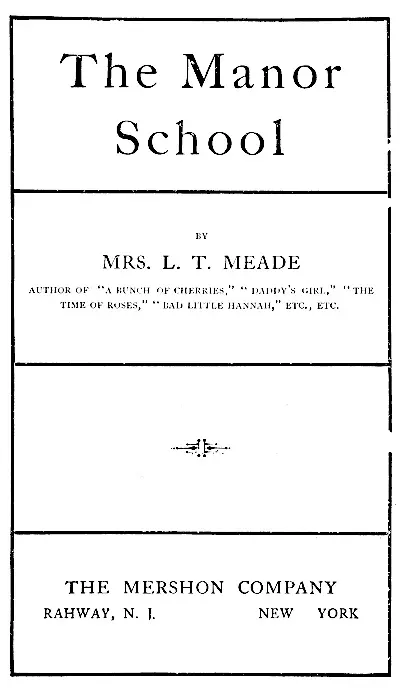
THE CLASSIC COLLECTION · 1903
"The Manor School" by L. T. Meade is a novel written in the early 20th century. The story revolves around a thirteen-year-old girl named Christian Mitford, who feels trapped by her parents' decision to send her away to a strict-school following their impending move to Persia. As she grapples with the news, the narrative explores her imaginative spirit, deep yearning for adventure, and plans to escape her predetermined path alongside her friend, Rose. At the start of the story, readers are introduced to Christian, an imaginative and somewhat rebellious girl. She spends much of her time in the attics of her large home, conjuring up adventurous scenarios with her dolls and fairy tales. However, her life takes a sudden turn when she overhears her mother's plans to send her to a severe school, which she envisions as a prison. In response to this perceived threat to her freedom, Christian begins to plot a daring escape with Rose, laying the groundwork for what promises to be an adventurous journey filled with challenges and an exploration of her identity. This opening sets the stage for a larger narrative about childhood innocence, the desire for autonomy, and the clash between familial expectations and personal dreams.
Introduction adapted from the source catalogue; source summaries may be automatically generated.
Free to read · English · 97,048 words · No account needed
MAKE TIME FOR A GOOD BOOK
On by default. Untick to stop anonymous reading totals. Each page counts after 10 seconds in view. How this works.
Anonymous counting is on unless you have switched it off.
When Star came in she saw Mr. Dixie having his fiery whiskers violently pulled by the firm, somewhat dirty hands of the small girls.
"Oh, I say! let me alone and behave yourselves," he said, dropping them
to the ground.
They both set up shrieks of indignation, and Star was motioned to a
chair at the table.
"Here, Robert," said Mrs. Dixie; "this is one of Miss Peacock's young ladies. Rufus, do clear a place; brush away those crumbs, and then go out to Maria and tell her to bring in fresh tea."
"She's out, mother," said Rufus, not attempting to stir and not
removing the crumbs.
"Oh, dear, I'm so sorry!" said Mrs. Dixie. "We look upon it as such an honor having you here, miss. We think an immensity of any of the Manor young ladies."
"Miss Peacock is one of the finest, proudest, grandest women I have ever met," said Mr. Dixie. "Have a seat, miss. Here, Rufus; go out and bring in some more tea."
"I say Maria is out," said Rufus. "Who's to make the tea?"
"Make it yourself, and be quick about it."
Rufus caught up the family teapot and disappeared from the room,
banging the door after him.
"How is it, dear," said Mr. Dixie, turning to his spouse, "that we always have ditch-water instead of tea on Sunday evenings?"
"Don't blame me, Robert," said the good lady. "It isn't to be wondered at. When eight spoilt children each want the strongest and the best, what can be left for a stranger? Florence, you might have told us that you were going to honor us with Miss Lestrange's company."
Poor Star! she had been trying to do her best, but it seemed to her that she was getting deeper and deeper into hot water each moment. What madness had seized her when she had hinted to Florence Dixie that she would like to go home with her? Already she had broken a rule of the school--a rule just expressed when they were all in trouble, and Miss Peacock was specially to be cared for and loved and honored. Oh, if she might only go home again!
After a great deal of squabbling and difficulty, and a great many words passing between one Dixie and another, a cup of tea which had been made in the kitchen was brought in and placed before Star. Scalding hot as it was, she drank it off, and then rose hastily to say good-by.
"I am very much obliged to you," she said to Mrs. Dixie.
Mr. Dixie accompanied her to the door; and Florence, feeling intensely important, went with her into the street.
Your reading position is saved on this browser. Take it to another device with a library code. Reading pages adapt to text, rather than matching a printed edition.
BEHIND THE BOOK
This eBook is for the use of anyone anywhere in the United States and most other parts of the world at no cost and with almost no restrictions whatsoever. You may copy it, give it away or re-use it under the terms of the Project Gutenberg License included with this eBook or online at www.gutenberg.org. If you are not located in the United States, you will have to check the laws of the country where you are located before using this eBook. Read the source licence.
The original source file, including credits and licence, is retained by this library. Request an original-format copy at no charge. Please include the book title and Project Gutenberg identifier #61878.
KEEP YOUR CURIOSITY GOING
Coulson Kernahan

Maurice Baring
Frances Wright
Cécile Tormay

Frederic Jesup Stimson

W. H. P. (William Henry Pope) Jarvis


