The gospel of freedom
Robert Herrick
THE CLASSIC COLLECTION · 1897
"The Man Who Wins" by Robert Herrick is a novel written in the late 19th century. The story revolves around the Ellwell family and their complex relationships, tracing their decline from respectable New England lineage to a life plagued by scandal and addiction. The reader is introduced to various family members, particularly John Ellwell, whose reckless choices lead to the family's downfall, contrasted with his sister Leonora, who navigates the challenges posed by their diminished status in society. At the start of the novel, the reader gets a vivid description of the Ellwell family history and their estate known as the Four Corners in Middleton. The narrative explores the generational shifts within the family, particularly focusing on John Ellwell's morally questionable lifestyle and his father's attempts to maintain the family’s reputation. Through scenes of camaraderie among college students and descriptions of familial dynamics, the opening sets the stage for a deeper exploration of themes such as social status, moral decay, and the consequences of familial legacy. The introduction of young characters like Roper Thornton suggests a potential intertwining of lives that may challenge the family’s troubled legacy.
Introduction adapted from the source catalogue; source summaries may be automatically generated.
Free to read · English · 18,056 words · No account needed
MAKE TIME FOR A GOOD BOOK
On by default. Untick to stop anonymous reading totals. Each page counts after 10 seconds in view. How this works.
Anonymous counting is on unless you have switched it off.
"It tired you too, did it? Somehow I never felt so weary from it as I
do to-night."
"Is it always just so?" he asked, bluntly.
"Why, of course; why not? There are different people. But dinner is always the chief affair of the day in our house; you see the men are free then and their cares are over. My father is very particular about dinner, but it is tiresome sometimes."
Talk dropped. This line was dangerous.
"Tell me," she said again in curious inquiry; "you are not one of
Roper's set?"
"No, he is some years my junior."
"But that does not make any difference. You never belonged to Roper's set. Isn't it very dull being a grind? Roper says you are a dig and fearfully clever."
"One must play for something." He waived aside the compliment.
"But how do you do it? Tell me just what you do every day."
Thornton was willing to take her seriously. He sketched his humdrum labors, the prizes in his way of life. "And it isn't so stupid," he ended with a laugh, "to play the game that way when once you have begun it." He added carelessly, as if to himself, "the body will give you only a few sensations, such a very few, and so humiliatingly inadequate."
"So we live for the body," the girl said, sharply, diving into his
meaning.
"How do I know?" Thornton replied, irritated at his foolish remark.
"No you meant it; you meant it, and I suppose it is so. But one feels the body so constantly. Neuralgia racks me, and fatigue. Some days one would do anything to satisfy the cravings of that same body you seem to think we shouldn't pamper."
"If you give in you must do more another time," he added a little
solemnly.
"How you must despise us!" Her eyes flashed suddenly. "You live coolly, tranquilly on for something at the end, never, never forgetting to have balance."
"Nonsense, I am blue at times, and life is tame."
"And we stumble about with our senses, making a muddle of our earth."
"Here is the carriage already!" It was a relief to find an excuse to
break away.
"You will not come again, I fancy?" she asked, simply. An hour ago he would have answered yes, meaning in his heart never. Now the unsolved woman opposite prompted him to say: "If you want to see me again, if I may?"
"Come down some, some week-day, when it is so quiet. We can have more talk, and I promise you it will do you good to mix with the herd occasionally."
She laughed lightly.
Your reading position is saved on this browser. Take it to another device with a library code. Reading pages adapt to text, rather than matching a printed edition.
Robert Herrick
Robert Herrick
Robert Herrick
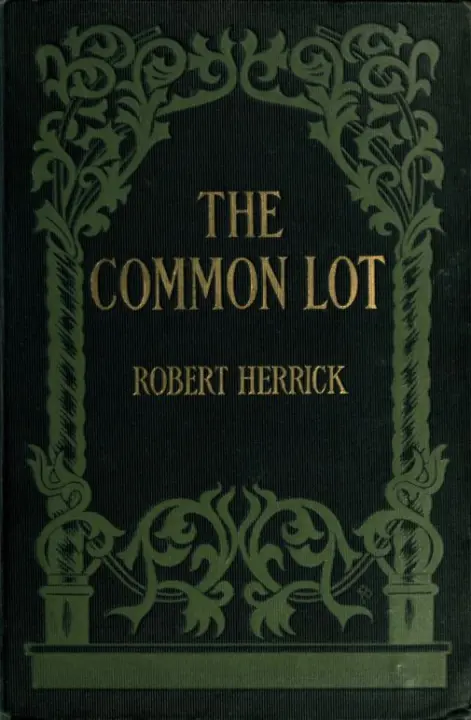
Robert Herrick
BEHIND THE BOOK
This eBook is for the use of anyone anywhere in the United States and most other parts of the world at no cost and with almost no restrictions whatsoever. You may copy it, give it away or re-use it under the terms of the Project Gutenberg License included with this eBook or online at www.gutenberg.org. If you are not located in the United States, you will have to check the laws of the country where you are located before using this eBook. Read the source licence.
The original source file, including credits and licence, is retained by this library. Request an original-format copy at no charge. Please include the book title and Project Gutenberg identifier #29808.
KEEP YOUR CURIOSITY GOING
Coulson Kernahan

Maurice Baring
Frances Wright
Cécile Tormay

Frederic Jesup Stimson

W. H. P. (William Henry Pope) Jarvis