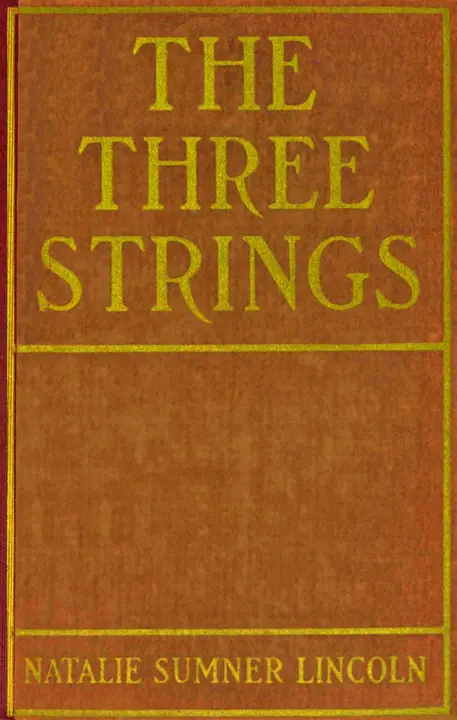
The three strings
Natalie Sumner Lincoln

THE CLASSIC COLLECTION · 1914
"The Man Inside" by Natalie Sumner Lincoln is a novel written in the early 20th century. The story unfolds against the backdrop of Panama and Washington, D.C., exploring themes of mystery and intrigue surrounding a senator's death. The narrative follows various characters, including a mysterious stranger in Colon and Senator James Carew, as they become entangled in a plot filled with political tension and personal secrets. The opening of the novel introduces a stranger in Colon, who observes the evening scene in a dimly lit bar while reflecting on his troubled past. His attention is piqued by a conversation between two men discussing political unrest in Panama and a looming conspiracy against U.S. interests. As the stranger grapples with his identity and memories, the narrative shifts to Senator Carew's family and the events leading to his tragic death. The tension escalates as the senator is found dead in a carriage after attending a ball, raising questions about murder or suicide amidst the chaotic backdrop of political struggles. The initial chapters set the stage for a complex web of relationships and betrayals that promise to unravel as the story progresses.
Introduction adapted from the source catalogue; source summaries may be automatically generated.
Free to read · English · 56,270 words · No account needed
MAKE TIME FOR A GOOD BOOK
On by default. Untick to stop anonymous reading totals. Each page counts after 10 seconds in view. How this works.
Anonymous counting is on unless you have switched it off.
"I hope you can give me a few minutes of your time," said Brett; "will you be so good as to step into the library?" and he stood aside to allow Philip Winthrop to enter first. Douglas followed them into the room and locked the door. As the key clicked slightly Winthrop frowned, and his pale face flushed.
"That is only a precaution against eavesdroppers," explained Douglas
quickly.
"Mr. Winthrop, this is Mr. Douglas Hunter, who is assisting me in my efforts to unravel the mystery surrounding Senator Carew's death, and with your permission will be present at this interview."
"Why, certainly," exclaimed Winthrop, with well simulated heartiness; "won't you both sit down?" and he dropped into the revolving desk chair. Douglas picked out his old seat in the window and turned his back to the light the better to face Winthrop and Brett, who also sat near the desk.
"When will they hold the inquest, Mr. Brett?" questioned Winthrop.
"The coroner, Dr. Penfield, told me to-morrow."
"Has Hamilton a lawyer to look out for his interests?"
"That's not absolutely necessary at the inquest, Mr. Winthrop. At present the negro is simply held on suspicion. If the inquest so decides, he will be charged with the murder and held for the grand jury."
Douglas had been busy scanning Winthrop's face intently. He noted the heavy lines in the handsome face, and the unnatural brilliancy of his eyes. It was apparent to both men, by Winthrop's thick speech and unsteady hands, which kept fingering the desk ornaments nervously, that he had been drinking heavily.
"Where did you last see Senator Carew?"
"In this room yesterday afternoon."
"Did you see him alone, or were others present?"
"He was alone."
"Did he show you a letter which he was then writing?" inquired Douglas at a venture, and was startled at the effect of his question on Winthrop. The latter whitened perceptibly, and pulled his short black mustache to hide his twitching lips.
"I know nothing about any letter," he stammered.
Brett did not press the point, but asked instead: "Where did you spend
last night?"
"I dined here with my mother and cousin."
"And afterwards?" put in Douglas.
"I went to the Alibi Club soon after dinner."
"How late did you stay there?"
"Most of the night," was the evasive reply.
"Please mention the exact hour you left the club," persisted Brett.
"I really cannot recollect the exact time; I did not reach this house until after two this morning. We had a pretty gay time at the club, and I was in no condition to remember the hour," and he smiled deprecatingly.
Your reading position is saved on this browser. Take it to another device with a library code. Reading pages adapt to text, rather than matching a printed edition.
Natalie Sumner Lincoln
Natalie Sumner Lincoln
Natalie Sumner Lincoln
Natalie Sumner Lincoln
BEHIND THE BOOK
This eBook is for the use of anyone anywhere in the United States and most other parts of the world at no cost and with almost no restrictions whatsoever. You may copy it, give it away or re-use it under the terms of the Project Gutenberg License included with this eBook or online at www.gutenberg.org. If you are not located in the United States, you will have to check the laws of the country where you are located before using this eBook. Read the source licence.
The original source file, including credits and licence, is retained by this library. Request an original-format copy at no charge. Please include the book title and Project Gutenberg identifier #63223.
KEEP YOUR CURIOSITY GOING
Coulson Kernahan

Maurice Baring
Frances Wright
Cécile Tormay

Frederic Jesup Stimson

W. H. P. (William Henry Pope) Jarvis