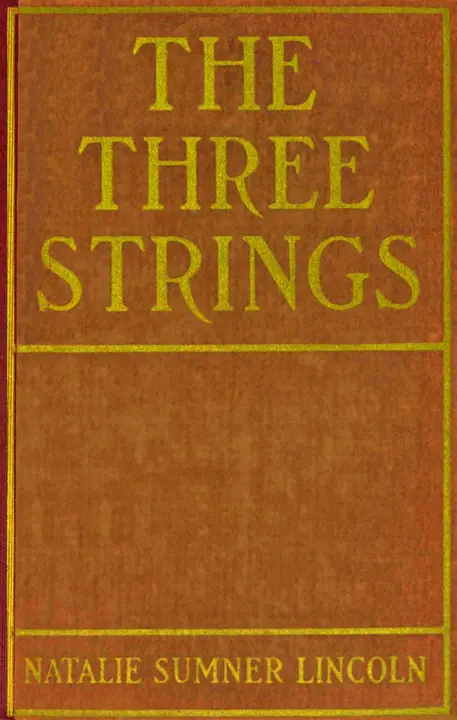
The three strings
Natalie Sumner Lincoln

THE CLASSIC COLLECTION · 1914
"The Man Inside" by Natalie Sumner Lincoln is a novel written in the early 20th century. The story unfolds against the backdrop of Panama and Washington, D.C., exploring themes of mystery and intrigue surrounding a senator's death. The narrative follows various characters, including a mysterious stranger in Colon and Senator James Carew, as they become entangled in a plot filled with political tension and personal secrets. The opening of the novel introduces a stranger in Colon, who observes the evening scene in a dimly lit bar while reflecting on his troubled past. His attention is piqued by a conversation between two men discussing political unrest in Panama and a looming conspiracy against U.S. interests. As the stranger grapples with his identity and memories, the narrative shifts to Senator Carew's family and the events leading to his tragic death. The tension escalates as the senator is found dead in a carriage after attending a ball, raising questions about murder or suicide amidst the chaotic backdrop of political struggles. The initial chapters set the stage for a complex web of relationships and betrayals that promise to unravel as the story progresses.
Introduction adapted from the source catalogue; source summaries may be automatically generated.
Free to read · English · 56,270 words · No account needed
MAKE TIME FOR A GOOD BOOK
On by default. Untick to stop anonymous reading totals. Each page counts after 10 seconds in view. How this works.
Anonymous counting is on unless you have switched it off.
Her individuality had stamped itself upon the whole room. A picture or two, far above the average, a few choice books, whose dainty binding indicated a taste and refinement quite unusual; one or two Chinese vases, old when the Revolutionary War began; an ivory carving of the Renaissance; a mirror in whose lustrous depths Venetian beauties had seen their own reflections hundreds of years ago. All these things gave sure indication of study and travel, and a maturity of thought and taste which, oddly enough, seemed rather to enhance Eleanor's natural charm.
A discreet knock sounded on her door. "Bon jour, Mademoiselle," exclaimed the maid, entering with the breakfast tray.
"Bon jour, Annette," responded Eleanor, rousing herself, then lapsing into English, which her maid spoke with but a slight accent. "Put the tray here beside me. Must I eat that egg?" she made a slight grimace.
"But yes, Mademoiselle." The Frenchwoman stepped to the window and raised the shade. "Madame Truxton gave orders to Fugi to tell the cook that he must send you a more substantial breakfast. She does not approve of rolls and coffee. I think she wishes you to eat as she does."
Eleanor shuddered slightly. "Did--did she have beefsteak and fried onions this morning?" she inquired.
"But yes, Mademoiselle," Annette's pretty features dimpled into a smile, "and she ate most heartily."
"Not another word, Annette, you take away my appetite. Is Mrs. Truxton
waiting to see me?"
"No, Mademoiselle; she was up at six o'clock and had her breakfast at half-past seven." Annette paused in the act of laying out a supply of fresh lingerie. "What have the Americans on their conscience that they cannot sleep in the morning?"
"You cannot complain of my early rising," laughed Eleanor, glancing at the clock, whose hands pointed to a quarter to twelve.
"Ah, Mademoiselle, you have lived so long away from America that you
have acquired our habits."
"You may take the tray, Annette; I have even less appetite than usual to-day." Eleanor waited until it had been removed, then sprang out of bed. "Come back in fifteen minutes," she called.
It did not take her long to complete her toilette, and when the maid returned she was seated before her dressing table.
"What news to-day, Annette?" she asked, as the Frenchwoman, with skilful fingers, arranged her wavy hair, which fell far below her waist.
"Madame and Fugi----" began the maid.
"I don't want household details," broke in Eleanor impatiently. "Tell me of some outside news, if there is any."
"Oh, indeed, yes; news the most startling. Senator Carew----" she paused to contemplate her handiwork.
"Well, what about him?" inquired Eleanor listlessly.
"He is dead."
Your reading position is saved on this browser. Take it to another device with a library code. Reading pages adapt to text, rather than matching a printed edition.
Natalie Sumner Lincoln
Natalie Sumner Lincoln
Natalie Sumner Lincoln
Natalie Sumner Lincoln
BEHIND THE BOOK
This eBook is for the use of anyone anywhere in the United States and most other parts of the world at no cost and with almost no restrictions whatsoever. You may copy it, give it away or re-use it under the terms of the Project Gutenberg License included with this eBook or online at www.gutenberg.org. If you are not located in the United States, you will have to check the laws of the country where you are located before using this eBook. Read the source licence.
The original source file, including credits and licence, is retained by this library. Request an original-format copy at no charge. Please include the book title and Project Gutenberg identifier #63223.
KEEP YOUR CURIOSITY GOING
Coulson Kernahan

Maurice Baring
Frances Wright
Cécile Tormay

Frederic Jesup Stimson

W. H. P. (William Henry Pope) Jarvis