
Last letters from the living dead man
David Patterson (Spirit) Hatch
THE CLASSIC COLLECTION · 1900
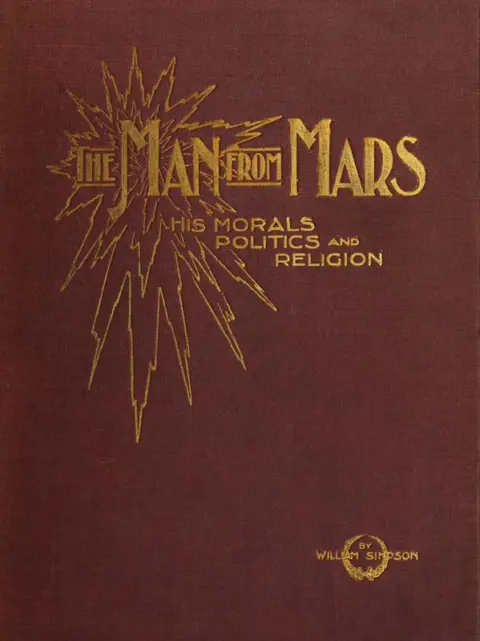
"The Man from Mars: His Morals, Politics and Religion" by William Simpson is a philosophical exploration, probably written in the late 19th century. The text delves into themes of morality, politics, and religion, aiming to challenge and critique societal norms and beliefs through the narrative of a Martian visitor. The central focus is on the implications of his perspective on Earthly societies and their systems. The opening of the book introduces the narrator as a reclusive observer residing in a serene, mountainous region where he engages in deep contemplation of celestial bodies, especially Mars. The narrator shares his observations of nature and expresses a longing for connection, eventually encountering a figure who claims to be from Mars. This figure, described as remarkably beautiful and wise, begins to explain his advanced knowledge of Mars, including its technology, societal structure, and ethical treatment of life, contrasting it sharply with Earth's practices. This initial exchange sets the stage for a deeper philosophical conversation about the progress of human civilization and the importance of empathy and knowledge in shaping ethical societies.
Introduction adapted from the source catalogue; source summaries may be automatically generated.
Free to read · English · 56,454 words · No account needed
MAKE TIME FOR A GOOD BOOK
On by default. Untick to stop anonymous reading totals. Each page counts after 10 seconds in view. How this works.
Anonymous counting is on unless you have switched it off.
The foregoing was written to indicate that line of thought, whose convictions are briefly expressed, here and there, through the pages of this little book, now offered to the public in its third edition. It is always safer and pleasanter to deal with received theology in the spirit of reverence, usually found in literature; thus offending no one, and meeting the approval of a worthy and influential class; but, there are other reasons why an adverse criticism of theological methods and beliefs, are not so often publicly exploited as their importance to society deserves. In the first place experience has shown that errors of religious belief, fixed upon the mind in infancy and youth, are seldom removed by discussion. We are not yet arrived at that stage, when the love of truth so predominates in the minds of men, that they will sacrifice every prejudice, and reject all opposing influence to obtain it. Christianity has imposed an elaborate system of prejudices on every young mind within its jurisdiction and they have become entwined with all the most hallowed associations of childhood, appealing so strongly to the affections, that any expressed denial of their exact truth excites, in most cases, a feeling of resentment, and often stirs to petty persecution. A large majority of the human race accept their opinions from authority, and all authority heretofore has encouraged beliefs, which appear so inseparably connected with the moral well being of society, and which hold in continued supremacy, institutions and modes of thought whose subversion it is alleged would be in many ways dangerous. Yet, the fact remains that it is mostly through its inroads upon these old beliefs that the world has arrived at its present stage of progress, and the opinion of orthodox theologians that they should be retained in their entirety, or of others that they should be abolished, cuts no figure; because, whether for good or evil in the opinions of men, Providence has ordained, that those only which represent the truth shall live, and knowing this of a certainty, it becomes of the greatest interest to discover what society is likely to lose or gain by that modification of religious beliefs, wherein only the truth shall remain. If we cannot foretell this future condition with certainty, it is largely foreshadowed by past and present experience. What the world has lost in the modification of religious beliefs, would be hard to find, what it has gained would take volumes to recount. In the most important of all human interests, liberty of person, liberty of conscience, and liberty of speech, there has been, as yet, no adequate acknowledgement by mankind of the great services of the silent and avowed skepticism which brought about the consummation of these blessings. The writings of Moses, the recorded wisdom of Solomon, the encyclicals of popes, and the sermons of bishops and priests, both Protestant and Catholic, in their rising up of the lowly, in their encouragement of brotherhood, and in that exact and even justice to all men, so far as their practical services to humanity in these directions can be measured, sink into an empty insignificance, when compared with those organic declarations and laws, upon which this great republic was founded, and which were the outcome and product of a then recent enlightenment, due to the combined efforts of European skeptical writers, who by their genius of sarcasm and incisive argument, were disturbing the old theological modes of thought, and awaking the world to wide strides in rationalism. That these new American rules of political equality, beacons of liberty for men to follow and admire, obtained their inspiration and incentive from those new lights in literature, which, at that time, were stirring the world of thought, there can be no question. In these famous American documents, were embodied the practical carrying out of principles, enunciated, and suggested by the European writers, and the most active of the men engaged in the noble work of forming the new government, are known to have been disciples of these leaders of anti-theologic thought. Our Declaration of Independence and Federal Constitution, stand, to-day, grand achievements of modern scientific thought, and conspicuous triumphs of rationalism, over old methods, foreshadowing in these, its great works, a better wisdom to govern the affairs of men, than all the ages guided by Hebrew tradition. Yet, in these documents will be seen an overflowing of natural religion, and the spirit of the Master. “Do unto others as ye would that others shall do unto you.”
Your reading position is saved on this browser. Take it to another device with a library code. Reading pages adapt to text, rather than matching a printed edition.
BEHIND THE BOOK
This eBook is for the use of anyone anywhere in the United States and most other parts of the world at no cost and with almost no restrictions whatsoever. You may copy it, give it away or re-use it under the terms of the Project Gutenberg License included with this eBook or online at www.gutenberg.org. If you are not located in the United States, you will have to check the laws of the country where you are located before using this eBook. Read the source licence.
The original source file, including credits and licence, is retained by this library. Request an original-format copy at no charge. Please include the book title and Project Gutenberg identifier #56979.
KEEP YOUR CURIOSITY GOING
David Patterson (Spirit) Hatch
Coulson Kernahan

Ralph Waldo Emerson

Maurice Baring
Frances Wright
Cécile Tormay