THE CLASSIC COLLECTION✦A dead man’s diaryCLASSIC FREE BOOKS
A dead man’s diary
Coulson Kernahan
THE CLASSIC COLLECTION · 1873
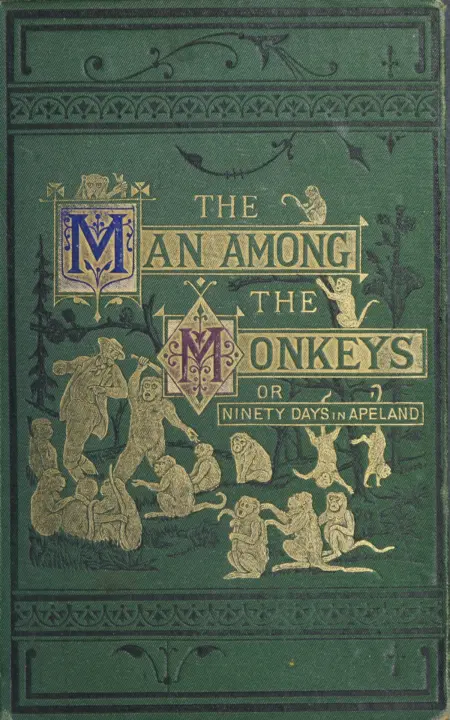
"The Man Among the Monkeys; or, Ninety Days in Apeland" by Léon Gozlan is a fictional narrative likely written in the late 19th century. This tale chronicles the adventures of Polydorus Marasquin, who becomes embroiled in extraordinary encounters with a variety of apes after a shipwreck leaves him stranded on a mysterious island. Through his journey, themes of survival, the intricate nature of human-animal relationships, and the dark humor tied to his misfortunes with animals are explored. At the start of the story, the protagonist, Polydorus Marasquin, provides a background of his family's legacy and his passion for natural history. After losing his father to a tiger, he takes over the family business of acquiring and trading exotic animals, including an array of apes. Tragedy strikes when a baboon, seeking revenge, sets fire to his menagerie, killing his mother and forcing him into a precarious new life. As he sets sail for Oceania once more, his journey takes a dramatic turn when he shipwrecks on a jungle-filled island, only to find himself besieged by a chaotic multitude of apes, setting the stage for the wild adventures that will ensue.
Introduction adapted from the source catalogue; source summaries may be automatically generated.
Free to read · English · 102,120 words · No account needed
MAKE TIME FOR A GOOD BOOK
On by default. Untick to stop anonymous reading totals. Each page counts after 10 seconds in view. How this works.
Anonymous counting is on unless you have switched it off.
In the midst of this little wood, and on the bank of a tiny lake, stands a moderate-sized mansion, which has been deserted since the death of him who erected it, and the front of which faces the rising sun. Behind are the farm buildings, hemmed in on all sides by luxuriant foliage. So secluded is the spot that a traveller might pass almost close to the mansion without seeing it, while from afar the red-tile roofs are visible only from the high ground.
There lived here not more than thirty or forty years ago, in philosophical repose and contemplation, Lieutenant-General Martin Ernst von Schlieffen, formerly Hessian Minister of State, an honourable old gentleman, and a valiant German soldier, with correct ideas of honour and right; one of the pupils of the Seven Years’ War, a lover of art and science, himself blessed with a lively fancy, and, in addition, a philosopher and somewhat of a character. He was born in Pomerania in the year 1732. It was his lot to receive a defective education, and, when scarcely more than a mere boy, the rank of ensign in a Prussian regiment. A lingering illness, which prostrated him at the expiration of two or three years, caused the King probably to doubt the youth’s further fitness for service, and, instead of the extension of leave demanded, to send him his dismissal. On recovering his health the youth remained for some time without any occupation, till the outbreak of the Seven Years’ War encouraged him to offer his services once more to Frederick II. But the King would not have him, so he went, with recommendations from Prince Henry of Prussia and of Duke Ferdinand of Brunswick in his pocket, to Cassel, where the Landgrave made him a lieutenant in the Hessian contingent in the pay of England. In this position he so distinguished himself, first under the Duke of Cumberland, and then under the latter’s successor, Duke Ferdinand of Brunswick, that, within five years, he worked his way up to a colonelcy, and was summoned to Cassel as Adjutant-General and Chamberlain by the Landgrave. Court life, however, detained him captive for only a short time, and he returned to the victorious standard of his celebrated general, who met with so deplorable a death at Jena. Herr von Schlieffen had attracted the attention of his hereditary King, and Frederick the Great now made an attempt to gain once more to his service the man whom, but a few years previously, he had so ungraciously rebuffed. But the Landgrave created him a general, and Herr von Schlieffen continued in his service. By the advice of the Prince he refused, also, a tempting offer from the Emperor of Russia, and, in consideration of his so doing, the Landgrave settled upon him a life annuity of one thousand thalers. While Fortune thus lavished her gifts upon him, he devoted himself zealously to study, in order to make up for his neglected education. He learned Greek and Latin, of which he acquired such a knowledge as to be capable of reading the old classic authors in their original language. He accompanied the Landgrave on his travels to Paris and Berlin. He then proceeded, on business of his own, to Warsaw, and, on his return to Cassel, entered the ministry. He subsequently obtained the post of ambassador in London, where friends and former brothers-in-arms essentially advanced his efforts for the benefit of his sovereign. At length—for what is more fickle than the favour of the great—he incurred the displeasure of the Landgrave, and obeyed a summons to Prussia as general and governor of the fortress of Wesel. A year later, when the Belgian provinces had torn themselves from Austria, and created themselves into an independent State, a message was despatched from the deputies assembled in Brussels to Herr von Schlieffen, inviting him to assume the Stadtholdship. Consideration for Prussia, at that very time engaged in negotiations for a reconciliation with Austria, made him determine to refuse this honour. Hereupon the King, no longer Frederick II., sent for him to Berlin, and offered him the portfolio of Foreign Affairs. But Herr von Schlieffen found the Court in so unfavourable a situation, the influence of England so predominant, and Austria attached in so loose and ambiguous a manner to Prussia, that he refused to enter the ministry. Though he was greatly esteemed by the King, he was, after a short time, induced to send back his general’s staff to his majesty. The fact is that, when Austria and Prussia agreed to take up arms against the revolutionary party in France, Herr von Schlieffen endeavoured to convince the King of the danger and foolishness of such intervention. But his honest efforts were in vain; the campaign against the Republic was resolved on, and Herr von Schlieffen, who should have been one of the first to march out, was left behind. He pressed the King either to alter this arrangement or allow him to retire, because he saw in it an insulting slight. As neither the one course nor the other was taken he resigned his posts, and retired to his estates. The King, however, remained well disposed towards him, and, some years subsequently, Herr von Schlieffen, in order to refute calumnies and envious Court tittle-tattle, felt himself called on once more to place himself at the King’s disposal; as, however, it was not yet decided whether or no Prussia would take part in the projected campaign of 1794, the King, in a gracious letter of thanks, declined his offer. Out of a feeling of patriotism, he had not accepted an invitation he received in the year 1792 to join the French army as a general. At a subsequent period, when Napoleon’s star was in the ascendant, and the relations between France and Germany were becoming more threatening, Frederick William sought, it is true, to obtain once again the services of the holiday-keeping hero, but the latter, assigning his age as an excuse, repressed his desire of reappearing as an actor upon the stage of glory and of honour. Who knows how matters would have ended at Jena had all the other old generals of the Prussian army then followed his example?
Your reading position is saved on this browser. Take it to another device with a library code. Reading pages adapt to text, rather than matching a printed edition.
BEHIND THE BOOK
This eBook is for the use of anyone anywhere in the United States and most other parts of the world at no cost and with almost no restrictions whatsoever. You may copy it, give it away or re-use it under the terms of the Project Gutenberg License included with this eBook or online at www.gutenberg.org. If you are not located in the United States, you will have to check the laws of the country where you are located before using this eBook. Read the source licence.
The original source file, including credits and licence, is retained by this library. Request an original-format copy at no charge. Please include the book title and Project Gutenberg identifier #68059.
KEEP YOUR CURIOSITY GOING
Coulson Kernahan

Maurice Baring
Frances Wright
Cécile Tormay

Frederic Jesup Stimson

W. H. P. (William Henry Pope) Jarvis