Rebel women
Evelyn Sharp
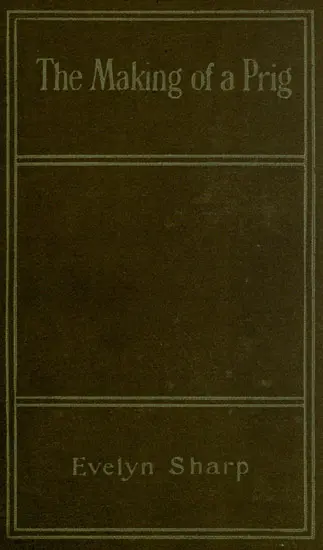
THE CLASSIC COLLECTION · 1897
"The Making of a Prig" by Evelyn Sharp is a novel written in the late 19th century. The story revolves around young Katharine, the Rector's daughter, as she grapples with the constraints of her upbringing, her burgeoning independence, and her relationships with the people in her life, particularly her father and Aunt Esther, who represent differing viewpoints on propriety and emotional expression. At the start of the narrative, the reader is introduced to the dynamics within the Rectory as Katharine and her Aunt Esther engage in a familiar conflict over the Rector's late arrival for supper. This setting lays the groundwork for Katharine’s rebellious spirit, which becomes increasingly evident as she questions the societal expectations placed upon her and expresses frustration at being a girl in a world that often feels limited and oppressive. The opening chapters also hint at her growing curiosity about a new character, Paul Wilton, who arrives injured and thus becomes an interest of both her and her Aunt Esther, setting the stage for deeper interactions and explorations of character motivations.
Introduction adapted from the source catalogue; source summaries may be automatically generated.
Free to read · English · 87,745 words · No account needed
MAKE TIME FOR A GOOD BOOK
On by default. Untick to stop anonymous reading totals. Each page counts after 10 seconds in view. How this works.
Anonymous counting is on unless you have switched it off.
"But surely," said Katharine, "a girl can have a man for a friend without going through all that!"
"Don't believe in it; never did; it doesn't work."
"I think it does, sometimes," observed Katharine. "Of course it
depends on the girl."
"Entirely," said Phyllis cheerfully. "The man would always spoil it, if he could--without being found out."
Katharine leaned back on the pillow, with her arms behind her head, and her eyes fixed on the ceiling.
"That's just it," she said thoughtfully; "men are so much more conventional than women. I am glad I am not a man, after all. There is no need for a woman to be conventional, is there? She isn't afraid of being suspected, all the time. I'm certain conventionality was made for man, and not man for conventionality, and that woman never had a hand in it at all."
"I don't know about that, though it sounds very fine," said Phyllis. "But of course men have to be more conventional than we are. It helps them to make some show of respectability, I guess."
"It is very horrible, if one analyses it," murmured Katharine. "According to that, the man who is openly bad is preferable to the man who is conventionally good. Of course Paul is not bad at all; but, oh! I do wish I didn't see through people, when they try to pretend things,--it always annoys them."
"Eh?" said Phyllis, looking up. "Your tea is getting cold."
"Never mind about the tea! Tell me, Phyllis, do you think any woman can attract any man, if she likes?"
"Of course she can, if she is not in love with him."
Katharine winced, and brought her eyes down to look at her unconscious friend, who was still munching shortbread with an expression of complete contentment on her face.
"I mean if she is in love with him, very much in love with him."
"Can't say; never was, myself. But I don't believe you can do anything, if you've got it badly; you have to let yourself go, and hope for the best."
"I don't believe you know any more about it than I do, Phyllis. I'll tell you what it is that is attractive to a man in a woman: it is her imperfections. He likes her to be jealous, and vain, and full of small deceptions. He hates her to be tolerant, and large-minded, and truthful; above all, he hates her to be truthful. I don't know why it is so, but it is."
"It is because she isn't too mighty big to worship him, then; nor cute enough to see through him," said Phyllis.
Your reading position is saved on this browser. Take it to another device with a library code. Reading pages adapt to text, rather than matching a printed edition.
BEHIND THE BOOK
This eBook is for the use of anyone anywhere in the United States and most other parts of the world at no cost and with almost no restrictions whatsoever. You may copy it, give it away or re-use it under the terms of the Project Gutenberg License included with this eBook or online at www.gutenberg.org. If you are not located in the United States, you will have to check the laws of the country where you are located before using this eBook. Read the source licence.
The original source file, including credits and licence, is retained by this library. Request an original-format copy at no charge. Please include the book title and Project Gutenberg identifier #42153.
KEEP YOUR CURIOSITY GOING
Coulson Kernahan

Maurice Baring
Frances Wright
Cécile Tormay

Frederic Jesup Stimson

W. H. P. (William Henry Pope) Jarvis