The Mountain of Fears
Henry C. (Henry Cottrell) Rowland
THE CLASSIC COLLECTION · 1910
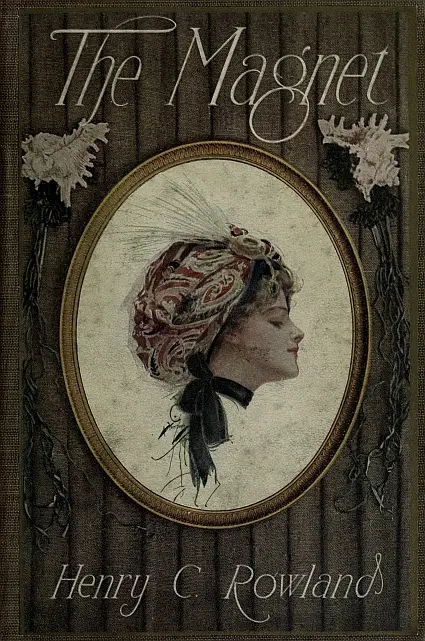
"The magnet: A romance" by Henry C. Rowland is a novel written in the early 20th century. Set aboard a Maine-anchored schooner-yacht, it centers on retired Captain Bell, his three daughters—Cécile, Paula, and Hermione—and their steadfast sailing-master, Christian Heldstrom, whose floating household is shadowed by an eccentric poet, Harold Applebo, in a yawl he trails like a “pilot-fish.” Flirtation, pride, and sudden tests of character entwine as the sisters draw suitors and the poet’s odd chivalry stirs both annoyance and curiosity. The opening of the story introduces the yacht Shark at Shoal Harbour and sketches the family: choleric gourmand Captain Bell, disciplined “Uncle Chris” Heldstrom, coquettish Cécile, gentle Paula, and fiery Hermione. Huntington Wood, an old suitor, visits as the crew watches for the “Pilot-fish,” Applebo, who arrives in his yawl Daffodil; Bell recounts the poet’s whimsical resolve to follow them so he needn’t choose his own course. Wood learns Applebo is secretly devoted to a lady aboard, while Paula and Cécile trade impressions of the odd celebrity; a farcical failed vol-au-vent spurs Bell to vow a chase to shake the pursuer. At dawn, Hermione’s illicit shore shoot ends in a confrontation with a game-warden until Applebo intervenes, after which a prickly, revealing exchange shows his disdain for her poaching, his abstract approach to love, and a startling reaction to Heldstrom’s name, hinting at deeper ties as the excerpt breaks off.
Introduction adapted from the source catalogue; source summaries may be automatically generated.
Free to read · English · 62,697 words · No account needed
MAKE TIME FOR A GOOD BOOK
On by default. Untick to stop anonymous reading totals. Each page counts after 10 seconds in view. How this works.
Anonymous counting is on unless you have switched it off.
Two bells were struck forward, to be followed by a smothered chorus of exultation from the winners of sundry bets. "Silence, there," cried Bell, and added to Wood: "This ship has got to be no more than a bloomin' Grand Stand. That lobster has lost me ten dollars. He must have stopped to fish."
Captain Heldstrom started forward, smiling under his grizzled beard.
"Win, captain?" snapped Bell.
"Fife dollars ... from der cook, zir," answered the captain.
"I'm glad it was the cook..." muttered Bell.
"This Pilot-fish," observed Wood, "has got the races beaten to a
finish."
All eyes aboard the Shark were directed over the starboard bow. Out of the vivid glare appeared presently a small, chunky vessel, yawl-rigged, though from the size of her mizzen she might have been classed as a ketch. No bunting did she fling to the light, offshore breeze; no pennant, burgee, ensign, nor even so much as a tell-tale at her truck. Huntington, a yachtsman of some experience, doubted that she had been designed and built for a yacht. Beating back and forth across the bay, the yawl finally made her berth about halfway between the Shark and the eastern side of the harbour.
"What is her name?" asked Wood.
"Her name," Bell answered, "goes with the tea and macaroons. It is
Daffodil."
"Oh, fudge..."
"His name," said Cécile, "is Harold Applebo."
She had expected to hear a feeble cry for help, but was disappointed. Wood sprang up from his lounging position.
"Harold Applebo..." he cried. "Why, he was a classmate of mine. I might have known ... from your father's description."
Cécile opened wide her grey eyes. "Tell us about him," said she.
"Harold Applebo," Wood began, "is eccentric and a poet. At college, however, he was not considered by any means a fool."
"Does he write good verse?" asked Cécile.
"One needs to get into the bath-tub to read it. Yet, although mushy, he has a few admirers, and has published two books, doubtless at his own expense. Selections from the first were read to me this summer by a friend. When she had finished my head felt like a bottle full of bees. There was one 'Ode to a Dew-drop in the Heart of a Pansy'; another was called 'Flowers at Play.'"
"Nuf', nuf' ... let me up..." murmured Bell.
"I managed to keep my strength," continued Wood, "until my friend, who happened to be a young mother, recited from memory, 'Baby in the Asphodel.' That finished me. I have never felt the same toward babies since. That is unfortunate, considering my charity."
Your reading position is saved on this browser. Take it to another device with a library code. Reading pages adapt to text, rather than matching a printed edition.
Henry C. (Henry Cottrell) Rowland
BEHIND THE BOOK
This eBook is for the use of anyone anywhere in the United States and most other parts of the world at no cost and with almost no restrictions whatsoever. You may copy it, give it away or re-use it under the terms of the Project Gutenberg License included with this eBook or online at www.gutenberg.org. If you are not located in the United States, you will have to check the laws of the country where you are located before using this eBook. Read the source licence.
The original source file, including credits and licence, is retained by this library. Request an original-format copy at no charge. Please include the book title and Project Gutenberg identifier #76293.
KEEP YOUR CURIOSITY GOING
Coulson Kernahan

Maurice Baring
Frances Wright
Cécile Tormay

Frederic Jesup Stimson

W. H. P. (William Henry Pope) Jarvis