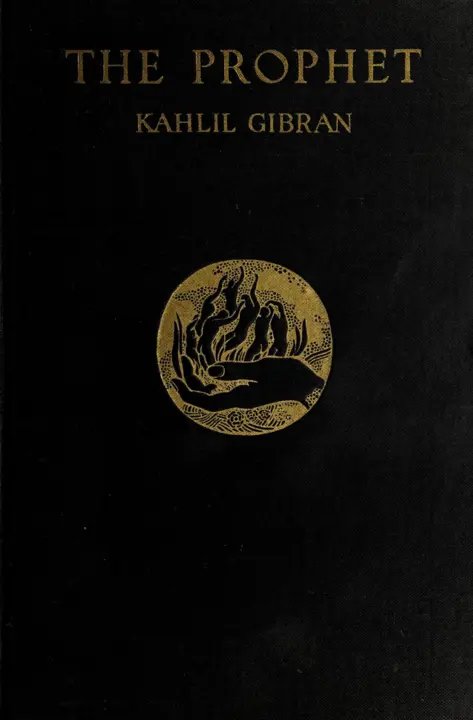
The Prophet
Kahlil Gibran
THE CLASSIC COLLECTION · 1918
"The Madman: His Parables and Poems" by Kahlil Gibran is a poetic collection that delves into profound themes of identity, existence, and the nature of humanity, characteristic of Gibran's literary style in the early 20th century. This work reflects a philosophical exploration of the human condition through parables and poems, imbuing them with spiritual and metaphysical insights. Written during the early modern period, the book brings a unique blend of mystical thought and artistic expression. The content of "The Madman" is structured around the thoughts, musings, and experiences of a narrator who embodies the qualities of a madman, yet offers wisdom in his madness. He reflects on various aspects of life such as love, friendship, existence, and societal norms through engaging parables, like the tale of the scarecrow who finds joy in his loneliness and stories that reveal the darker complexities of the human psyche. Gibran addresses the struggle between individuality and societal expectations, exploring themes of conflict, love, and enlightenment as the madman navigates his own reality, ultimately portraying both the burdens and the liberating aspects of madness. This collection invites readers to contemplate deeper truths about their own lives and the world around them.
Introduction adapted from the source catalogue; source summaries may be automatically generated.
Free to read · English · 7,070 words · No account needed
MAKE TIME FOR A GOOD BOOK
On by default. Untick to stop anonymous reading totals. Each page counts after 10 seconds in view. How this works.
Anonymous counting is on unless you have switched it off.
And when I walk the streets no one looks at me.
Only in my sleep I hear voices saying in pity, "See, there lies
the man whose Sorrow is dead."
And When my Joy was Born
And when my Joy was born, I held it in my arms and stood on the house-top shouting, "Come ye, my neighbours, come and see, for Joy this day is born unto me. Come and behold this gladsome thing that laugheth in the sun."
But none of my neighbours came to look upon my Joy, and great was
my astonishment.
And every day for seven moons I proclaimed my Joy from the house-top--and yet no one heeded me. And my Joy and I were alone, unsought and unvisited.
Then my Joy grew pale and weary because no other heart but mine held its loveliness and no other lips kissed its lips.
Then my Joy died of isolation.
And now I only remember my dead Joy in remembering my dead Sorrow. But memory is an autumn leaf that murmurs a while in the wind and then is heard no more.
"The Perfect World"
God of lost souls, thou who are lost amongst the gods, hear me:
Gentle Destiny that watchest over us, mad, wandering spirits, hear
me:
I dwell in the midst of a perfect race, I the most imperfect.
I, a human chaos, a nebula of confused elements, I move amongst finished worlds--peoples of complete laws and pure order, whose thoughts are assorted, whose dreams are arranged, and whose visions are enrolled and registered.
Their virtues, O God, are measured, their sins are weighed, and even the countless things that pass in the dim twilight of neither sin nor virtue are recorded and catalogued.
Here days and night are divided into seasons of conduct and governed by rules of blameless accuracy.
To eat, to drink, to sleep, to cover one's nudity, and then to be
weary in due time.
To work, to play, to sing, to dance, and then to lie still when
the clock strikes the hour.
To think thus, to feel thus much, and then to cease thinking and feeling when a certain star rises above yonder horizon.
To rob a neighbour with a smile, to bestow gifts with a graceful wave of the hand, to praise prudently, to blame cautiously, to destroy a sound with a word, to burn a body with a breath, and then to wash the hands when the day's work is done.
To love according to an established order, to entertain one's best self in a preconceived manner, to worship the gods becomingly, to intrigue the devils artfully--and then to forget all as though memory were dead.
Your reading position is saved on this browser. Take it to another device with a library code. Reading pages adapt to text, rather than matching a printed edition.
BEHIND THE BOOK
This eBook is for the use of anyone anywhere in the United States and most other parts of the world at no cost and with almost no restrictions whatsoever. You may copy it, give it away or re-use it under the terms of the Project Gutenberg License included with this eBook or online at www.gutenberg.org. If you are not located in the United States, you will have to check the laws of the country where you are located before using this eBook. Read the source licence.
The original source file, including credits and licence, is retained by this library. Request an original-format copy at no charge. Please include the book title and Project Gutenberg identifier #5616.
KEEP YOUR CURIOSITY GOING

David Patterson (Spirit) Hatch

David Patterson (Spirit) Hatch

David Patterson (Spirit) Hatch

Ralph Waldo Emerson

Maurice Baring

Oscar Wilde & James McNeill Whistler