THE CLASSIC COLLECTION✦A dead man’s diaryCLASSIC FREE BOOKS
A dead man’s diary
Coulson Kernahan
THE CLASSIC COLLECTION · 1909
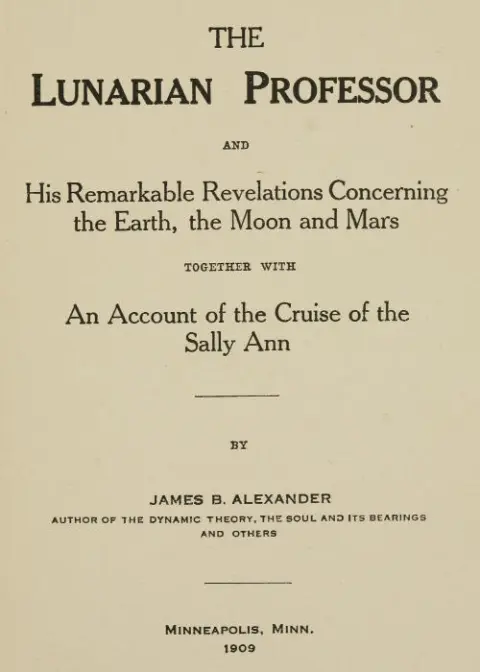
"The Lunarian Professor and His Remarkable Revelations Concerning the Earth, the Moon and Mars" by James B. Alexander is a science fiction novel written in the early 20th century. The narrative is centered around a professor from the Moon who shares intriguing insights about life on various celestial bodies, focusing particularly on Earth and its inhabitants. Through a blend of humor and philosophical reflection, the book sets the stage for an exploration of advanced alien civilizations and their perspectives on humanity. At the start of the novel, the narrator reflects on his long-overdue outing to Lake Minnetonka, where he plans to unwind and enjoy solitude. As he embarks on the cruise of his boat, the Sally Ann, he unexpectedly encounters Allan Ocheltree, a close friend from his past. Their reunion is marked by nostalgic conversations, and soon after, the professor from the Moon makes his entrance, initiating a dialogue about his home and the remarkable differences between it and Earth. The opening sets a tone of whimsical adventure infused with speculative science, hinting at discussions on societal evolution, technology, and the nature of life beyond our planet.
Introduction adapted from the source catalogue; source summaries may be automatically generated.
Free to read · English · 80,068 words · No account needed
MAKE TIME FOR A GOOD BOOK
On by default. Untick to stop anonymous reading totals. Each page counts after 10 seconds in view. How this works.
Anonymous counting is on unless you have switched it off.
As I approached the entrance to the canal, I observed standing on the south bank, a man with a gun in his hand and dressed in outing costume, whose figure and attitude reminded me of someone I had seen before. “Can it be possible,” I said to myself, “that that is Allan Ocheltree?” By the time the boat touched the land, I had made sure that it was and I sprang ashore to greet him. The recognition and gratification at meeting were mutual. Our friendship for each other, was always the closest friendship either of us had. We had been room-mates and class-mates for four years at college, and our temperaments and tastes were like complementary colors, of such harmonious contrast as to fit each other to a T. In our class we were to each other like the two end men of a minstrel troup; he at one end—the head end—and I at the other. It is singular how people, like drift wood on the stream of time, are at times drifted toward each other and float along together till some eddy or obstruction in the current separates them, and hurries them off in diverging directions, perhaps to meet again farther down the stream, it may be more than once. Sometimes a leave-taking under circumstances, that seem to forebode it to be the last and clothe it in gloom, and sorrow, is nevertheless not the last by many; while a cheerful good-by with a light hearted “ta-ta-old-fellow-see-you-to-morrow,” may prove the beginning of a separation destined to endure for years—perhaps forever.
The Ocheltree family and my ancestors, were from the same Scotch-Irish stock, were friends and neighbors near Belfast and emigrated to Maryland about two hundred and thirty years ago, settling at first in Somerset County. A few years later they moved north into Cecil County, and from there in 1760 a large emigration took place to Mechlenburg County, North Carolina. Among these emigrants, were Duncan Ocheltree and my grandfather’s Uncle John. These two were friends and neighbors in the new settlement and when the revolutionary war broke out, they both adopted the patriotic cause. The Mechlenburg declaration of independence was adopted and signed May 20th or 31st, 1775, by a convention of which John was secretary, and it was supported by Duncan. But in 1780, Lord Cornwallis overran the state and captured Charlotte, the county seat of Mechlenburg, and Duncan, believing all was lost, hastened to turn Tory and make his submission to his lordship in order to save his wealth of which he had acquired a goodly share. This was a bad break and he made it worse by the supererogatory zeal of a new convert, in harassing his former friends and piloting the red-coated foragers to their hay stacks, hen roosts and pig pens, not sparing his old friend John. But the triumph of Cornwallis was short; in a few days, he was obliged to evacuate Charlotte and then Duncan realized that he had placed himself in a very bad position. As the British troops were packing their knapsacks preparatory to decamping from Charlotte between two days, Duncan determined to throw himself upon the generosity of his former friend John, and so under cover of the darkness he rode out to his farm-house nine miles in the country. John, who was two miles off in the patriot camp, was sent for. Duncan surrendered his sword and begged his old friend to forgive bygones and advise him what to do. John’s sympathy for him at that stage of affairs was not particularly tender as may be supposed, but nevertheless his advice was no doubt the best possible. He said: “Ocheltree, neither your life nor your property is safe in Mechlenburg. The Whigs will take both. Your only safety is in instant flight. I advise you to reach the Yadkin before daylight.” He took the advice. And so they parted. Four generations later like two stray straws on a flood, Allan Ocheltree and I were floated into the same class room at school. Did it make any difference to me or to him that his great grandfather, made a bad guess seventy years before? Not a bit. Every man’s ancestral tree is just the same height as all the rest, his lineage is just as long and his pedigree must contain practically the same number of terms whether we reckon back to Adam or to the Ascidian or to original protoplasm. Not a member of the long line made himself or the circumstances surrounding him, and in no two cases were these precisely the same. The circumstances that made Confucius or Alexander the Great, or Julius Caesar, or Columbus, or Washington never happened to anybody else. It was no fault of the obscure ancestors or descendants or cousins near and remote of those worthies that these circumstances never surrounded them. On the other hand it cannot be ascribed to the merit of the long line of those belonging to the dead level of the average, in size and in quality, that they have been missed by the untoward circumstances that selected certain individuals to be in one respect or another conspicuously below that dead level.
Your reading position is saved on this browser. Take it to another device with a library code. Reading pages adapt to text, rather than matching a printed edition.
BEHIND THE BOOK
This eBook is for the use of anyone anywhere in the United States and most other parts of the world at no cost and with almost no restrictions whatsoever. You may copy it, give it away or re-use it under the terms of the Project Gutenberg License included with this eBook or online at www.gutenberg.org. If you are not located in the United States, you will have to check the laws of the country where you are located before using this eBook. Read the source licence.
The original source file, including credits and licence, is retained by this library. Request an original-format copy at no charge. Please include the book title and Project Gutenberg identifier #60059.
KEEP YOUR CURIOSITY GOING
Coulson Kernahan

Maurice Baring
Frances Wright
Cécile Tormay
Francis Greenleaf Allinson & Anne C. E. (Anne Crosby Emery) Allinson

Frederic Jesup Stimson