THE CLASSIC COLLECTION✦A dead man’s diaryCLASSIC FREE BOOKS
A dead man’s diary
Coulson Kernahan
THE CLASSIC COLLECTION · 1909
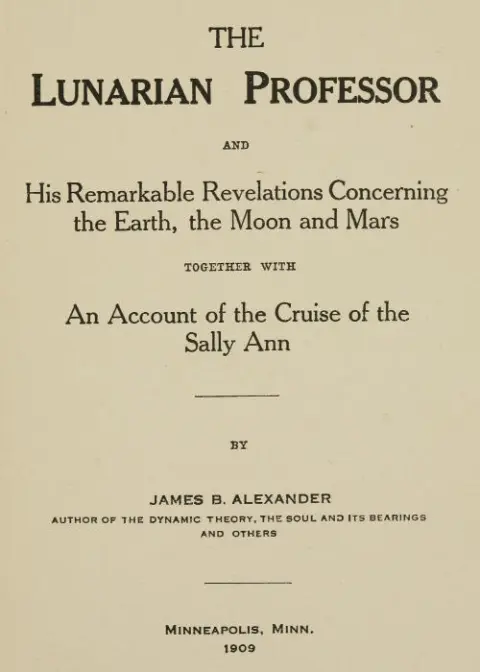
"The Lunarian Professor and His Remarkable Revelations Concerning the Earth, the Moon and Mars" by James B. Alexander is a science fiction novel written in the early 20th century. The narrative is centered around a professor from the Moon who shares intriguing insights about life on various celestial bodies, focusing particularly on Earth and its inhabitants. Through a blend of humor and philosophical reflection, the book sets the stage for an exploration of advanced alien civilizations and their perspectives on humanity. At the start of the novel, the narrator reflects on his long-overdue outing to Lake Minnetonka, where he plans to unwind and enjoy solitude. As he embarks on the cruise of his boat, the Sally Ann, he unexpectedly encounters Allan Ocheltree, a close friend from his past. Their reunion is marked by nostalgic conversations, and soon after, the professor from the Moon makes his entrance, initiating a dialogue about his home and the remarkable differences between it and Earth. The opening sets a tone of whimsical adventure infused with speculative science, hinting at discussions on societal evolution, technology, and the nature of life beyond our planet.
Introduction adapted from the source catalogue; source summaries may be automatically generated.
Free to read · English · 80,068 words · No account needed
MAKE TIME FOR A GOOD BOOK
On by default. Untick to stop anonymous reading totals. Each page counts after 10 seconds in view. How this works.
Anonymous counting is on unless you have switched it off.
“Over the south pole of Mars is a mountain some 8,000 feet above the sea level. They found the exact pole not far from the highest part of this mountain which was a lucky circumstance. Here they planted a great steel shaft deep in the hard rock, its end sticking up so as to receive the eye of the cable. A good deal of grading and leveling off of obstructions that stood up above the proposed sweep of the cable, had to be removed. But the largest part of the work was the construction of the circular railway. This railway was built in a circle around the pole and 285 miles distant from it. The diameter of this circle was 570 and the length of the road was 1,791 miles. There were two purposes to be served by this road. A person standing at the pole of Mars cannot see Deimos on account of the bulge or convex surface of the globe. And it is only when he gets 285 miles from the pole that he can look over the bulge and see the little moon. So a rope drawn taut from Deimos to the pole of the planet, would drag on the ground for the 285 miles next the pole, but outside of the 285 miles the line would gradually leave the ground. A large heavy car was made to travel on the railroad to hold up the cable as it swept around. Attached to this car there was to be a train holding the dynamos in which the power was to be turned into electricity.
“When everything was ready to hook on to the little moon, the cable was caused to erect itself by repulsion. It tended to stand directly out in line with the pole as if it were a continuation of the axis, and care had to be taken to prevent it slipping off its shaft and going off bodily into space. This had been anticipated and provided against however. After standing a few hours under the influence of repulsion it became rigid and perfectly straight. One-half of the strands throughout the whole length of the cable except the last twenty miles were now placed under the influence of attraction and the other half under repulsion. This left it still rigid, but indifferent and movable in any direction by a very small force like a water soaked log in the water. Attraction was now turned on a very small portion of the lower end of the cable and it began slowly to incline toward the ground. When it got down almost to the ground it was found that the ground where the railroad was built was running under the cable from west to east at the rate of 72½ miles an hour. Some very delicate manipulation was required here. The cable by having been erected at the pole had no rotary motion as the planet had. The planet revolved from west to east at the rate of 521.4 miles an hour at the equator, but, at the circular railroad this was reduced to 72.6 miles. At the pole of course it was nothing. As the railroad track and the car for carrying the cable were whirling along at that rate while the cable itself was stationary, it became necessary to give the cable a rotary sweep corresponding in direction with the diurnal revolution of the planet, and at somewhere near the same speed. This was accomplished by compelling work to be done by the revolution of the planet. Several little circular tracks were laid around the pole and close to it on which were placed cars carrying heavy steel beams that projected on either side and dragged cutting and scraping tools. The cars being attached to the cable, as the planet revolved they were made to pare down the mountain, and as this process continued long after the successful attachment of the cable to Deimos the part of the mountain immediately at the pole became shaped like an immense pin or capstan. The doing of this work by this steady pulling on the cable gradually set the cable to revolving around the shaft at the pole, the speed constantly increasing until at the railway the cable had developed a speed of 60 miles an hour or within 12.6 miles an hour of the rate the surface of the planet at the railway was traveling. A locomotive was now attached to the car or truck that was to carry the cable, and by running it from east to west at the rate of 12.6 miles an hour it could be kept directly under the cable. Before lowering it, however, it was necessary to hump or raise up that part of it extending from the pole to the railway, to keep it from dragging on the ground which if straight it would do on account of the rounding of the globe of Mars. That was done by turning on repulsion over that part of it, and simultaneously putting on attraction in the region of the railway. This tended to cant the loose end of the cable toward the plane of the planet’s equator and brought it very near to the orbit of Deimos. The cable was settled upon its truck without trouble. This truck with the cable now had an apparent motion from east to west of 12.6 miles an hour its real motion being from west to east 60 miles an hour and that of the railway track also from west to east 72.6 miles an hour. The loose end of the cable swept around with a speed proportional with its distance from the pole of Mars. This speed was 3,062½ miles per hour which is 46 miles faster than that of Deimos which is 3,016½ as I mentioned before. Of course it was now only necessary to tip the cable over a little more so as to get it into the equatorial plane of Mars in order to bring it into contact with Deimos. This was done by applying attraction to a short section of the cable just outside of the railway track. The cable slowly moved at the switch end and came into line with Deimos about 43 days after having passed him. So as it gained on him only 46 miles an hour, it took about 40 days after this to catch up. This gave ample time to get the cable into exact position so there would be no danger of missing him. This most exciting race was now closely watched by every body on Mars that could get near a telescope—and our folks had introduced some very excellent ones. The cable gradually crept up on Jack—so the spectators said—like an old woman with a broom. As the final moment approached the excitement became intense. The cable like a vast arm terminated by an immense hand with extended fingers came up threateningly behind and at the fated instant gave Jack a spank on the rear with a shock of 46 miles an hour which sent all the fingers flying around him and clasping him with a tremendous grasp.
Your reading position is saved on this browser. Take it to another device with a library code. Reading pages adapt to text, rather than matching a printed edition.
BEHIND THE BOOK
This eBook is for the use of anyone anywhere in the United States and most other parts of the world at no cost and with almost no restrictions whatsoever. You may copy it, give it away or re-use it under the terms of the Project Gutenberg License included with this eBook or online at www.gutenberg.org. If you are not located in the United States, you will have to check the laws of the country where you are located before using this eBook. Read the source licence.
The original source file, including credits and licence, is retained by this library. Request an original-format copy at no charge. Please include the book title and Project Gutenberg identifier #60059.
KEEP YOUR CURIOSITY GOING
Coulson Kernahan

Maurice Baring
Frances Wright
Cécile Tormay
Francis Greenleaf Allinson & Anne C. E. (Anne Crosby Emery) Allinson

Frederic Jesup Stimson