THE CLASSIC COLLECTION✦A dead man’s diaryCLASSIC FREE BOOKS
A dead man’s diary
Coulson Kernahan
THE CLASSIC COLLECTION · 1909
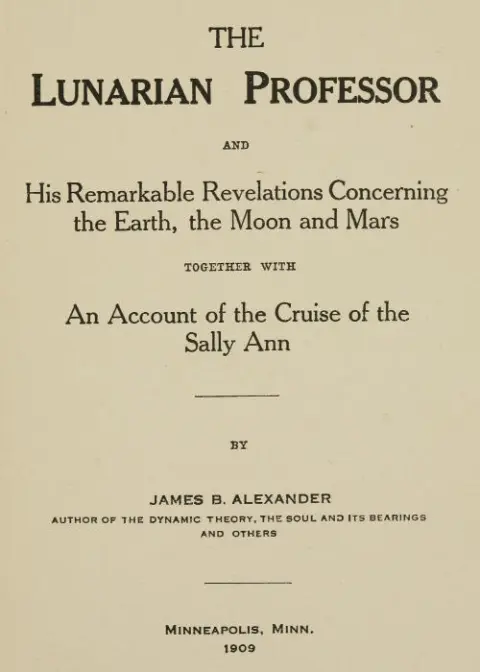
"The Lunarian Professor and His Remarkable Revelations Concerning the Earth, the Moon and Mars" by James B. Alexander is a science fiction novel written in the early 20th century. The narrative is centered around a professor from the Moon who shares intriguing insights about life on various celestial bodies, focusing particularly on Earth and its inhabitants. Through a blend of humor and philosophical reflection, the book sets the stage for an exploration of advanced alien civilizations and their perspectives on humanity. At the start of the novel, the narrator reflects on his long-overdue outing to Lake Minnetonka, where he plans to unwind and enjoy solitude. As he embarks on the cruise of his boat, the Sally Ann, he unexpectedly encounters Allan Ocheltree, a close friend from his past. Their reunion is marked by nostalgic conversations, and soon after, the professor from the Moon makes his entrance, initiating a dialogue about his home and the remarkable differences between it and Earth. The opening sets a tone of whimsical adventure infused with speculative science, hinting at discussions on societal evolution, technology, and the nature of life beyond our planet.
Introduction adapted from the source catalogue; source summaries may be automatically generated.
Free to read · English · 80,068 words · No account needed
MAKE TIME FOR A GOOD BOOK
On by default. Untick to stop anonymous reading totals. Each page counts after 10 seconds in view. How this works.
Anonymous counting is on unless you have switched it off.
“In a great number of places tunnels have penetrated to regions of insupportable heat, and this heat transformed into electricity has been conveyed to the surface and its power distributed to great distances. This plan has been largely practiced in the mountainous regions of Asia and South America, Scandinavia, Alaska and other countries. In such regions heat can be reached without descending, and so the tunnels are self draining. This source of power helps out the sun in the rainy seasons etc.”
“You mentioned something about state savings institutions just now; I suppose they receive the money of the people and pay interest on it—or how?”
“The state savings institutions receive money and take care of it, but they pay no interest. They do not loan it, so get no income from it and cannot pay any. In fact their fundamental ideas of business have undergone a radical change for these many ages back. They deny that it is fair business to take a profit on any transaction. If a man lends his money to another he is entitled to pay for the time it takes him to make the loan and collect it, but he is not entitled to interest for use of the money. If a man borrows a plow worth ten dollars and wears it to the amount of one dollar, he should pay the owner the one dollar, but it is for repairs, not interest. If he borrows ten dollars in money and returns the full amount there is no wear to make good. If a man borrows ten dollars for which he must pay one dollar interest, then buys a plow and wears it one dollar’s worth he is out two dollars. So he must charge one dollar above its cost, for his crop, when he sells it, and this is called profit. He does not keep it, however, but must pass it over to the capitalist. He might charge two dollars profit, in which case, he would keep one for his profit and give the other to the capitalist for his. In both cases they say, it is wrong and unsound as a business transaction, because it is getting or giving something for nothing. The idea of the legitimacy of profits and interest arose in ancient times in connection with the uncertainty or the gambling element that entered into all business. This was due to individualism or the practice of each one doing business for himself, taking his own risks and chances in a thousand ways. If one spent his time and money in making something to sell, he was not absolutely sure he would be able to find a buyer. And if one loaned his money to be used in business he shared the risks of it and could not be absolutely sure of getting it back again. Up to the amount of the risks, profit and interest were under the conditions legitimate. But while under the individual system everybody charged for the risk of loss, the losses in reality fell on only a part, and so the rest got something for nothing. When insurance companies were organized to distribute part of the risks, making those who did not lose, contribute to make up the loss of those who did, the risks of all were diminished, and the profit and interest charges on that account reduced. If insurance with its distribution of risks had extended to every form of risk, and if the members of the companies or insured persons had embraced everyone in the community instead of only a part, then the special risks to each one would have been altogether eliminated, the insurance would have become a part of the cost of the goods to be added to their sale value, and profits above this no longer legitimate. For if one is entitled to profits so are all those with whom he exchanges and nobody gains; unless the profits of one are higher than those of another in which case someone is cheated or in other words robbed. Now when the state undertook practically all business and all transportation, and owned all houses, shops and factories, all risks of all forms were at once distributed to all the people, without the ceremony of insurance. If a building burned, or tools, or machinery became superseded by better ones, or goods became unsalable, or employes dishonest, or incompetent, the loss was fully insured, for it fell upon all, and there was nobody outside of this “all” to make it good. There could therefore be no possible honest end to be gained by profits; and interest on money falls with profits. As all the people work some time or other and receive wages, all have a bank account, for they are taught to be careful and economical, and they understand that one cannot spend a dollar and still have it.”
Your reading position is saved on this browser. Take it to another device with a library code. Reading pages adapt to text, rather than matching a printed edition.
BEHIND THE BOOK
This eBook is for the use of anyone anywhere in the United States and most other parts of the world at no cost and with almost no restrictions whatsoever. You may copy it, give it away or re-use it under the terms of the Project Gutenberg License included with this eBook or online at www.gutenberg.org. If you are not located in the United States, you will have to check the laws of the country where you are located before using this eBook. Read the source licence.
The original source file, including credits and licence, is retained by this library. Request an original-format copy at no charge. Please include the book title and Project Gutenberg identifier #60059.
KEEP YOUR CURIOSITY GOING
Coulson Kernahan

Maurice Baring
Frances Wright
Cécile Tormay
Francis Greenleaf Allinson & Anne C. E. (Anne Crosby Emery) Allinson

Frederic Jesup Stimson