THE CLASSIC COLLECTION✦A dead man’s diaryCLASSIC FREE BOOKS
A dead man’s diary
Coulson Kernahan
THE CLASSIC COLLECTION · 1909
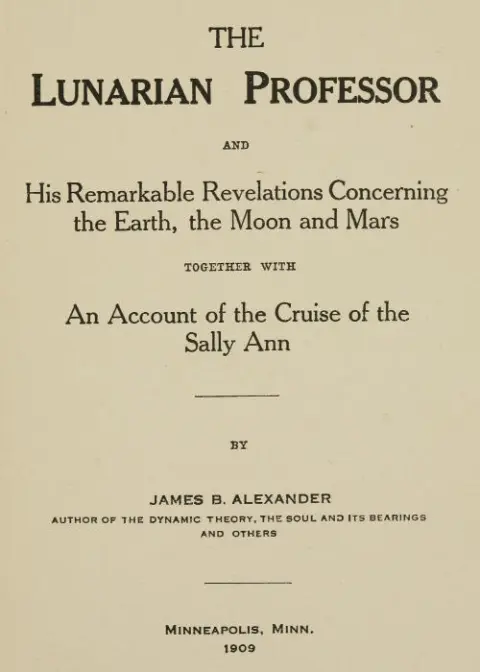
"The Lunarian Professor and His Remarkable Revelations Concerning the Earth, the Moon and Mars" by James B. Alexander is a science fiction novel written in the early 20th century. The narrative is centered around a professor from the Moon who shares intriguing insights about life on various celestial bodies, focusing particularly on Earth and its inhabitants. Through a blend of humor and philosophical reflection, the book sets the stage for an exploration of advanced alien civilizations and their perspectives on humanity. At the start of the novel, the narrator reflects on his long-overdue outing to Lake Minnetonka, where he plans to unwind and enjoy solitude. As he embarks on the cruise of his boat, the Sally Ann, he unexpectedly encounters Allan Ocheltree, a close friend from his past. Their reunion is marked by nostalgic conversations, and soon after, the professor from the Moon makes his entrance, initiating a dialogue about his home and the remarkable differences between it and Earth. The opening sets a tone of whimsical adventure infused with speculative science, hinting at discussions on societal evolution, technology, and the nature of life beyond our planet.
Introduction adapted from the source catalogue; source summaries may be automatically generated.
Free to read · English · 80,068 words · No account needed
MAKE TIME FOR A GOOD BOOK
On by default. Untick to stop anonymous reading totals. Each page counts after 10 seconds in view. How this works.
Anonymous counting is on unless you have switched it off.
“In ancient times the umbilical cord through which the embryo received its nourishment became pinched off on the outside after birth, while the part of it that remained inside of the body cavity became reduced to a mere string, a useless rudiment. But now that inside piece is kept in use from birth, the child being fed in the same way after as before birth. This opening by hereditary habit has developed wonderful changes for which, however, the long ages of use have furnished ample time for adjustment into a perfect adaptation of the parts and functions concerned. But really the changes are by no means so radical as they seem at first view. The change made in the mode of life of a new infant is in reality the same in effect now that it was in your day. The essential operation in both cases is the introduction of nourishment into the blood and it is accomplished in both cases by osmosis. The history of this evolution is interesting, but I can give you only a bare outline of it.
“As the business of the world came to be done almost exclusively by machinery directed by men’s brains, there was but little use for muscular exertion, especially of the legs and body. The use for legs in locomotion was also superseded by artificial modes of conveyance. Every road and street in the world was as smooth and clean as a parlor floor. On these were unlimited facilities for inexpensive transportation, public and private, the power being electric. Besides these were the flyers, also public and private. The life became almost exclusively a sitting life, even when in motion, sedentary in the most literal sense. This was, however, accompanied by the most intense activity of the brain. These conditions were decidedly antagonistical to the old system of the nourishment of the body by the stomach and intestines, because that system had been developed in connection with an active muscular body, and could be kept in good health only by vigorous muscular activity. Formerly four-fifths of the blood went to support digestion and muscular activity, and one-fifth went to the brain to support the mind. Increasing mental activity diverted more and more of the circulation towards the brain, until now it consumes three-fifths, muscular work takes not quite two-fifths and digestion and assimilation almost none. The result of the changes that constantly pressed in this direction, was that the first millennium was an age of dyspepsia. The increasing disability of the stomach for digestion, encouraged the use of digested foods, and these by excusing the stomach from doing its proper work, increased its disability. Children at first were usually born with good stomachs, but these by middle life or before, commonly degenerated into instruments of misery. Finally they would not even tolerate digested food and it became necessary to convey food within by some other means. Any method by which the nutritious matter properly digested can be introduced into the blood will support life. It became necessary to adopt hypodermic injections and other similar expedients. As this sort of treatment had to be applied earlier and earlier in life as time went on, even in some cases in childhood and infancy, they finally hit on the plan of using the ancient natural entrance of the umbilicus and not allowing it to close at all during life. In this way the ancient system of support and nutrition for the body through the stomach has been entirely subverted. The chemical processes of digestion, selection and assimilation of food are all done outside of the body, by artificial processes, and the cavity of the body is no longer filled with a series of brewing vats, soap factories, gas works and receptacles for refuse filth and foul water. For we may truly say that digestion consists of processes of fermentation of several different kinds and saponification or soap making. Little or nothing that is now taken into the body requires to be excreted and the only excretory organs are the skin and lungs, for moisture and carbonic dioxide. This radical change was not all effected at once, but was extended over many generations, and was not fully consummated till the second millennium was well spent. But before that one was finished, the atrophy of the digestive functions was so far complete that cases of possible reversion to them were extremely rare. The people of the present time look back with amusement, commiseration and disgust upon the walking laboratories that constituted their ancestors.”
Your reading position is saved on this browser. Take it to another device with a library code. Reading pages adapt to text, rather than matching a printed edition.
BEHIND THE BOOK
This eBook is for the use of anyone anywhere in the United States and most other parts of the world at no cost and with almost no restrictions whatsoever. You may copy it, give it away or re-use it under the terms of the Project Gutenberg License included with this eBook or online at www.gutenberg.org. If you are not located in the United States, you will have to check the laws of the country where you are located before using this eBook. Read the source licence.
The original source file, including credits and licence, is retained by this library. Request an original-format copy at no charge. Please include the book title and Project Gutenberg identifier #60059.
KEEP YOUR CURIOSITY GOING
Coulson Kernahan

Maurice Baring
Frances Wright
Cécile Tormay
Francis Greenleaf Allinson & Anne C. E. (Anne Crosby Emery) Allinson

Frederic Jesup Stimson