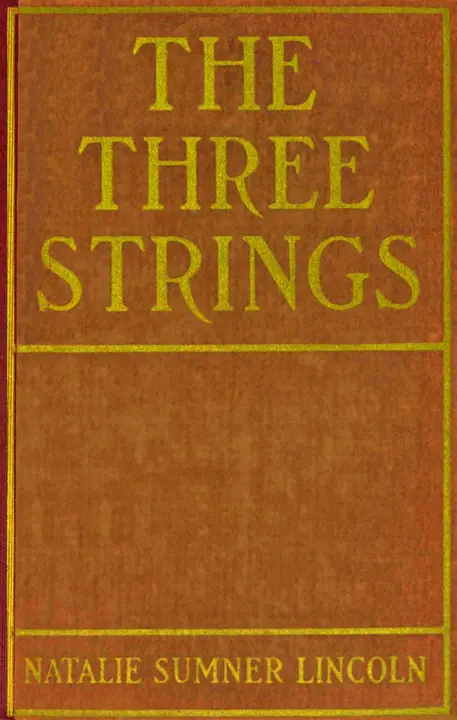
The three strings
Natalie Sumner Lincoln
THE CLASSIC COLLECTION · 1913
"The Lost Despatch" by Natalie Sumner Lincoln is a historical novel written in the early 20th century. Set during the American Civil War, the book likely explores themes of espionage, loyalty, and the complexity of human relationships amid the backdrop of war. The story involves Captain Lloyd and his companion, Symonds, who are engaged in secret service operations that lead them into encounters with spies and deception, ultimately revolving around a central female character, Nancy. The opening of the novel introduces a tense December night in 1864, where Captain Lloyd and Symonds are riding through the Maryland woods as they pursue leads related to a spy. Their mission is complicated when they encounter a Confederate courier revealed to be a woman, provoking a surprise attack that leads to a chaotic scene. Meanwhile, the tension of impending threats looms large as Lloyd contemplates the dangers of espionage and deception in Washington. The narrative sets the stage for a gripping tale of intrigue and personal stakes, promising a mix of action, character development, and the moral dilemmas faced during wartime.
Introduction adapted from the source catalogue; source summaries may be automatically generated.
Free to read · English · 55,735 words · No account needed
MAKE TIME FOR A GOOD BOOK
On by default. Untick to stop anonymous reading totals. Each page counts after 10 seconds in view. How this works.
Anonymous counting is on unless you have switched it off.
A long table with writing materials on it had been provided for the use of the members of the court, and a smaller one for Nancy and her counsel was placed near it. Facing the two tables was a chair for the witnesses, and beyond that another small table for the use of the reporters.
The officers, who wore their full-dress uniforms and side arms, were soon seated about the table, with the presiding officer, Colonel Andrews, at the head, and the judge advocate, Captain Foster, in undress uniform, facing him at the foot. At a signal from the judge advocate, one of the orderlies in attendance stepped to the door and spoke to the sentry.
In a few minutes, Nancy was ushered into the room by the provost sergeant of the guard. Warren rose instantly, and escorted her to her seat, and his eyes flashed in admiration of her poise and beauty.
Tranquilly and with dignity, she returned the salutes of the officers; if she had been receiving them in her own drawing-room, her manner could not have been more composed.
Mrs. Warren, who sat between Mrs. Arnold and Mrs. Bennett, noticed with pitying heart the deep shadows under Nancy's eyes and the hollows in her white cheeks. She bent forward, and impulsively kissed her hand to Nancy when the latter looked wistfully at her, and was promptly rebuked by the presiding officer. Nancy had hoped that her aunt would be present, but Warren had decided to call Miss Metoaca as one of the witnesses for the defence, and therefore she could not attend the hearings.
The judge advocate rapped for order; then rose and signed to Nancy to do likewise as he read from a paper in his hand:
"Special Orders } War Department,
No. 576 } Office of the Adjutant-General,
} April 8th, 1865.
"4 ... A Military Commission is appointed to meet in the City of Washington, District of Columbia, at nine o'clock on Monday, April 10th, 1865, for the trial of Miss Nancy Newton.
"Detail for the Commission
"Colonel Andrews U.S. Volunteers Major Charles Lane U.S. Veterans Reserve Corps Captain John Taylor 1st Squadron Provisional Cavalry Lieutenant Joseph Clarke 1st Mass. Heavy Artillery Lieutenant Henry Wells 1st N.H. Heavy Artillery Lieutenant Harvey Slocum 3rd Mass. Heavy Artillery Lieutenant James Phillipse 2nd District Volunteer Cavalry Captain George Foster --th U.S. Infantry, Judge Advocate and Recorder.
"A greater number of officers cannot be assembled without manifest injury to the service at this time.
"By command of the President.
"E. D. TOWNSEND,
Assistant Adjutant-General."
"Prisoner," the judge advocate turned and faced her directly, "do you object to being tried by any member of this commission?"
"No, sir," answered Nancy calmly.
Your reading position is saved on this browser. Take it to another device with a library code. Reading pages adapt to text, rather than matching a printed edition.
Natalie Sumner Lincoln
Natalie Sumner Lincoln
Natalie Sumner Lincoln
Natalie Sumner Lincoln
BEHIND THE BOOK
This eBook is for the use of anyone anywhere in the United States and most other parts of the world at no cost and with almost no restrictions whatsoever. You may copy it, give it away or re-use it under the terms of the Project Gutenberg License included with this eBook or online at www.gutenberg.org. If you are not located in the United States, you will have to check the laws of the country where you are located before using this eBook. Read the source licence.
The original source file, including credits and licence, is retained by this library. Request an original-format copy at no charge. Please include the book title and Project Gutenberg identifier #24204.
KEEP YOUR CURIOSITY GOING
Cécile Tormay

Moritz Busch
Coulson Kernahan
John L. Ransom

Maurice Baring
Frances Wright