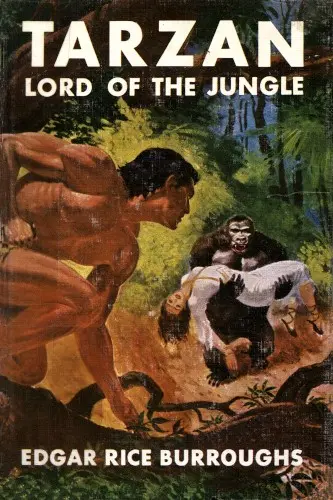
Tarzan, lord of the jungle
Edgar Rice Burroughs
THE CLASSIC COLLECTION · 1916
"The Lost Continent" by Edgar Rice Burroughs is a novel likely written in the early 20th century. The story is set in a post-apocalyptic future where the Eastern Hemisphere has been cut off from the West for over 200 years following a devastating war. The narrative revolves around Lieutenant Jefferson Turck, a naval officer of the Pan-American Federation, who embarks on a journey beyond the borders set by his civilization, seeking to uncover the mysteries of a long-lost and savage Europe. At the start of the book, Jefferson Turck reflects on the isolation of Europe and the consequences of the Great War that left it abandoned and forgotten. When his ship, the Coldwater, suffers mechanical failures, Turck finds himself crossing the forbidden line into this unknown territory. After a harrowing experience at sea, he and a few crew members wash ashore in a wild and dangerous land. As they navigate this savage world, they encounter exotic beasts and primitive tribes, revealing that civilization has regressed into a state of brutality and ignorance, far removed from the advanced society Turck knows. The opening sets the stage for a gripping adventure filled with peril, exploration, and the struggle to survive amidst the remnants of a once-great civilization.
Introduction adapted from the source catalogue; source summaries may be automatically generated.
Free to read · English · 38,076 words · No account needed
MAKE TIME FOR A GOOD BOOK
On by default. Untick to stop anonymous reading totals. Each page counts after 10 seconds in view. How this works.
Anonymous counting is on unless you have switched it off.
A moment later, with our assistance, the man had scrambled from beneath the carcass of his would-be slayer, without a scratch to indicate how close to death he had been.
Delcarte’s buoyance was entirely unruffled. He came from under the tiger with a broad grin on his handsome face, nor could I perceive that a muscle trembled or that his voice showed the least indication of nervousness or excitement.
With the termination of the adventure, we began to speculate upon the explanation of the presence of this savage brute at large so great a distance from its native habitat. My readings had taught me that it was practically unknown outside of Asia, and that, so late as the twentieth century, at least, there had been no savage beasts outside captivity in England.
As we talked, Snider joined us, and I returned his rifle to him. Taylor and Delcarte picked up the slain deer, and we all started down toward the launch, walking slowly. Delcarte wanted to fetch the tigerl’s skin, but I had to deny him permission, since we had no means to properly cure it.
Upon the beach, we skinned the deer and cut away as much meat as we thought we could dispose of, and as we were again embarking to continue up the river for fresh water and fuel, we were startled by a series of screams from the bushes a short distance away.
“Another Felis tigris,” said Taylor.
“Or a dozen of them,” supplemented Delcarte, and, even as he spoke, there leaped into sight, one after another, eight of the beasts, full grown—magnificent specimens.
At the sight of us, they came charging down like infuriated demons. I saw that three rifles would be no match for them, and so I gave the word to put out from shore, hoping that the “tiger,” as the ancients called him, could not swim.
Sure enough, they all halted at the beach, pacing back and forth,
uttering fiendish cries, and glaring at us in the most malevolent
manner.
As we motored away, we presently heard the calls of similar animals far inland. They seemed to be answering the cries of their fellows at the waterl’s edge, and from the wide distribution and great volume of the sound we came to the conclusion that enormous numbers of these beasts must roam the adjacent country.
“They have eaten up the inhabitants,” murmured Snider, shuddering.
“I imagine you are right,” I agreed, “for their extreme boldness and fearlessness in the presence of man would suggest either that man is entirely unknown to them, or that they are extremely familiar with him as their natural and most easily procured prey.”
Your reading position is saved on this browser. Take it to another device with a library code. Reading pages adapt to text, rather than matching a printed edition.
Edgar Rice Burroughs

Edgar Rice Burroughs
Edgar Rice Burroughs

Edgar Rice Burroughs
BEHIND THE BOOK
This eBook is for the use of anyone anywhere in the United States and most other parts of the world at no cost and with almost no restrictions whatsoever. You may copy it, give it away or re-use it under the terms of the Project Gutenberg License included with this eBook or online at www.gutenberg.org. If you are not located in the United States, you will have to check the laws of the country where you are located before using this eBook. Read the source licence.
The original source file, including credits and licence, is retained by this library. Request an original-format copy at no charge. Please include the book title and Project Gutenberg identifier #149.
KEEP YOUR CURIOSITY GOING
Coulson Kernahan

Maurice Baring
Frances Wright
Cécile Tormay
Francis Greenleaf Allinson & Anne C. E. (Anne Crosby Emery) Allinson

Frederic Jesup Stimson