THE CLASSIC COLLECTION✦The trail of the Golden HornCLASSIC FREE BOOKS
The trail of the Golden Horn
H. A. (Hiram Alfred) Cody
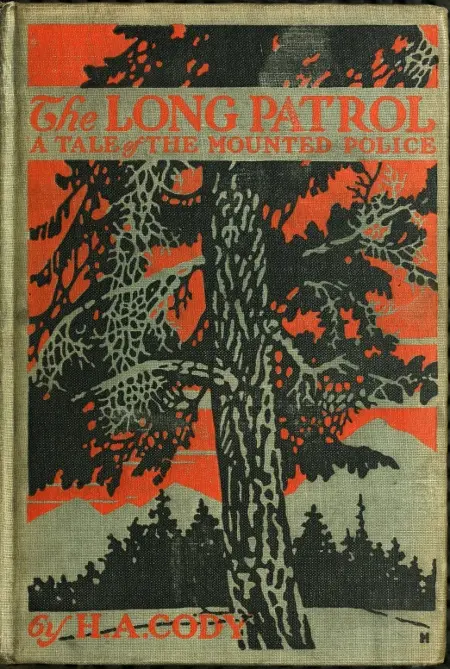
THE CLASSIC COLLECTION · 1912
"The Long Patrol: A Tale of the Mounted Police" by H. A. Cody is a novel written in the early 20th century. It follows the journey of Constable Norman Grey, a member of the Royal North West Mounted Police, as he embarks on a perilous mission to rescue a kidnapped child, Donnie, in the remote wilderness of the Yukon Territories. The story is interwoven with themes of duty, bravery, and the personal struggles of the protagonist as he confronts both external dangers and internal conflicts during his quest. The opening of the novel introduces us to Grey in the Big Glen Barracks after he receives orders from Major Sterling to investigate the disappearance of Donnie, the son of a prominent local citizen. As he prepares for his journey, we see a glimpse of his character through the admiration of his peers who recognize his courage and capability. The narrative shifts to Grey's daunting trek through unforgiving landscapes, punctuated by a fierce encounter with a grizzly bear, showcasing his tenacity. Ultimately, Grey's determination pays off as he rescues Donnie from the icy waters of the Hishu River, setting the stage for further developments in this gripping tale of adventure and morality.
Introduction adapted from the source catalogue; source summaries may be automatically generated.
Free to read · English · 76,425 words · No account needed
MAKE TIME FOR A GOOD BOOK
On by default. Untick to stop anonymous reading totals. Each page counts after 10 seconds in view. How this works.
Anonymous counting is on unless you have switched it off.
Slowly he rose to his feet and began to climb the bank. Scarcely had he reached the level above ere he gave a start and looked quickly up-stream. What was that? A shout, a cry of terror, which winged its way to his ears. He straightened himself up, shaded his eyes with his hand, and scanned the river. The sun had been down for some time, but the long northern twilight was still struggling with night, and it was not hard to discern objects some distance away. As Grey's eyes rested upon the rapids he beheld a boat--a frail craft--go to pieces upon a sunken rock right in the centre of that swirling death. Then out from the midst of the roaring mass of tumultuous billows darted a dark object. Rapidly it was borne down the stream, and as it approached nearer Grey observed a man clinging frantically with one hand to a fragment of the boat, while with the other he was clutching the limp form of a little child. Grey was all alert now. His weariness and pain were gone. His tall gaunt figure was drawn to its full height, forming a dark silhouette against the evening sky. The clinging man looked toward the shore. His face was filled with agony, and twitched convulsively.
"Help! help!" he cried. "This icy water's killing me! I can't hold on any longer!--oh--God!" and with a wild piercing yell he threw up his hands and sank beneath the surface.
Quicker than words Grey tore off his buckskin jacket, and throwing discretion to the wind hurled himself into the racing stream. Though a powerful swimmer he was but a gnat in that terrible current. It seemed the maddest of folly to attempt a rescue in such a place. The waters were icy, and his soggy clothes impeded his progress. Why give up his own life for a vague uncertainty? Why risk all in a hazardous throw? But a little face--oh, so white--gleamed before him, and a curly head of gold appeared. The sight nerved him almost to superhuman effort. With lusty sinews and mighty strokes he clove the water like a Titan. He reached the child, he clutched it, held its head above the surface, and turned toward the shore. Fortunately the piece of broken boat floated near. This he grasped with one hand, and the child with the other. No longer now did he try to stem the stream, but simply allowed himself to drift. On and on they sped, Grey becoming more numbed all the time. Often he felt he could endure no longer, that he must give up and sink. But the sight of that little child, lying so still in his arm, caused him to grip the wreck more firmly. Only a short time before he had cherished the idea of rest and peace beneath those same cold waters. Now all was changed, and, instead of death, life was uppermost in his mind. Not life for himself alone, but for that helpless form pressed close to his breast. Oh, for a friendly voice from the shore, and a strong hand stretched out to lift them from the icy depths. Ere long his brain began to whirl. He seemed to be battling in the midst of thousands of hideous serpents. They were coiling about his legs, arms and body. They were leaping up, trying to tear away the child from his breast, and to loosen his hold upon the boards. How much longer would they torture him? Would they soon gain complete possession and bear him down never to rise again? No, he would fight them. He would conquer. He would beat them back. They were worse than the grizzly, but he would win. And even as he made another great determined struggle his feet struck something which sent a thrill of hope through his heart. Was it merely a delusion? Was it only a fond fancy of his reeling brain? No, it was true. His feet had struck a sand-bar, which put out from the shore like a long finger hidden beneath the surface. Relaxing his grip of the raft, and with the child in his arms Grey feebly and with much difficulty made his way through the swirling water. So numb was his body that his legs seemed like two lifeless sticks as he staggered forward. It was all he could do to reach the shore and climb the bank. Then his strength deserted him. He trembled and sank upon the hard ground. It was only for a few seconds, however, for the child lying there needed immediate attention. Kneeling by his side he peered into the little white face, noticed the wan, pinched features, the luxuriant curly hair dripping with water, and the soaked clothes clinging like cerements to his body. "What was such a lad doing there?" he wondered. That not more than three summers had passed over his head was quite evident. He was no poor man's child, for the garments betokened a home of means and loving care above the ordinary. At his throat a small safety pin was fastened, and as Grey peered down through the faint and uncertain light he saw engraved there the one word "Donnie." An exclamation of astonishment escaped his lips. His eyes were suddenly opened, and he beheld before him Silas Farwell's little stolen child.
Your reading position is saved on this browser. Take it to another device with a library code. Reading pages adapt to text, rather than matching a printed edition.
H. A. (Hiram Alfred) Cody
H. A. (Hiram Alfred) Cody
H. A. (Hiram Alfred) Cody
H. A. (Hiram Alfred) Cody
BEHIND THE BOOK
This eBook is for the use of anyone anywhere in the United States and most other parts of the world at no cost and with almost no restrictions whatsoever. You may copy it, give it away or re-use it under the terms of the Project Gutenberg License included with this eBook or online at www.gutenberg.org. If you are not located in the United States, you will have to check the laws of the country where you are located before using this eBook. Read the source licence.
The original source file, including credits and licence, is retained by this library. Request an original-format copy at no charge. Please include the book title and Project Gutenberg identifier #45245.
KEEP YOUR CURIOSITY GOING
Coulson Kernahan

Maurice Baring
Frances Wright
Cécile Tormay

Frederic Jesup Stimson

W. H. P. (William Henry Pope) Jarvis