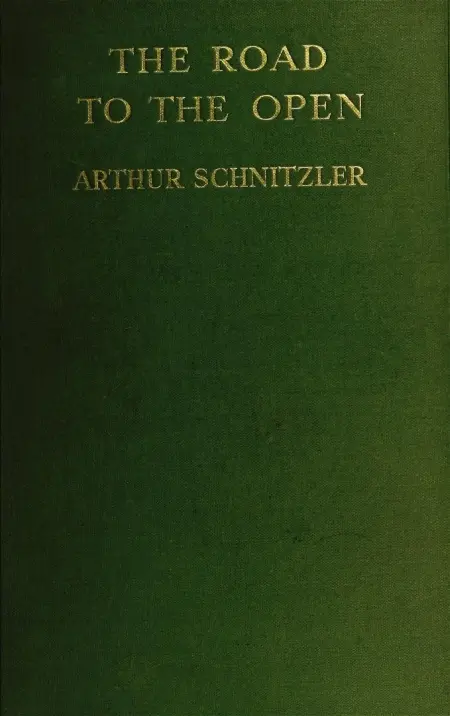
The Road to the Open
Arthur Schnitzler
THE CLASSIC COLLECTION · 1915
"The Lonely Way—Intermezzo—Countess Mizzie" by Arthur Schnitzler is a collection of three plays written in the early 20th century. The works delve into themes of love, personal struggle, and the complexities of human relationships, set against the backdrop of early modern Vienna. The characters in Schnitzler's plays often embody the tensions between societal expectations and individual desires, making the collection a poignant exploration of human intimacy and existential themes. The opening of the first play, "The Lonely Way," introduces a family dynamic within the garden of Professor Wegrat's house, highlighting his interactions with his wife and children, as well as their acquaintances. As the characters converse, they navigate the weight of familial expectations, personal aspirations, and the looming presence of illness, which adds an undercurrent of melancholy. The dialogue reveals deep-seated fears and desires, particularly through the character of Johanna, who grapples with her mother's illness and the implications of their growing distance. This opening sets the stage for the unfolding emotional conflicts, inviting readers into the intricate webs of relationships that Schnitzler masterfully explores.
Introduction adapted from the source catalogue; source summaries may be automatically generated.
Free to read · English · 70,089 words · No account needed
MAKE TIME FOR A GOOD BOOK
On by default. Untick to stop anonymous reading totals. Each page counts after 10 seconds in view. How this works.
Anonymous counting is on unless you have switched it off.
Yes, Felix, it's easy for you to talk.
What do you mean?
JOHANNA (speaking as if to herself)
I don't know if you'll be able to understand me.
FELIX (smiling)
Why should it all at once be so hard for me to understand you?
JOHANNA (looking calmly at him)
Now when she is sick, I don't love her as much as before.
FELIX (startled)
What?
No, it's impossible that you could quite understand. All the time she is getting farther away from us.... It is as if every day a new set of veils dropped down about her.
And what is the meaning of it?
JOHANNA (continues to look at him in the same calm way)
You think...?
You know, Felix, that I never make any mistakes in things of that kind.
I know, you say...?
When poor little Lillie von Sala had to die, I was aware of it in advance--before the rest of you knew that she was sick even.
Yes, you had had a dream--and you were nothing but a child.
I didn't dream it. I knew it. (Brusquely) It's something I can't
explain.
FELIX (after a pause)
And papa--has he resigned himself to it?
Resigned himself?--Do you think he too can see those veils coming down?
FELIX (having first shaken his head slightly)
Nothing but imagination, Johanna--I am sure.--But now I want to.... (Turning toward the house) Papa hasn't come home yet?
No. As a rule he's very late these days. He has an awful lot to do in
the Academy.
I'll try not to wake her up--I'll be careful. (He goes out by way of
the veranda)
[While alone for a while, Johanna seats herself on the garden bench with her hands clasped across her knees. Sala enters. He is forty-five, but looks younger. Slender to the verge of leanness, and smooth-shaven. His brown hair, which has begun to turn gray at the temples, and which he wears rather long, is parted on the right side. His features are keen and energetic; his eyes, gray and clear.
Good evening, Miss Johanna.
Good evening, Mr. von Sala.
They told me your mother was having a little nap, and so I permitted myself to come out here in the meantime.
Felix just got here.
Well? Have they already granted him another furlough? In my days they were stricter in that regiment. However, we were then stationed near the border--somewhere in Galicia.
I can never keep in mind that you have gone through that kind of thing
too.
Your reading position is saved on this browser. Take it to another device with a library code. Reading pages adapt to text, rather than matching a printed edition.
Arthur Schnitzler
Arthur Schnitzler
BEHIND THE BOOK
This eBook is for the use of anyone anywhere in the United States and most other parts of the world at no cost and with almost no restrictions whatsoever. You may copy it, give it away or re-use it under the terms of the Project Gutenberg License included with this eBook or online at www.gutenberg.org. If you are not located in the United States, you will have to check the laws of the country where you are located before using this eBook. Read the source licence.
The original source file, including credits and licence, is retained by this library. Request an original-format copy at no charge. Please include the book title and Project Gutenberg identifier #29745.
KEEP YOUR CURIOSITY GOING
Maurice Baring
W. B. (William Butler) Yeats
Edward Martyn

John Brougham & Charlotte Brontë
Marguerite Merington
Leonid Andreyev