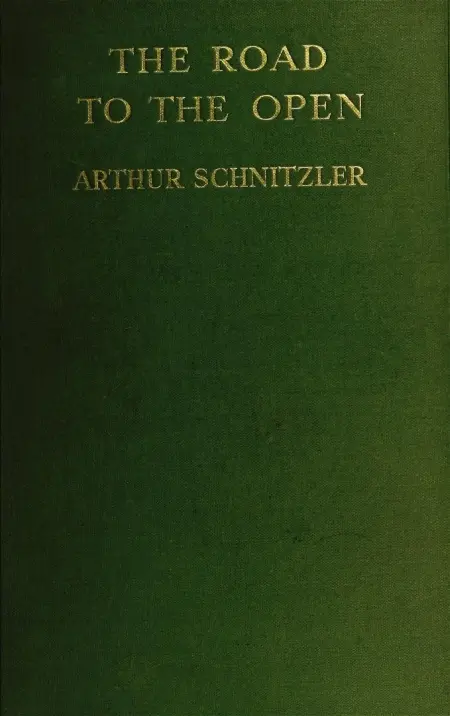
The Road to the Open
Arthur Schnitzler
THE CLASSIC COLLECTION · 1915
"The Lonely Way—Intermezzo—Countess Mizzie" by Arthur Schnitzler is a collection of three plays written in the early 20th century. The works delve into themes of love, personal struggle, and the complexities of human relationships, set against the backdrop of early modern Vienna. The characters in Schnitzler's plays often embody the tensions between societal expectations and individual desires, making the collection a poignant exploration of human intimacy and existential themes. The opening of the first play, "The Lonely Way," introduces a family dynamic within the garden of Professor Wegrat's house, highlighting his interactions with his wife and children, as well as their acquaintances. As the characters converse, they navigate the weight of familial expectations, personal aspirations, and the looming presence of illness, which adds an undercurrent of melancholy. The dialogue reveals deep-seated fears and desires, particularly through the character of Johanna, who grapples with her mother's illness and the implications of their growing distance. This opening sets the stage for the unfolding emotional conflicts, inviting readers into the intricate webs of relationships that Schnitzler masterfully explores.
Introduction adapted from the source catalogue; source summaries may be automatically generated.
Free to read · English · 70,089 words · No account needed
MAKE TIME FOR A GOOD BOOK
On by default. Untick to stop anonymous reading totals. Each page counts after 10 seconds in view. How this works.
Anonymous counting is on unless you have switched it off.
Please, my dear fellow, don't forget when writing your play, to introduce a figure on which reality in this case has lavished much more care than on the hero--I mean, the fool.
You can't insult me in that way. I have always regarded myself as
closely akin to him.
[Marie enters with little Peter and the Governess.
Mamma is coming!
The carriage has just stopped outside.
It was impossible to make the boy stay in bed.
And look at the fine flowers he has got!
That's for mamma!
AMADEUS (takes a flower out of the bunch)
I hope you permit, sonny ...
CECILIA (enters followed by the Chambermaid)
Good evening!--Oh, are you here, too? That's awfully nice!
Mamma!--Flowers!
CECILIA (picks him up and kisses him)
My boy! My boy! (Then she shakes hands with the rest)
AMADEUS (handing her the single flower)
Peter let me have one, too.
Thanks. (She shakes hands with him; then to the chambermaid) Get my things out of the carriage, please. The coachman will help you. He has been paid already.
CHAMBERMAID (goes out)
CECILIA (taking off her hat)
Well, Marie?... (To the other two) Can it be possible that you
have been working?
We have tried.
CECILIA (to the governess)
Has he behaved like a little man?
Indeed I have! Have you brought anything for me?
Of course. But you won't get it until to-morrow morning.
Why not?
Because I am too tired to unpack. To-morrow, when you wake up, you'll find it on your little table.
What is it?
You'll see by and by....
Is my little table big enough for it?
We'll hope so.
AMADEUS (who is leaning against the piano, keeps looking at her all
the time)
CECILIA (pretends not to notice him)
You're looking splendid.
I'm a little bit worn out.
You must be hungry.
Not at all. We had something to eat in the dining car. Almost everybody did. But I do want a cup of tea. (To the governess) Will you see to it, please?
Let me have a cup, too, and please see that I get a few slices of cold
meat.
I have given orders for it already. (She goes out)
Have you really been waiting for me with the supper?
No ... I haven't been waiting. I ... simply never thought of it.
CECILIA (to Albert and Marie)
Why don't you sit down?
No, we are going, my dear Cecilia. Let me congratulate you with all my heart--that will be enough for to-day.
Your reading position is saved on this browser. Take it to another device with a library code. Reading pages adapt to text, rather than matching a printed edition.
Arthur Schnitzler
Arthur Schnitzler
BEHIND THE BOOK
This eBook is for the use of anyone anywhere in the United States and most other parts of the world at no cost and with almost no restrictions whatsoever. You may copy it, give it away or re-use it under the terms of the Project Gutenberg License included with this eBook or online at www.gutenberg.org. If you are not located in the United States, you will have to check the laws of the country where you are located before using this eBook. Read the source licence.
The original source file, including credits and licence, is retained by this library. Request an original-format copy at no charge. Please include the book title and Project Gutenberg identifier #29745.
KEEP YOUR CURIOSITY GOING
Maurice Baring
W. B. (William Butler) Yeats
Edward Martyn

John Brougham & Charlotte Brontë
Marguerite Merington
Leonid Andreyev