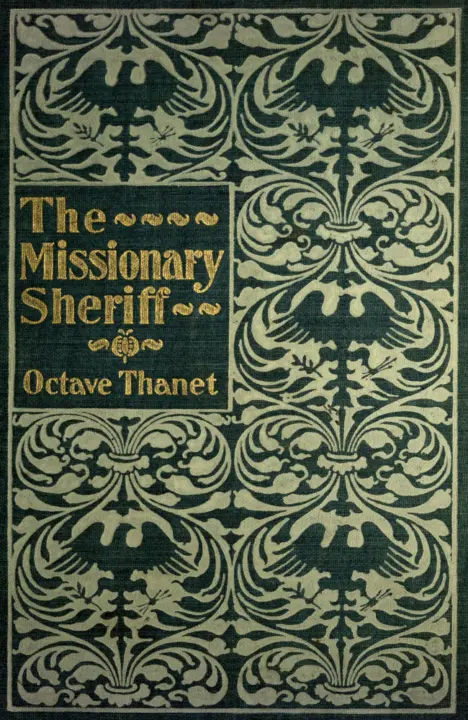
The Missionary Sheriff Being incidents in the life of a plain man who tried to do his duty
Octave Thanet
THE CLASSIC COLLECTION · 1907
"The Lion's Share" by Octave Thanet is a novel written in the early 20th century. The story opens with Colonel Rupert Winter, a soldier returning home from the Philippines on furlough and meeting Cary Mercer, the brother of a young man involved in a tragic incident, setting the stage for a narrative filled with intrigue and complex family dynamics. The opening of the book introduces Colonel Winter's chance encounter with Cary Mercer, who is grappling with the aftermath of his brother's suicide. Set against a backdrop of financial turmoil and personal loss, the narrative begins to weave a tale of familial connections and hidden motives, especially regarding the older generation represented by Aunt Rebecca. As Winter becomes entangled in a web of relationships and potential dangers, particularly surrounding the enigmatic Miss Smith and the restless Archie, the groundwork is laid for a tension-filled exploration of loyalty, fear, and the pursuit of truth.
Introduction adapted from the source catalogue; source summaries may be automatically generated.
Free to read · English · 77,403 words · No account needed
MAKE TIME FOR A GOOD BOOK
On by default. Untick to stop anonymous reading totals. Each page counts after 10 seconds in view. How this works.
Anonymous counting is on unless you have switched it off.
With extreme courtesy of manner Winter approached the young man.
“Pardon me,” said he. “I am Colonel Winter; my aunt, Mrs. Winter, has the rooms near yours, and she finds that she needs another room or two. Are you leaving yours?”
“These are Mr. Keatcham’s rooms, not mine,” the young man responded politely. “He is leaving them.”
“When you give up your keys, would you mind asking the clerk to send them up to me?” pursued the colonel. “Room three twenty-seven.”
“Certainly,” replied the young man, “or would you like to look at them
a moment now?”
“Why--if it wouldn’t detain you,” hesitated Winter; he was hardly prepared for the offer of admittance.
“Get the elevator and hold it a minute, Colvin,” said the young man, and he instantly fitted the key to the door, which he flung open.
“Excuse me,” said he, as they stood in the room, “but aren’t you the Colonel Winter who held that mountain pass to let the other fellows get off, after your ammunition was exhausted?”
“I seem to recall some such episode, only it sounds rather gaudy the
way you put it.”
“I read about you in the papers; you swam a river with Funston; did all
kinds of stunts--”
“Or the newspaper reporter did. You don’t happen to know anything about the price of these rooms, I suppose?”
The young man did not know, but he showed the colonel through all the rooms with vast civility. He seemed quite indifferent to the colonel’s interest in closets, baths and wardrobes; he only wanted to talk about the Philippines.
The colonel, who always shied like a mettled horse from the flutter of his own laurels, grew red with discomfort and rattled the door-knobs.
“There the suite ends,” said the young man.
“Oh, we don’t want it all, only a room or two,” Colonel Winter demurred. “Any one of these rooms would do. Well, I will not detain you. The elevator boy will be tired, and Mr. Keatcham will grow impatient.”
“Not at all; he will have gone. I--I’m so very glad to have met you,
Colonel--”
In this manner, with mutual civilities, they parted, the young man escorting the colonel to his own door, which the latter was forced to enter by the sheer demands of the situation.
But hardly had the door closed than he popped out again. The young man was swinging round the corner next the elevator.
Your reading position is saved on this browser. Take it to another device with a library code. Reading pages adapt to text, rather than matching a printed edition.
BEHIND THE BOOK
This eBook is for the use of anyone anywhere in the United States and most other parts of the world at no cost and with almost no restrictions whatsoever. You may copy it, give it away or re-use it under the terms of the Project Gutenberg License included with this eBook or online at www.gutenberg.org. If you are not located in the United States, you will have to check the laws of the country where you are located before using this eBook. Read the source licence.
The original source file, including credits and licence, is retained by this library. Request an original-format copy at no charge. Please include the book title and Project Gutenberg identifier #68875.
KEEP YOUR CURIOSITY GOING
Coulson Kernahan

Maurice Baring
Frances Wright
Cécile Tormay

Frederic Jesup Stimson

W. H. P. (William Henry Pope) Jarvis