THE CLASSIC COLLECTION✦Ewing’s LadyCLASSIC FREE BOOKS
Ewing’s Lady
Harry Leon Wilson
THE CLASSIC COLLECTION · 1903
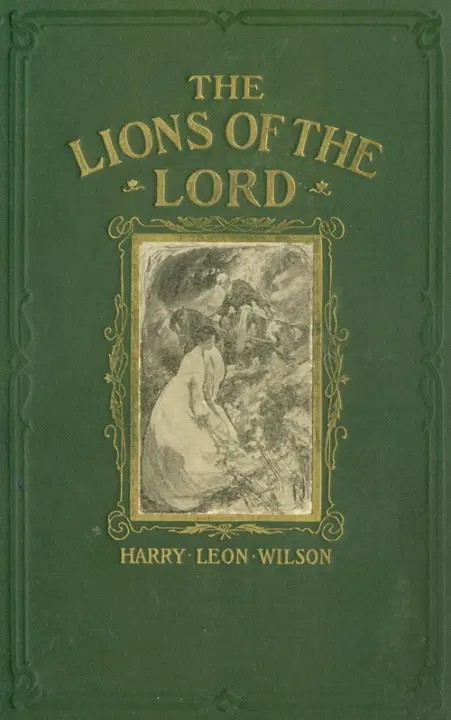
"The Lions of the Lord: A Tale of the Old West" by Harry Leon Wilson is a historical novel written in the early 20th century. The story focuses on moments in the life of a pioneering community in the Old West, particularly exploring their struggles with persecution and the quest for a promised land, as depicted through the experiences of its central character, Joel Rae. The narrative touches on themes of faith, sacrifice, and identity against the backdrop of a frontier filled with both hope and danger. At the start of the book, the narrative paints a haunting picture of a deserted city, once vibrant but now eerily silent and lifeless. Young Joel Rae arrives to find the streets empty and the signs of a recent exodus evident, triggering feelings of anxiety and confusion. As he explores, he encounters a hostile environment shaped by recent mob violence against his community, highlighting the precarious circumstances faced by the Saints, which include displacement and the dire consequences of their beliefs. In his efforts to piece together what has happened, Joel's encounters reveal both personal and collective struggles as he grapples with his identity, love, and responsibilities to his family and faith. The opening sets the stage for a tale of resilience amidst adversity.
Introduction adapted from the source catalogue; source summaries may be automatically generated.
Free to read · English · 125,370 words · No account needed
MAKE TIME FOR A GOOD BOOK
On by default. Untick to stop anonymous reading totals. Each page counts after 10 seconds in view. How this works.
Anonymous counting is on unless you have switched it off.
But, after the needful preliminaries, and a very little coy hesitation on the part of the lady, Lorena Sears, spinster, native of Elyria, Ohio, was duly sealed to, for time and eternity, and became a star forever in the crown of, Joel Rae, Elder after the Order of Melchisedek in the Church of Jesus Christ of Latter-day Saints and President of the Amalon Stake of Zion.
In the bustle of the start south there were, of necessity, moments in which the crown's new star could not talk; but these blessed respites were at an end when at last they came to the open road.
At first, as her speech flowed on, he looked sidelong at her, in a trouble of fear and wonder; then, at length, absently, trying to put his mind elsewhere and to leave her voice as the muted murmur of a distant torrent. He succeeded fairly well in this, for Lorena combined admirably in herself the parts of speaker and listener, and was not, he thankfully noted, watchful of his attention.
But in spite of all he could do, sentences would come to seize upon his ears: "... No chance at all back there for a good girl with any heart in her unless she's one of the doll-baby kind, and, thank fortune, I never was that! Now there was Wilbur Watkins--his father was president of the board of chosen freeholders--Wilbur had a way of saying, 'Lorena's all right--she weighs a hundred and seventy-eight pounds on the big scales down to the city meatmarket, and it's most of it heart--a hundred and seventy-eight pounds and most all heart--and she'd be a prize to anybody,' but then, that was his way,--Wilbur was a good deal of a take-on,--and there was never anything between him and me. And when the Elder come along and begun to preach about the new Zion and tell about the strange ways that the Lord had ordered people to act out here, something kind of went all through me, and I says, 'That's the place for me!' Of course, the saying is, 'There ain't any Gawd west of the Missouri,' but them that says it ain't of the house of Israel--lots of folks purtends to be great Bible readers, but pin 'em right down and what do you find?--you find they ain't really studied it--not what you could call pored over it. They fuss through a chapter here and there, and rush lickety-brindle through another, and ain't got the blessed truth out of any of 'em--little fine points, like where the Lord hardened Pharaoh's heart every time, for why?--because if He hadn't 'a' done it Pharaoh would 'a' give in the very first time and spoiled the whole thing. And then the Lord would visit so plumb natural and commonlike with Moses--like tellin' him, 'I appeared unto Abraham, unto Isaac, and unto Jacob by the name of God Almighty, for by my name Jehovah was I not known unto them.' I thought that was awful cute and friendly, stoppin' to talk about His name that way. Oh, I've spent hours and hours over the blessed Book. I bet I know something you don't, now--what verse in the Bible has every letter in the alphabet in it except 'J'? Of course you wouldn't know. Plenty of preachers don't. It's the twenty-first verse of the seventh chapter of the book of Ezra. And the Book of Mormon--I do love to git set down in a rocker with my shoes off--I'm kind of a heavy-footed person to be on my feet all day--and that blessed Book in my hands--such beautiful language it uses--that verse I love so, 'He went forth among the people waving the rent of his garment in the air that all might see the writing which he had wrote upon the rent,'--that's sure enough Bible language, ain't it? And yet some folks say the Book of Mormon ain't inspired. And that lovely verse in Second Niphi, first chapter, fourteenth verse: 'Hear the words of a trembling parent whose limbs you must soon lay down in the cold and silent grave from whence no traveller can return.' Back home the school-teacher got hold of that--he's an awful smarty--and he says, 'Oh, that's from Shakespeare,' or some such book, just like that--and I just give him one look, and I says, 'Mr. Lyman Hickenlooper, if you'll take notice,' I says, 'you'll see those words was composed by the angel Moroni over two thousand years ago and revealed to Joseph Smith in the sacred light of the Urim and Thummim,' I says, and the plague-oned smarty snickered right in my face--and say, now, what did you and your second git a separation for?"
Your reading position is saved on this browser. Take it to another device with a library code. Reading pages adapt to text, rather than matching a printed edition.
Harry Leon Wilson
Harry Leon Wilson
Harry Leon Wilson
Harry Leon Wilson
BEHIND THE BOOK
This eBook is for the use of anyone anywhere in the United States and most other parts of the world at no cost and with almost no restrictions whatsoever. You may copy it, give it away or re-use it under the terms of the Project Gutenberg License included with this eBook or online at www.gutenberg.org. If you are not located in the United States, you will have to check the laws of the country where you are located before using this eBook. Read the source licence.
The original source file, including credits and licence, is retained by this library. Request an original-format copy at no charge. Please include the book title and Project Gutenberg identifier #11534.
KEEP YOUR CURIOSITY GOING
Cécile Tormay

Moritz Busch
Coulson Kernahan
John L. Ransom

Maurice Baring
Frances Wright