
Canada, the Spellbinder
Lilian Whiting
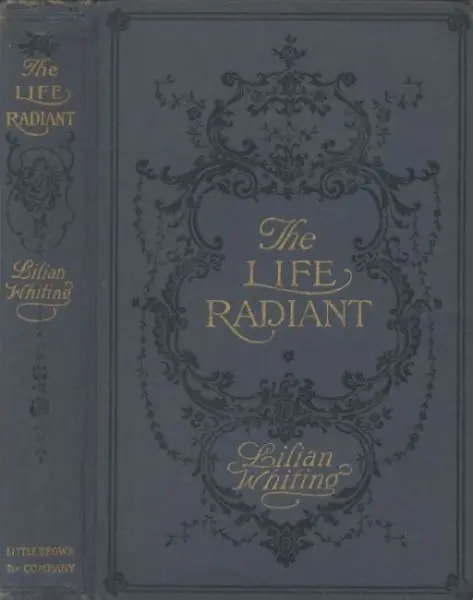
THE CLASSIC COLLECTION · 1903
"The Life Radiant" by Lilian Whiting is a spiritual and philosophical guide written in the early 20th century. The book explores the journey towards a more enlightened, fulfilling existence based on a harmonization of human will with divine will. Whiting emphasizes that individuals possess the power to create their own realities through faith and the recognition of spiritual energies. The opening of the text invites readers to consider their daily lives as part of a spiritual drama, where every experience contributes to a greater understanding of divine guidance. Whiting argues that life's challenges can be transformed into opportunities for spiritual growth, encouraging individuals to actively engage with both seen and unseen forces. Through a blend of inspiration and introspection, the author aims to teach readers the significance of intertwining their deeper spiritual aspirations with everyday experiences, setting the stage for the profound insights and transformative practices that will follow throughout the rest of the book.
Introduction adapted from the source catalogue; source summaries may be automatically generated.
Free to read · English · 72,842 words · No account needed
MAKE TIME FOR A GOOD BOOK
On by default. Untick to stop anonymous reading totals. Each page counts after 10 seconds in view. How this works.
Anonymous counting is on unless you have switched it off.
Here is one of the most marvellous among the new illustrations of the finer forces. But this "ship detector," which acts on the principle of wireless telegraphy, is less potent than are the electric forces in every human being, if it were known how to control and utilize these to serve the purposes of perception. For perception is a faculty that may far transcend both sight and hearing. Perception is a faculty of the soul--often undeveloped; rarely developed to anything like its full possibilities, but capable of locating objects or of discerning persons and events, or of apprehending states of mind in others, regardless of space, as the ship's detector and the shore stations become aware of each other through their relation of finer vibrations. A recent experimenter in electric and super-physical force, M. Tessier d'Helbaicy, states this theory: "Taking as his premise the fundamental law of physical science, that all chemical reaction is accompanied by a generation of heat and electricity, he said to himself that the human body, with the innumerable and incessant chemical reactions presented by all its cells, should create a thermo-electric pile of great power. In any case, the Austrian savant, Reichenbach, in his remarkable series of experiments, has already proved, fifty years ago, that we radiate electric waves of a special kind, visible in the dark under certain conditions, and these present positive and negative poles." This being granted, M. d'Helbaicy has measured the yielding power of the human machine in heat and electricity, and has compared these with what the heat industrial machines can do, such as those run by steam, dynamos, and electric piles.
[Sidenote: A Glorious Inauguration.]
The new year of 1903 was inaugurated by the scientific success of the most remarkable, the most marvellous achievement of any age,--that of wireless telegraphy. "Before you write 1903 I will have demonstrated the success of wireless communication," exclaimed Marconi, early in 1902; and ten days before the dawning of the year he named, the achievement was an undisputed success. It is so marvellous a thing that thought, without visible mechanism, can be flashed through the air, across the ocean, and record itself, that the success of Marconi can be held as nothing less than sublime. It is the most impressive of all the realizations of the past decade in entering on the unseen and intangible potencies. It has become a familiar thing to see the cars in city streets, and carriages move swiftly by a motor power that is invisible to the eye; a power that no one can analyze or detect save in its effects and its results. It has become so familiar a thing that one can carry on a conversation with a friend at a thousand miles' distance, that one forgets how wonderful it really is. Within the memory of men still living is the time when it required forty days to make the voyage to Europe, and to obtain, or to send, news between the two countries. Now, within forty minutes, the news is flashed under the ocean. All these discoveries that annihilate Time and Space are simply the result of the evolution of life to higher stages; of the advance of man into the ethereal realm. For is not the underlying and fundamental truth this: that all is spirit? One may talk of "the spiritual life," but there is no other life! Withdraw the spiritual element, and there is no life at all! The difference, then, between the physical and the material worlds is only a difference of degree,--as ice-water, steam, and vapor are only different degrees and conditions of the same element. Progress is the transformation of the physical into the spiritual; of the lower and cruder and denser life into the finer, the more potent, the more ethereal. Energy is proportioned in potency to its ethereal aspects. In its cruder and denser form there is only a low degree of potency, and in its more ethereal forms is there higher potency. The ox-team is a dense and crude form of potency, and the electric motor is the more ethereal and intense form of energy. Now the progress of humanity is unfailingly registered by its advance into the employment of the ethereal forces and the more intense energies, as these form conditions that react upon life. How far more intelligent a nation may be when its facilities for swift intercommunication foster and stimulate and instantly disseminate the knowledge of all events, discoveries, and experiences; and when its facilities for swift transportation facilitate all economic and social intercourse! Judged, then, by their unfailing measurements, how significant was the triumphal achievement of wireless telegraphy on the eve of the dawn of 1903.
Your reading position is saved on this browser. Take it to another device with a library code. Reading pages adapt to text, rather than matching a printed edition.
Lilian Whiting

Lilian Whiting

Lilian Whiting
Lilian Whiting
BEHIND THE BOOK
This eBook is for the use of anyone anywhere in the United States and most other parts of the world at no cost and with almost no restrictions whatsoever. You may copy it, give it away or re-use it under the terms of the Project Gutenberg License included with this eBook or online at www.gutenberg.org. If you are not located in the United States, you will have to check the laws of the country where you are located before using this eBook. Read the source licence.
The original source file, including credits and licence, is retained by this library. Request an original-format copy at no charge. Please include the book title and Project Gutenberg identifier #23820.
KEEP YOUR CURIOSITY GOING

David Patterson (Spirit) Hatch

David Patterson (Spirit) Hatch

David Patterson (Spirit) Hatch
Coulson Kernahan

Ralph Waldo Emerson
Frances Wright