
Canada, the Spellbinder
Lilian Whiting
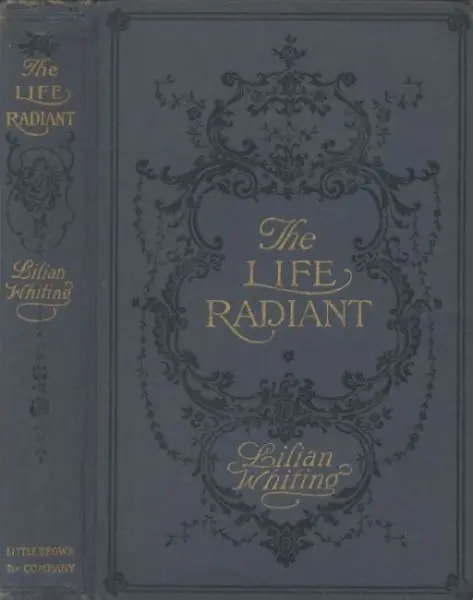
THE CLASSIC COLLECTION · 1903
"The Life Radiant" by Lilian Whiting is a spiritual and philosophical guide written in the early 20th century. The book explores the journey towards a more enlightened, fulfilling existence based on a harmonization of human will with divine will. Whiting emphasizes that individuals possess the power to create their own realities through faith and the recognition of spiritual energies. The opening of the text invites readers to consider their daily lives as part of a spiritual drama, where every experience contributes to a greater understanding of divine guidance. Whiting argues that life's challenges can be transformed into opportunities for spiritual growth, encouraging individuals to actively engage with both seen and unseen forces. Through a blend of inspiration and introspection, the author aims to teach readers the significance of intertwining their deeper spiritual aspirations with everyday experiences, setting the stage for the profound insights and transformative practices that will follow throughout the rest of the book.
Introduction adapted from the source catalogue; source summaries may be automatically generated.
Free to read · English · 72,842 words · No account needed
MAKE TIME FOR A GOOD BOOK
On by default. Untick to stop anonymous reading totals. Each page counts after 10 seconds in view. How this works.
Anonymous counting is on unless you have switched it off.
Yet, when one comes to examine the actual average attitude of humanity toward this subject of the divine will, one finds it is largely that of a mere gloomy and enforced resignation, even at its best, and, at its worst, of distrust and rebellion to the will of God. It seems to be held as the last resort of desperation and despair, rather than as the one abounding source of all joy and success and achievement.
The average individual holds a traditional belief that he ought, perhaps, to be able sincerely to wish that God's will be done, but as a matter of fact he far prefers his own. The petition is, in his mind, invariably associated with seasons of great sorrow, disaster, and calamity, when, having apparently nothing else to hope for, a prayer is offered for the will of God! It is somewhat vaguely held to be the appropriate expression for the last emergency, and that it implies resigning one's self to the most serious and irreferable calamity. There is also a nebulous feeling that while the will of God may be entirely appropriate to the conditions and circumstances of the aged, the poor, the unfortunate, and the defective classes, it is the last thing in the world to be invoked for the young, the gifted, the strong, and the brilliant orders of society. It is tacitly relegated to a place in some last hopeless emergency, and not to a place in the creative energy of the most brilliant achievement.
Now, as a matter of profoundest truth, this attitude is as remote from the clear realization of what is involved in the will of God as would be the conviction that the flying express train or the swift electric motor cars might be suitable enough for the aged, and the weary, and the invalid, and the people whose time was of little consequence, but that the young, the radiant, the eager, the gifted, the people to whom time was valuable, must go by their own conveyances of horse or foot under their immediate personal control. This fallacy is no more remote from truth than is the fallacy that the will of God is something to be accepted with what decorum of resignation one may, only when he cannot help it! On the contrary, the will of God is the infinitely great motor of human life. Its power is as incalculably greater over the soul than that of radium over other elements, as it is higher in the scale of being; as spirit rather than substance; and the Life Radiant is really entered upon when one has come absolutely to merge all his longing and desire into the divine purposes. It is like availing one's self of the great laws of attraction and gravitation in nature. With the human will identified with the divine will, every day's experience becomes invested with the keenest zest and interest. The events that may arise at any moment enlist the energy and fascinate the imagination. The consciousness of union with God produces an exquisite confidence in the wise and sweet enchantment of life; the constant receptivity of the soul to the influence and the guiding of the Holy Spirit make an atmosphere ecstatic, even under the most commonplace or outwardly depressing circumstances. Celestial harmonies thrill the air. In this divine atmosphere--the soul's native air--every energy is quickened. The divine realm is as truly the habitat of the spiritual man--who, temporarily inhabiting a physical body that he may thus come into relations with a physical world, is essentially a spiritual rather than a physical being--as the air is the habitat of the bird, or the water of the fish. When the divine statement is made, "Without Me ye can do nothing," it is simply that of a literal fact. The gloom, the depression, the irritation that so often prevail and persist in mental conditions, do not arise, primarily, from any outward trial or perplexity; they are the result--the inevitable result--of the soul's lack of union with God; the lack of that rapport between the spirit of man and the divine spirit in which alone is exhilaration and joy. When this union is forged, when the human will rests perfectly in the divine will, one then absolutely knows, with the most positive and literal conviction, that "all things work together for good to them that love God." The assurance is felt with the unchallenged force of a mathematical demonstration. Not merely that the pleasant and agreeable things work together for good, but all things--pain, loss, sorrow, injustice, misapprehension. Then one realizes in his own experience the significance of the words, "We glory in tribulation, also." One has heard all one's life, perhaps, of "the ministry of sorrow," and similar phrases, and he has become a trifle impatient of them as a sort of incantation with which he has little sympathy. At the best, he relegates this order of ministry to the rank and file of humanity; to those whose lives are (to his vision) somewhat prosy and dull; and for himself he proposes to live in a world beautiful, where stars and sunsets and flames and fragrances enchant the hours, where, with his feet shod with silver bells, he is perpetually conscious of being
Your reading position is saved on this browser. Take it to another device with a library code. Reading pages adapt to text, rather than matching a printed edition.
Lilian Whiting

Lilian Whiting

Lilian Whiting
Lilian Whiting
BEHIND THE BOOK
This eBook is for the use of anyone anywhere in the United States and most other parts of the world at no cost and with almost no restrictions whatsoever. You may copy it, give it away or re-use it under the terms of the Project Gutenberg License included with this eBook or online at www.gutenberg.org. If you are not located in the United States, you will have to check the laws of the country where you are located before using this eBook. Read the source licence.
The original source file, including credits and licence, is retained by this library. Request an original-format copy at no charge. Please include the book title and Project Gutenberg identifier #23820.
KEEP YOUR CURIOSITY GOING

David Patterson (Spirit) Hatch

David Patterson (Spirit) Hatch

David Patterson (Spirit) Hatch
Coulson Kernahan

Ralph Waldo Emerson
Frances Wright