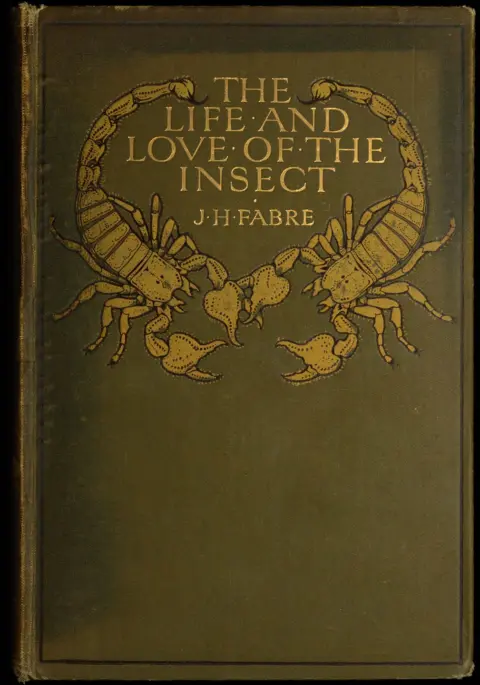
The Life and Love of the Insect
Jean-Henri Fabre
THE CLASSIC COLLECTION · 1912
"The Life of the Spider" by Jean-Henri Fabre is a scientific publication written in the late 19th century. The book serves as an observational study of spiders, particularly focusing on their behaviors, instincts, and ecological roles. Fabre explores various species, such as the Black-bellied Tarantula and the Banded Epeira, revealing the intricacies of their lives and the common misconceptions surrounding them. The opening of "The Life of the Spider" introduces readers to the Black-bellied Tarantula, discussing the prejudices against spiders and emphasizing the striking abilities and characteristics of this often-misunderstood creature. Fabre recounts his personal observations and hunting techniques for capturing tarantulas, detailing their construction of burrows and methods of capturing prey. Through fascinating anecdotes and descriptions, he showcases the tarantula's hunting prowess and the complex ecological relationships spiders maintain within their environments, setting the stage for a deeper exploration of their life cycles and behaviors throughout the text.
Introduction adapted from the source catalogue; source summaries may be automatically generated.
Free to read · English · 70,487 words · No account needed
MAKE TIME FOR A GOOD BOOK
On by default. Untick to stop anonymous reading totals. Each page counts after 10 seconds in view. How this works.
Anonymous counting is on unless you have switched it off.
{10} Such as the Hairy Ammophila, the Cerceris and the Languedocian Sphex, Digger-wasps described in other of the author's essays.--Translator's Note.
{11} The desnucador, the Argentine slaughterman whose methods of slaying cattle are detailed in the author's essay entitled, The Theory of Instinct.--Translator's Note.
{12} A family of Grasshoppers.--Translator's Note.
{13} A genus of Beetles.--Translator's Note.
{14} A species of Digger-wasp.--Translator's Note.
{15} The Cicada is the Cigale, an insect akin to the Grasshopper and found more particularly in the South of France.--Translator's Note.
{16} The generic title of the work from which these essays are taken is Entomological Memories, or, Studies relating to the Instinct and Habits of Insects.--Translator's Note.
{17} A species of Grasshopper.--Translator's Note.
{18} An insect akin to the Locusts and Crickets, which, when at rest, adopts an attitude resembling that of prayer. When attacking, it assumes what is known as 'the spectral attitude.' Its forelegs form a sort of saw-like or barbed harpoons. Cf. Social Life in the Insect World, by J. H. Fabre, translated by Bernard Miall: chaps. v. to vii.-- Translator's Note.
{19} .39 inch.-- Translator's Note.
{20} These experiments are described in the author's essay on the Mason Bees entitled Fragments on Insect Psychology.--Translator's Note.
{21} A species of Wasp.--Translator's Note.
{22} In Chap. VIII. of the present volume.--Translator's Note.
{23} Jules Michelet (1798-1874), author of L'Oiseau and L'Insecte, in addition to the historical works for which he is chiefly known. As a lad, he helped his father, a printer by trade, in setting type.--Translator's Note.
{24} Chapter III. of the present volume.--Translator's Note.
{25} A species of Dung-beetle. Cf. The Life and Love of the Insect, by J. Henri Fabre, translated by Alexander Teixeira de Mattos: chap. v.--Translator's Note.
{26} A species of Beetle.--Translator's Note.
{27} Cf. Insect Life, by J. H. Fabre, translated by the author of Mademoiselle Mori: chaps. i. and ii.; The Life and Love of the Insect, by J. Henri Fabre, translated by Alexander Teixeira de Mattos: chaps. i. to iv.--Translator's Note.
{28} Chapter II.--Translator's Note.
{29} .39 inch.--Translator's Note.
{30} The Processionaries are Moth-caterpillars that feed on various leaves and march in file, laying a silken trail as they go.--Translator's Note.
{31} The weekly half-holiday in French schools.--Translator's Note.
{32} Cf. Social Life in the Insect World, by J. H. Fabre, translated by Bernard Miall: chap. xiv.--Translator's Note.
{33} Cf. Insect Life, by J. H. Fabre, translated by the author of Mademoiselle Mori: chap. v.--Translator's Note.
Your reading position is saved on this browser. Take it to another device with a library code. Reading pages adapt to text, rather than matching a printed edition.
Jean-Henri Fabre
Jean-Henri Fabre
Jean-Henri Fabre
Jean-Henri Fabre
BEHIND THE BOOK
This eBook is for the use of anyone anywhere in the United States and most other parts of the world at no cost and with almost no restrictions whatsoever. You may copy it, give it away or re-use it under the terms of the Project Gutenberg License included with this eBook or online at www.gutenberg.org. If you are not located in the United States, you will have to check the laws of the country where you are located before using this eBook. Read the source licence.
The original source file, including credits and licence, is retained by this library. Request an original-format copy at no charge. Please include the book title and Project Gutenberg identifier #1887.
KEEP YOUR CURIOSITY GOING

John Muir

Asa Gray
Asa Gray

Florence Nightingale
Elizabeth Robins Pennell
Denison Olmsted