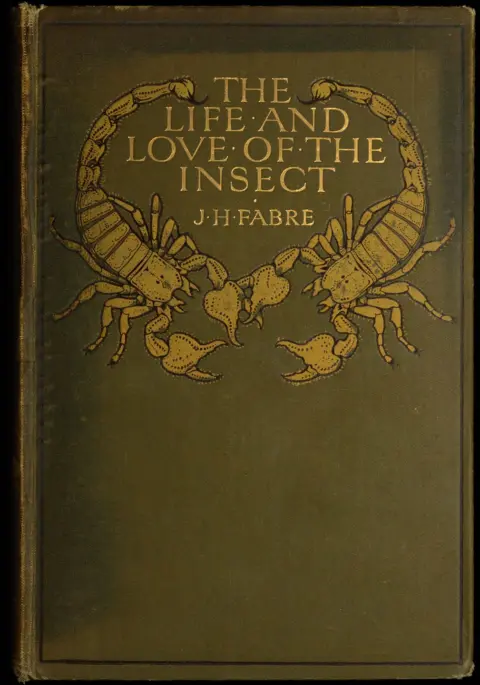
The Life and Love of the Insect
Jean-Henri Fabre
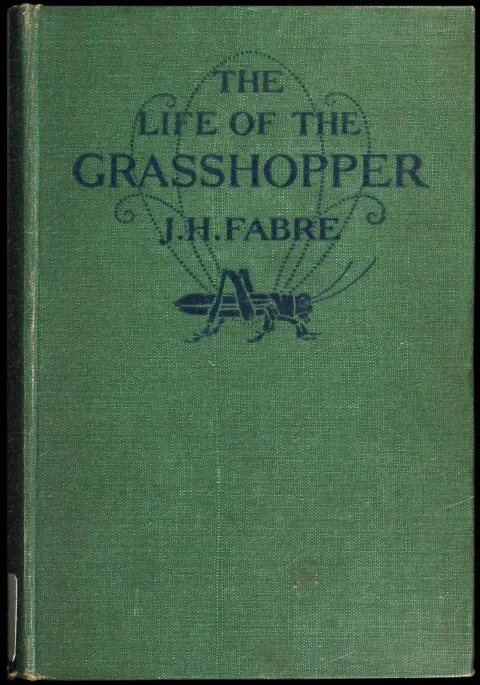
THE CLASSIC COLLECTION · 1917
"The Life of the Grasshopper" by Jean-Henri Fabre is a scientific publication written in the late 19th century. This work delves into the biology and behavior of grasshoppers and related insects, highlighting their fascinating life cycles, interactions, and the folklore surrounding them. Fabre emphasizes empirical observation and offers a detailed exploration of the natural world through the lens of entomology. The beginning of the work introduces the fable of the Cicada and the Ant, challenging common misconceptions about these insects. Fabre critiques the traditional narrative that characterizes the Cicada as a frivolous singer who suffers for lack of foresight, asserting instead that it is the Ant that engages in theft while the Cicada provides hospitality. This opening sets the stage for a deeper investigation into the lives of these insects, blending anecdotal observations with scientific inquiry as the author prepares to examine the Cicada's fascinating metamorphosis and its place in the ecosystem.
Introduction adapted from the source catalogue; source summaries may be automatically generated.
Free to read · English · 87,366 words · No account needed
MAKE TIME FOR A GOOD BOOK
On by default. Untick to stop anonymous reading totals. Each page counts after 10 seconds in view. How this works.
Anonymous counting is on unless you have switched it off.
[27] Cf. The Life of the Fly: chap. iv.—Translator’s Note.
[28] Cf. Bramble-bees and Others, by J. Henri Fabre, translated by Alexander Teixeira de Mattos: passim.—Translator’s Note.
[29] The Decticus, Tryxalis and Ephippiger are all species of Grasshoppers or Locusts.—Translator’s Note.
[30] Epeira sericea and E. diadema are two Garden Spiders for whom cf. The Life of the Spider, by J. Henri Fabre, translated by Alexander Teixeira de Mattos: chaps. ix to xiv.—Translator’s Note.
[31] Cf. The Life of the Spider: chap. viii.—Translator’s Note.
[32] Cf. The Hunting Wasps: passim.—Translator’s Note.
[33] 1.56 in. × .78 in.—Translator’s Note.
[34] Benjamin Thompson (1753–1814), an American loyalist, created Count Rumford in Bavaria, where he became minister for war. He discovered the convertibility of mechanical energy into heat.—Translator’s Note.
[35] Thomas Moffett, Moufet, or Muffet (1553–1604), author of a posthumous Insectorum sive Minimorum Animalium Teatrum, published in Latin in 1634 and in an English translation, by Edward Topsell, in 1658. Although giving credence to too many fabulous reports, Moffett was acknowledged the prince of entomologists prior to the advent of Jan Swammerdam (1637–1680).—Translator’s Note.
[36] Jacques Callot (1592–1635), the French engraver and painter, famed for the grotesque nature of his subjects.—Translator’s Note.
[37] Cf. The Hunting Wasps: chap. xiii.—Translator’s Note.
[38] Cotton-bees. Cf. Bramble-bees and Others: chap. ix.—Translator’s
Note.
[39] A genus of Mason-wasps, the essay on whom has not yet been translated into English.—Translator’s Note.
[40] A species of Burrowing Bees.—Translator’s Note.
[41] Œdipoda cærulescens, Lin.; Œ. miniata, Pallas; Sphingonotus cærulans, Lin.; Caloptenus italicus, Lin.; Pachytylus nigrofasciatus, de Geer; Truxalis nasuta, Lin.—Author’s Note.
[42] Conocephalus mandibularis, Charp.; Platycleis intermedia, Serv.; Ephippigea vitium, Serv.—Author’s Note.
[43] Cf. The Life of the Spider and The Hunting Wasps:
passim.—Translator’s Note.
[44] An orthopterous family which includes the Grasshoppers, but not the Locusts. The latter are Acridians.—Translator’s Note.
[45] The class of molluscs containing the Squids, Cuttlefish, Octopus, etc.—Translator’s Note.
[46] A genus of Myriapods including the typical
Centipedes.—Translator’s Note.
[47] Cf. Chapter XIV. of the present volume.—Translator’s Note.
[48] The highest mountain (6,270 feet) in the neighbourhood of Sérignan. Cf. The Hunting Wasps: chap. xi.—Translator’s Note.
[49] M. Bellot, forest-ranger of Beaumont (Vaucluse).—Author’s Note.
[50] .195 to .234 inch.—Translator’s Note.
[51] .039 inch.—Translator’s Note.
[52] This essay was written prior to that on the Grey Flesh-flies, who employ a similar method. Cf. The Life of the Fly: chap. x.—Translator’s Note.
[53] “Beneath the shade which beechen boughs diffuse,
You, Tityrus, entertain your sylvan muse.
. . . . . . .
These blessings friend, a deity bestowed:
. . . . . . .
He gave my kine to graze the flowery plain
And to my pipe renewed the rural strain.”
Your reading position is saved on this browser. Take it to another device with a library code. Reading pages adapt to text, rather than matching a printed edition.
Jean-Henri Fabre
Jean-Henri Fabre
Jean-Henri Fabre
Jean-Henri Fabre
BEHIND THE BOOK
This eBook is for the use of anyone anywhere in the United States and most other parts of the world at no cost and with almost no restrictions whatsoever. You may copy it, give it away or re-use it under the terms of the Project Gutenberg License included with this eBook or online at www.gutenberg.org. If you are not located in the United States, you will have to check the laws of the country where you are located before using this eBook. Read the source licence.
The original source file, including credits and licence, is retained by this library. Request an original-format copy at no charge. Please include the book title and Project Gutenberg identifier #66650.
KEEP YOUR CURIOSITY GOING

John Muir

Asa Gray
Asa Gray

Florence Nightingale
Elizabeth Robins Pennell
Denison Olmsted