THE CLASSIC COLLECTION✦An outlaw’s diary: the CommuneCLASSIC FREE BOOKS
An outlaw’s diary: the Commune
Cécile Tormay
THE CLASSIC COLLECTION · 1802
"The Life of Poggio Bracciolini" by William Shepherd is a historical account written in the early 19th century. This biography explores the life and contributions of Poggio Bracciolini, a pivotal figure in the Renaissance known for his role in the revival of literature and humanism. The narrative likely covers Bracciolini's education, professional career, and interactions with notable contemporaries within the context of the political and cultural landscape of 14th and 15th century Italy. At the start of the work, the author provides a preface explaining the motivation behind the biography, highlighting the inadequacies of previous accounts of Poggio's life. Shepherd mentions his preliminary research and the challenges he faced in compiling a coherent narrative. The opening chapters introduce Poggio’s birth and formative years, emphasizing his education in Florence and subsequent move to Rome, where he began his career in the Papal Chancery. The narrative sets the stage for an exploration of his personal relationships, scholarly achievements, and the tumultuous historical events he navigated, including various political factions and the Western Schism.
Introduction adapted from the source catalogue; source summaries may be automatically generated.
Free to read · English · 121,680 words · No account needed
MAKE TIME FOR A GOOD BOOK
On by default. Untick to stop anonymous reading totals. Each page counts after 10 seconds in view. How this works.
Anonymous counting is on unless you have switched it off.
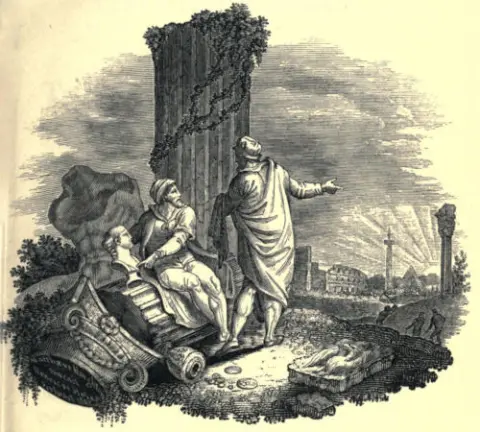
[251] The catalogue of reliques of Roman architecture, which Poggio has inserted in the interesting pröemium to his dialogue De varietate Fortunæ, evinces the diligence and care with which he had surveyed the ruins of ancient Rome. This catalogue did not escape the extensive researches of Gibbon, who has introduced it into the 71st chapter of his Decline and Fall of the Roman Empire.
[252] “Poggius noster sæpe mecum est; reliquias civitatis probe callens nos comitatur.”—Ambrosii Traversarii Epistolæ, p. 407.
In a letter to Bartolomeo Facio, Poggio thus invites him to visit the ruins of Rome. “Video te cupere urbem visere, et certe nisi incoeptum opus, ut ais, impediret hortarer te ad inspiciendas reliquias ejus urbis quæ quondam orbis lumen præclarissimum fuit. Equidem quamvis in eâ jam pluribus annis ab ipsâ juventute fuerim versatus, tamen quotide tamquam novus incola tantarum rerum admiratione obstupesco, recreoque persæpe animum visu eorum ædificiorum, quæ stulti propter ingenii imbecillitatem a Dæmonibus facta dicunt.”—Facius de viris Illustribus, p. 97.
[253] Mehi Vita Ambrosii Traversarii, p. lii.
[254] Mehi Vita Ambrosii Traversarii, p. lii. Poggii Epist. citat. a
Ton. tom. i. p. 258.
[255] Poggii Opera, p. 321.
[256] Ibid.
[257] Ibid, p. 329.
[258] Mehi Vita Ambrosii Traversarii, p. lii. liii.
[259] From an expression which Poggio uses in a letter on the subject of Francesco’s conduct, addressed to Andreolo Giustiniano, it should seem, either that the busts did not answer the expectation which he had formed concerning the exquisiteness of their workmanship, or that he suspected that Francesco had substituted inferior pieces of sculpture, in the place of those destined for him by Suffretus. The following is the expression in question. “Cum Suffretus quidem Rhodius ei consignasset tria capita marmorea, et signum integrum duorum fere cubitorum, quæ Franciscus se ad me allaturum promisit, capita quædam dedit, signo autem me fraudavit,” &c. Perhaps, however, quædam is, by an error of the press, substituted for quidem.
[260] Poggii Opera, p. 329.
[261] Poggii Opera, p. 329.
[262] The admirer of ancient art will find the principles, the observance of which led to the perfection to which it was carried by the Greeks, clearly and forcibly explained in the eighteenth, nineteenth, and twentieth pages of Mr. Fuseli’s Lectures on Painting. Of this work it may be asserted, that hardly any composition in the English language comprehends an equal quantity of thought in the same compass of expression. Almost every sentence which it contains is a theme of reflection, a text, pregnant with the most useful instruction.
[263] Poggii Epist. lvii. p. 181.
[264] Poggii Opera, p. 357, & seq.
[265] Poggii Opera, p. 366.
[266] See note to Tonelli’s translation, vol. i. p. 264.
[267] Poggii vita a Recanatio, p. xiv.
[268] Poggii vita a Recanatio, p. xiv.
Your reading position is saved on this browser. Take it to another device with a library code. Reading pages adapt to text, rather than matching a printed edition.
BEHIND THE BOOK
This eBook is for the use of anyone anywhere in the United States and most other parts of the world at no cost and with almost no restrictions whatsoever. You may copy it, give it away or re-use it under the terms of the Project Gutenberg License included with this eBook or online at www.gutenberg.org. If you are not located in the United States, you will have to check the laws of the country where you are located before using this eBook. Read the source licence.
The original source file, including credits and licence, is retained by this library. Request an original-format copy at no charge. Please include the book title and Project Gutenberg identifier #72437.
KEEP YOUR CURIOSITY GOING
Cécile Tormay

Moritz Busch
John L. Ransom
Frances Wright
Cécile Tormay

Mabel Potter Daggett