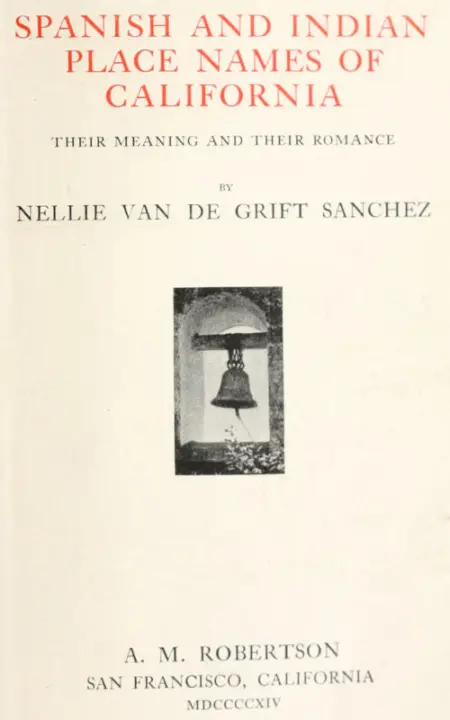
Spanish and Indian place names of California: Their Meaning and Their Romance
Nellie Van de Grift Sanchez
THE CLASSIC COLLECTION · 1920
"The Life of Mrs. Robert Louis Stevenson" by Nellie Van de Grift Sanchez is a biographical account written in the early 20th century. The book explores the life and experiences of Fanny Van de Grift Stevenson, detailing her fascinating journey from her ancestry to her marriage with the famous writer Robert Louis Stevenson. It presents a portrait of a woman whose life was filled with remarkable events and influences, painting her not only as a partner to an iconic literary figure but as a complex individual shaped by adventure, hardship, and resilience. At the start of the narrative, the author delves into Fanny's ancestral background, revealing the rich heritage that contributes to her character, including her family's early American pioneer roots. The text highlights her childhood in Indiana, marked by simplicity and connection to nature, and portrays her as a spirited, adventurous young girl. The opening chapters introduce her explorations, relationships, and formative experiences, setting the stage for her life stories as they intersect with those of her husband, ultimately hinting at the profound love and companionship between them that would endure amidst the trials of their lives together.
Introduction adapted from the source catalogue; source summaries may be automatically generated.
Free to read · English · 94,530 words · No account needed
MAKE TIME FOR A GOOD BOOK
On by default. Untick to stop anonymous reading totals. Each page counts after 10 seconds in view. How this works.
Anonymous counting is on unless you have switched it off.
"What can I say to you that will not seem cruelly irrelevant or vain? We have been sitting in darkness for nearly a fortnight, but what is our darkness to the extinction of your magnificent light? You will probably know in some degree what has happened to us--how the hideous news first came to us via Auckland, etc., and then how, in the newspapers, a doubt was raised about its authenticity--just enough to give one a flicker of hope; until your telegram to me via San Francisco--repeated also from other sources--converted my pessimistic convictions into the wretched knowledge. All this time my thoughts have hovered round you all, around you in particular, with a tenderness of which I could have wished you might have, afar-off, the divination. You are such a visible picture of desolation that I need to remind myself that courage, and patience, and fortitude are also abundantly with you. The devotion that Louis inspired--and of which all the air about you must be full--must also be much to you. Yet as I write the word, indeed, I am almost ashamed of it--as if anything could be 'much' in the presence of such an abysmal void. To have lived in the light of that splendid life, that beautiful, bountiful being--only to see it, from one moment to the other, converted into a fable as strange and romantic as one of his own, a thing that has been and has ended, is an anguish into which no one can enter with you fully and of which no one can drain the cup for you. You are nearest to the pain, because you were nearest the joy and the pride. But if it is anything to you to know that no woman was ever more felt with and that your personal grief is the intensely personal grief of innumerable hearts--know it well, my dear Fanny Stevenson, for during all these days there has been friendship for you in the very air. For myself, how shall I tell you how much poorer and shabbier the whole world seems, and how one of the closest and strongest reasons for going on, for trying and doing, for planning and dreaming of the future, has dropped in an instant out of life. I was haunted indeed with a sense that I should never again see him--but it was one of the best things in life that he was there, or that one had him--at any rate one heard him, and felt him and awaited him and counted him into everything one most loved and lived for. He lighted up one whole side of the globe, and was in himself a whole province of one's imagination. We are smaller fry and meaner people without him. I feel as if there were a certain indelicacy in saying it to you, save that I know that there is nothing narrow or selfish in your sense of loss--for himself, however, for his happy name and his great visible good fortune, it strikes one as another matter. I mean that I feel him to have been as happy in his death (struck down that way, as by the gods, in a clear, glorious hour) as he had been in his fame. And, with all the sad allowances in his rich full life, he had the best of it--the thick of the fray, the loudest of the music, the freshest and finest of himself. It isn't as if there had been no full achievement and no supreme thing. It was all intense, all gallant, all exquisite from the first, and the experience, the fruition, had something dramatically complete in them. He has gone in time not to be old, early enough to be so generously young and late enough to have drunk deep of the cup. There have been--I think--for men of letters few deaths more romantically right. Forgive me, I beg you, what may sound cold-blooded in such words--or as if I imagined there could be anything for you 'right' in the rupture of such an affection and the loss of such a presence. I have in my mind in that view only the rounded career and the consecrated work. When I think of your own situation I fall into a mere confusion of pity and wonder, with the sole sense of your being as brave a spirit as he was (all of whose bravery you shared) to hold on by. Of what solutions or decisions you see before you we shall hear in time; meanwhile please believe that I am most affectionately with you.... More than I can say, I hope your first prostration and bewilderment are over, and that you are feeling your way in feeling all sorts of encompassing arms--all sorts of outstretched hands of friendship. Don't, my dear Fanny Stevenson, be unconscious of mine, and believe me more than ever faithfully yours,
Your reading position is saved on this browser. Take it to another device with a library code. Reading pages adapt to text, rather than matching a printed edition.
Nellie Van de Grift Sanchez
BEHIND THE BOOK
This eBook is for the use of anyone anywhere in the United States and most other parts of the world at no cost and with almost no restrictions whatsoever. You may copy it, give it away or re-use it under the terms of the Project Gutenberg License included with this eBook or online at www.gutenberg.org. If you are not located in the United States, you will have to check the laws of the country where you are located before using this eBook. Read the source licence.
The original source file, including credits and licence, is retained by this library. Request an original-format copy at no charge. Please include the book title and Project Gutenberg identifier #24332.
KEEP YOUR CURIOSITY GOING
Cécile Tormay

Moritz Busch
John L. Ransom
Frances Wright
Cécile Tormay

Mabel Potter Daggett