THE CLASSIC COLLECTION✦An outlaw’s diary: the CommuneCLASSIC FREE BOOKS
An outlaw’s diary: the Commune
Cécile Tormay
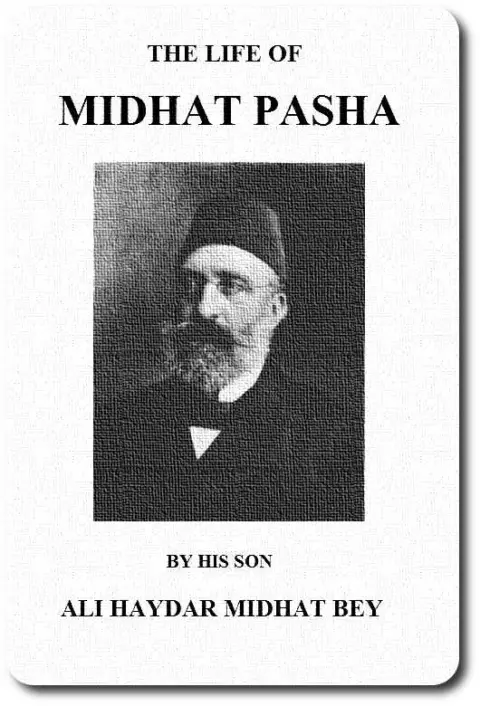
THE CLASSIC COLLECTION · 1903
"The Life of Midhat Pasha: A Record of His Services, Political Reforms, Banishment, and Judicial Murder" by Ali Haydar Midhat Bey is a historical account written in the early 20th century. The book presents a detailed examination of the life and political reforms implemented by Midhat Pasha, a significant figure in the Ottoman Empire, emphasizing his contributions and eventual downfall amidst the turbulent dynamics of Turkish politics during his time. The opening of the book provides a preface by Midhat's son, Ali Haydar, explaining the impetus behind writing this account. He shares his personal experiences as Midhat Pasha's son, detailing the hardships he faced in exile and his desire to reveal the true story of his father's career and death. Midhat's influence in reforming the Ottoman political structure during a period marked by despotism is highlighted, indicating that his initiatives were often met with resistance from established powers. Ali Haydar underscores the oppressive environment of Sultan Abdul Hamid II's regime that ultimately led to his father's banishment and execution, setting the stage for an exploration of the broader historical context surrounding Midhat Pasha's legacy in the subsequent chapters.
Introduction adapted from the source catalogue; source summaries may be automatically generated.
Free to read · English · 99,680 words · No account needed
MAKE TIME FOR A GOOD BOOK
On by default. Untick to stop anonymous reading totals. Each page counts after 10 seconds in view. How this works.
Anonymous counting is on unless you have switched it off.
“Midhat maintained that the prisoners who accused him should be regarded as witnesses against him, and considering, therefore, the decision of the tribunal as a miscarriage of justice, he declined to defend himself further, adding in a bitter tone, that he would derive little practical advantage from the punishment of a false witness after he was in his grave. The Court again retired for deliberation, and on returning after a few minutes, the President declared that Midhat’s request could not be granted. The prisoner, having three times declined to continue his defence, the President declared the proceedings at an end, and the Court retired to deliberate, returning after about an hour with a verdict of ‘Guilty’ against all the accused. The Court will meet again this morning at eleven o’clock to pronounce judgment, when this extraordinary, sensational trial, conducted as I reported, will come to a close.”
Later.—“Judgment was delivered this morning in the cases of the persons convicted of the murder of ex‐Sultan Abdul Aziz. Nine of the accused, including the Sultan’s two brothers‐in‐law and Midhat Pasha, were condemned to death. The remaining two accused were condemned to penal servitude.
“All the prisoners gave notice of appeal.”
Reuter’s Telegram.—“Constantinople, 29th June.—The Court pronounced judgment and delivered sentence of death upon Midhat Pasha, Mahmoud Damad Pasha, Nouri Pasha, Ali Bey, Nedjib Bey, Fahri Bey, Hadji Mehmed, Mustapha the Wrestler, and Mustapha the Gardener.
“Izzet and Sayd are each sentenced to ten years’ penal servitude. The prisoners have eight days allowed them to give notice of Appeal, and the indictment and document connected with the trial will be sent to the Court which will try the Appeal.”
“Times,” 4th July 1881.—“Constantinople, 1st July.”—In telegraphing about the recent State Trial, I have been hitherto working under serious restrictions, which I was not allowed to mention in my telegrams. All telegraphic despatches on the subject had to be submitted to the authorities, who naturally prevented the transmission of anything that might be disagreeable to the Palace. In the circumstances, it was, of course, impossible to criticise the proceedings, or even to give a full account of what took place. I have now, fortunately, an opportunity of communicating with you freely, and I hasten to declare that the trial was little better than a parody of European judicial procedure, which has justly roused the indignation, not only of foreign observers, but also of many Turks, who have an elementary conception of justice and fair play. In a trial in which the political element was so prominent, the first condition to be observed was complete neutrality of the Palace, and this condition was most grossly violated. It was at the Palace that the preliminary investigation was made, under the immediate personal direction of the Sultan, who is an interested party. It was at the Palace that the prisoners were confined, judges chosen, and even the counsel for the defence appointed, without the prisoners themselves being consulted. It was at the Palace that the accused were examined and various unjustifiable means were employed to extort confessions from them—as, for example, when the Grand Eunuch, one of the three highest official personages of the Empire, struck with his fists and otherwise maltreated the Chamberlain, Fahri Bey, when under examination, in the presence of His Majesty. It was in the Palace, and under the immediate influence of the Sultan, that the amount of the punishment for the accused was considered and decided. It was in the Palace that Sourouri Effendi, the President of the Tribunal, had a private audience with the Sultan, immediately before the opening of the proceedings, while a Palace dignitary appealed to the counsel for the defence in a cajoling, half‐plaintive tone, to refrain, in the fulfilment of their duty, from adding to the Sultan’s already numerous embarrassments! Lastly, it was in the immediate vicinity of the Palace that the trial was held. Soldiers of the Palace garrison surrounded the Court, aides‐de‐camp and other Palace officials were present, while eunuchs and other confidential messengers were constantly passing to and fro between the Palace and the tribunal. A certain amount of publicity was allowed with regard to the trial, for a few tickets were distributed among the Diplomatic Corps and leading representatives of the Press, but there were at the same time serious restrictions and difficulties. The date of the trial was kept strictly secret until a few hours before the proceedings began, and newspaper correspondents, nearly all of whom are imperfectly acquainted with, or entirely ignorant of, the Turkish language and judicial procedure, were not allowed to take a dragoman with them, though three‐fourths of the space reserved for the public remained all the time unoccupied. I made personal representations on this subject to some influential officials, but they all declared positively that no more tickets could be given. To the few who were admitted, I must say the greatest courtesy and consideration were shown by the Imperial aides‐de‐camp and the masters of the ceremonies, but the powers of these gentlemen were very limited. With regard to the restrictions placed on telegraphing I have already spoken above.
Your reading position is saved on this browser. Take it to another device with a library code. Reading pages adapt to text, rather than matching a printed edition.
BEHIND THE BOOK
This eBook is for the use of anyone anywhere in the United States and most other parts of the world at no cost and with almost no restrictions whatsoever. You may copy it, give it away or re-use it under the terms of the Project Gutenberg License included with this eBook or online at www.gutenberg.org. If you are not located in the United States, you will have to check the laws of the country where you are located before using this eBook. Read the source licence.
The original source file, including credits and licence, is retained by this library. Request an original-format copy at no charge. Please include the book title and Project Gutenberg identifier #51243.
KEEP YOUR CURIOSITY GOING
Cécile Tormay

Moritz Busch
John L. Ransom
Frances Wright
Cécile Tormay

Mabel Potter Daggett